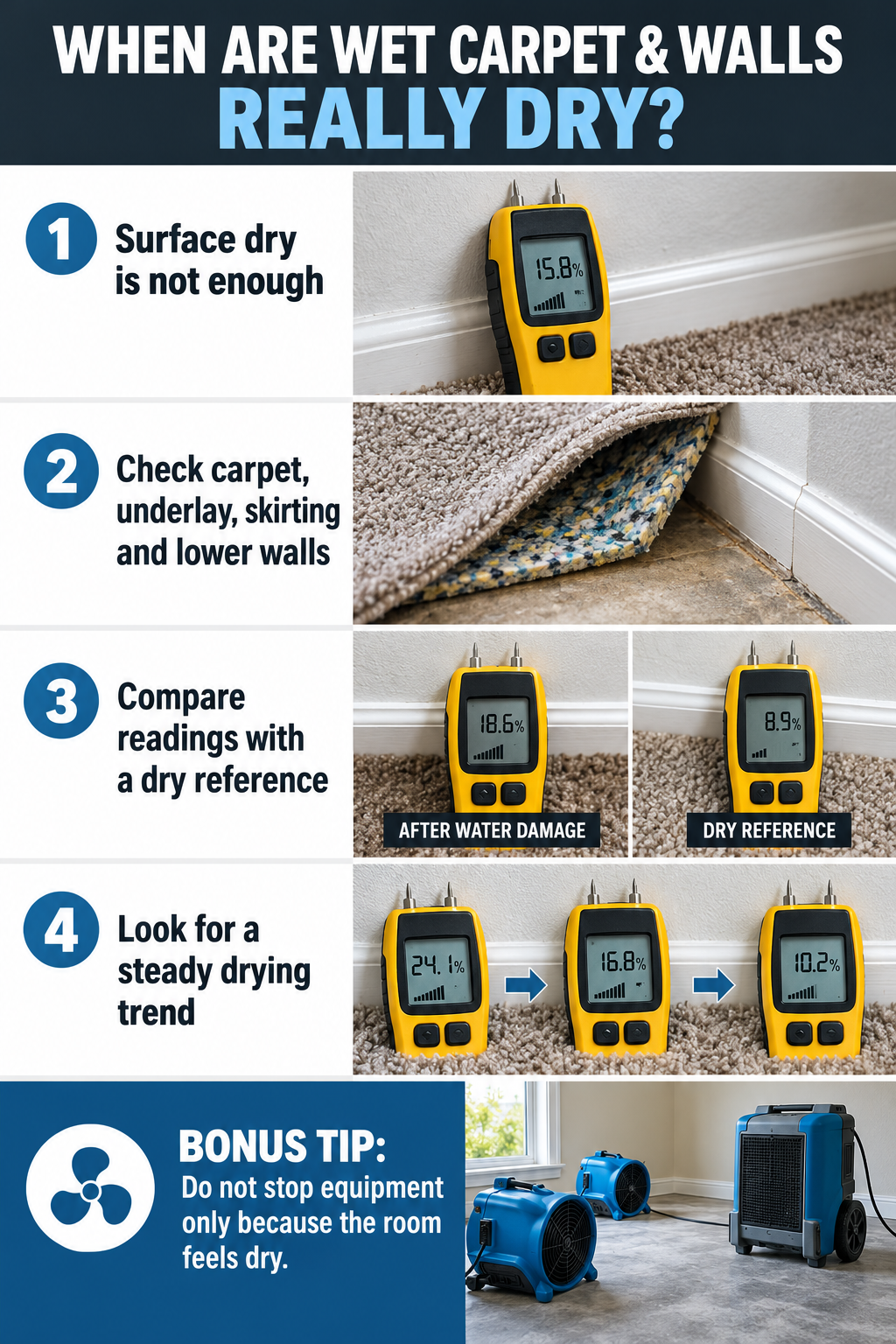
Quick answer: Wet carpet and walls are dry only when moisture checks show the affected materials have returned close to an appropriate dry reference—not simply when the surface feels dry. Carpet, underlay, skirting and lower walls can hold moisture out of sight after a leak or flood.
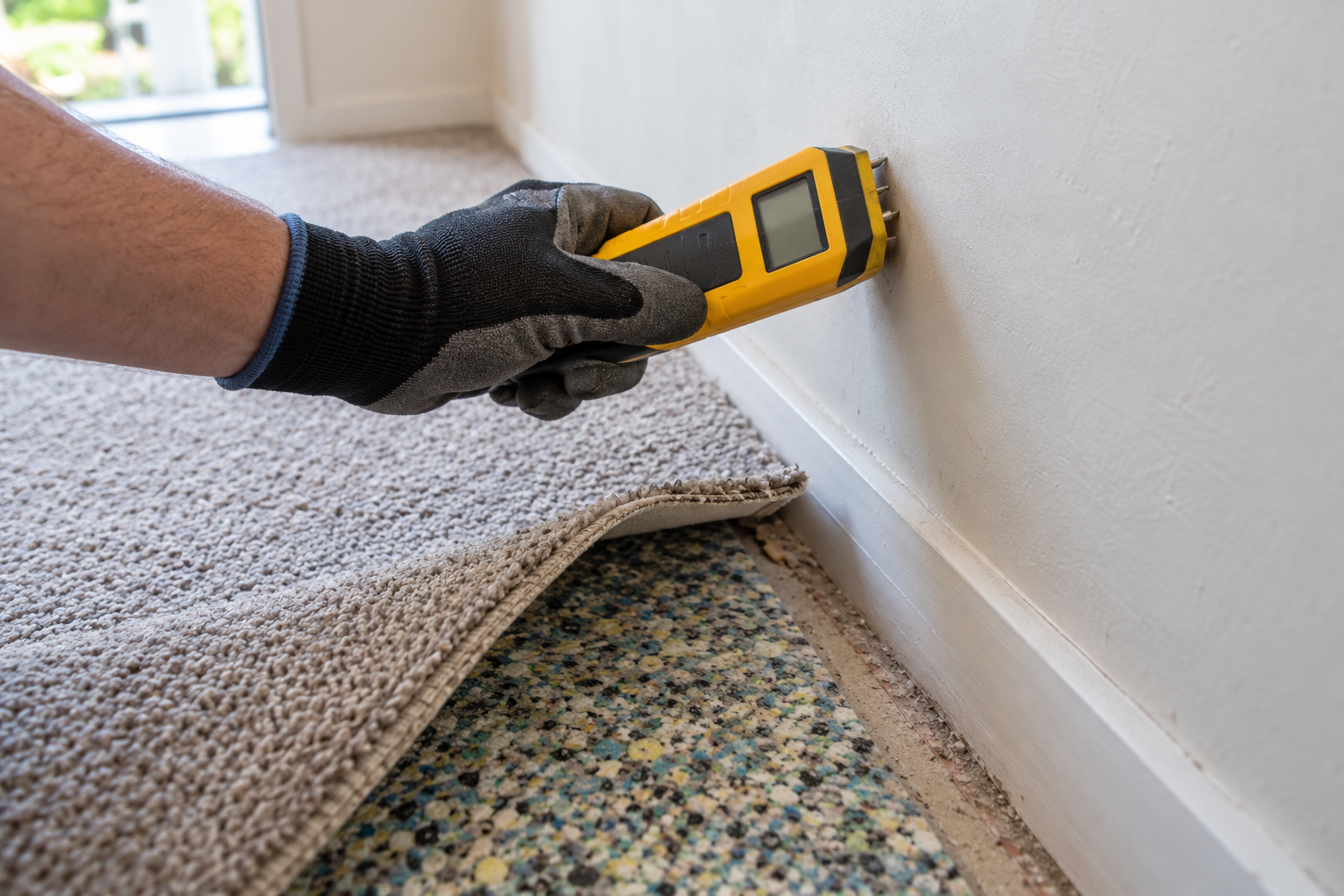
Why dry-to-touch is not enough
Airflow can make carpet feel dry on top while the backing, underlay or wall materials remain damp. Stopping too early can leave moisture trapped where it is harder to see, especially around carpet edges, skirting boards, doorways and the lower part of walls.
What should be checked after water damage?
| Area | What to compare | Why it matters |
|---|---|---|
| Carpet surface and backing | Feel, moisture readings and nearby dry carpet where suitable. | The face can dry before the backing or edge. |
| Underlay | Accessible areas and material condition beneath the carpet. | Underlay can hold moisture out of sight. |
| Skirting and lower walls | Affected zone against an unaffected reference area of the same material. | Water can travel beyond the visible wet carpet. |
| Room air | Humidity trend while equipment is operating. | It helps show whether the drying zone is being controlled, but does not prove materials are dry. |
A practical moisture-check process
- Map the water path: include carpet edges, adjoining rooms, skirting and any wall areas below the leak route.
- Choose a dry reference: compare like-for-like material in an unaffected nearby area where possible.
- Record the trend: the important signal is steady improvement across the affected materials, not one surface reading.
- Reposition equipment when a zone stalls: improve airflow to carpet edges and lower walls while keeping dehumidification working in the same drying zone.
- Confirm before stopping: do not rely on a dry feel, a quieter dehumidifier or a lower tank level alone.
When should fans and the dehumidifier be moved?
Reassess the setup when readings stop improving, carpet edges remain damp, or a lower wall is wetter than the centre of the room. Fans are used to move air over accessible wet surfaces; a commercial dehumidifier removes moisture from the air so evaporation can continue. Equipment placement matters as much as runtime—see where to place a dehumidifier and drying fans.
When drying needs an assessment
Seek restoration advice if water has crossed rooms, entered wall cavities or framing, reached electrical areas, involved sewage or contaminated water, or is not showing measurable improvement. The decision about carpet and underlay should be made with the water path and material condition in mind. Read whether wet carpet underlay can be dried for the key replacement-versus-drying factors.
Visual drying-check guide
Frequently Asked Questions
Can carpet feel dry while the underlay is still wet?
Yes. The carpet face can dry faster than the backing and underlay below it. That is why accessible checks and material comparison matter after water damage.
Should I stop the dehumidifier when the tank fills more slowly?
Not necessarily. A slower tank can occur as drying progresses, but it does not confirm the carpet, underlay or walls are dry. Use the material condition and moisture trend to decide.
Can I use a moisture meter on every material?
Different materials and meters need the right method and reference point. A moisture meter is a useful assessment tool, but readings should be interpreted for the specific material rather than treated as one universal number.
Need commercial drying support in Auckland?
Dry Me Now provides commercial dehumidifier and drying-fan hire with moisture checks and delivery options. For a larger event involving wet carpet and walls, see our flood-restoration drying service and our water-cylinder leak case study.
Related guides: how many drying fans you may need, how to choose dehumidifier capacity, and how long to run drying equipment.
Related water-damage resources
For the immediate response, use the first-24-hours leak checklist. For a larger or uncertain job, see Auckland flood restoration. This carpet and wall drying case study shows how a multi-room leak can be assessed and dried.
For equipment setup, see where to place dehumidifiers and drying fans and commercial dehumidifier hire in Auckland.