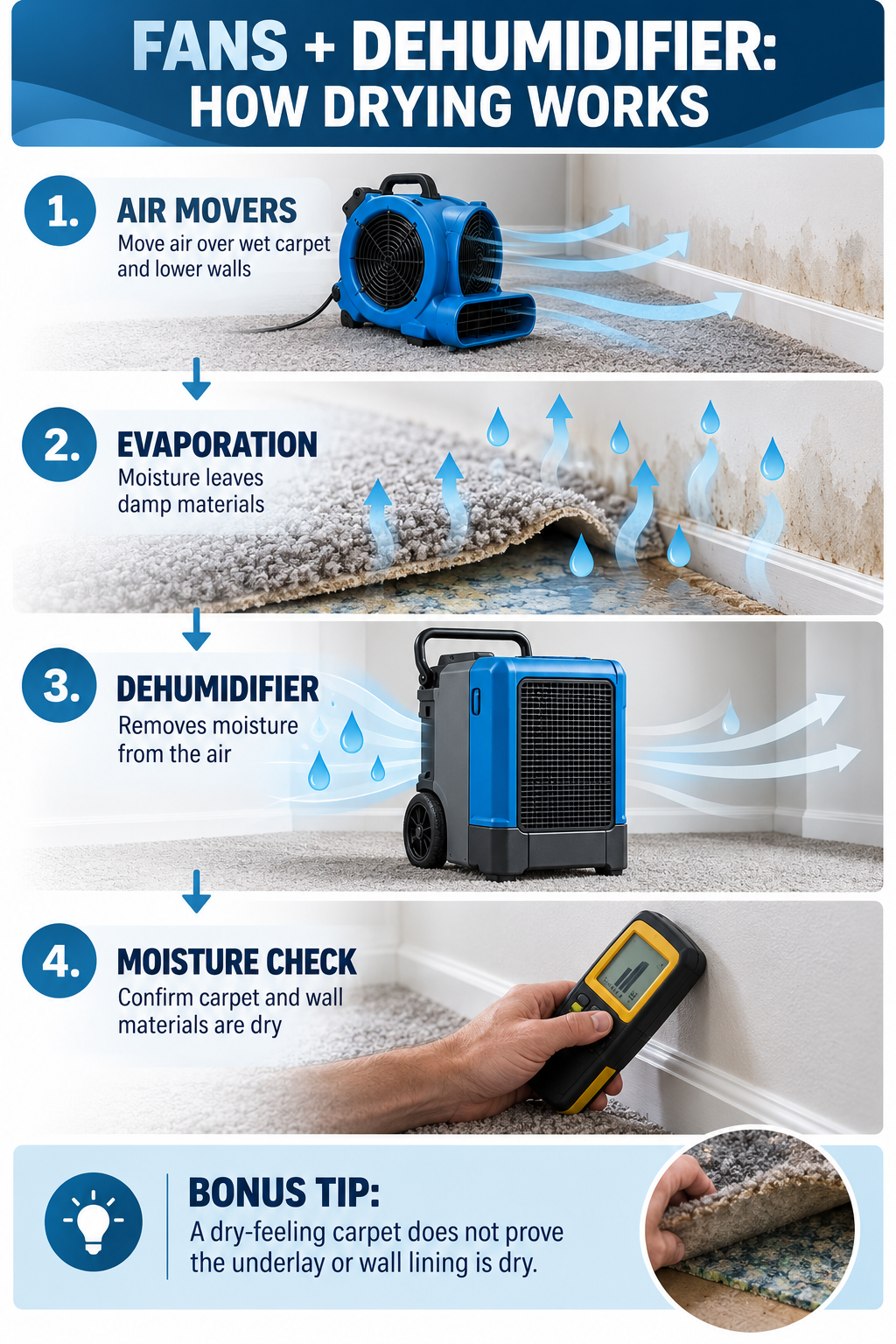
Quick answer: One drying fan may help a small, contained damp area after water extraction, while an average room commonly needs two or three fans placed to move air across carpet edges and lower wall areas. The right number is not a fixed formula: it depends on how far water travelled, the room layout, the materials affected and the moisture readings.
Start with the water path, not a fan count
Drying fans work by moving air over wet materials so moisture can evaporate. They do not remove bulk water from carpet or underlay, and they cannot dry a section they are not reaching. Before deciding how many fans are required, stop the water source, extract visible water and check whether moisture has travelled under carpet, through doorways or into skirting and lower walls.
A small damp patch may need only one carefully placed fan. A leak that has crossed a room, entered underlay or travelled into other spaces usually needs a more deliberate layout, plus dehumidification and moisture checks.
Typical drying-fan starting points
| Affected area | Typical starting point | What changes the setup |
|---|---|---|
| Small, contained carpet area | 1 fan | Whether the underlay or nearby skirting is damp. |
| One average room | 2–3 fans | Room shape, furniture, carpet edges and access to wet materials. |
| Large room or open-plan area | Multiple fans in zones | Distance between wet areas and whether air reaches the edges. |
| Multiple rooms or wet walls | Assess each moisture zone | Water may have migrated beyond the visible carpet. |
These are planning indicators, not a substitute for measuring the affected materials. Adding fans without a moisture plan can leave wet pockets behind furniture, under carpet edges or around thresholds.
Where should drying fans be placed?
Place fans so their airflow travels across wet carpet edges, accessible underlay areas and lower walls. Avoid lining every fan up in one direction or aiming them only at the middle of a room. The goal is to create purposeful airflow across the materials that actually got wet.
- Work the perimeter: carpet edges and skirting can hold moisture after the centre feels dry.
- Allow clear airflow: keep fan intakes and outlets clear of furniture, curtains and stored items.
- Break up large rooms: use zones rather than expecting one fan to cover an entire open area.
- Reposition as drying progresses: move fans when moisture readings show a slower-drying area.
Fans and dehumidifiers work as a system
Fans move damp air off the carpet and lower materials. A commercial dehumidifier removes moisture from that air in a managed drying area. Used together, they support continued evaporation without simply raising indoor humidity. Extraction still comes first when there is obvious water in carpet or underlay.
For the full process, read can a dehumidifier dry wet carpet? and how long to run a dehumidifier and drying fans after water damage.
How do I know if I have enough drying fans?
Do not judge by touch alone. A carpet surface can feel dry while the backing, underlay or lower wall areas remain damp. Check suitable materials against a dry reference area, review humidity and reposition equipment if the readings are not improving. If water has crossed rooms, entered wall cavities or framing, involved contaminated water or reached electrical areas, get restoration advice.
Frequently asked questions
Can I dry wet carpet with one fan?
One fan may assist a small, contained area after bulk water is extracted. It is usually not enough for a whole wet room, saturated underlay or water that has travelled into walls or other rooms.
Should fans point directly at a dehumidifier?
Not usually. Aim fans across wet materials first. The dehumidifier should be positioned with clear intake and exhaust space so it can manage moisture in the drying zone.
How long should drying fans run?
Run them until appropriate moisture checks show that accessible affected materials have returned to a suitable dry standard. Time alone is not a reliable finish line.
When is a drying setup too large for DIY?
Seek advice when the affected area includes multiple rooms, walls, framing, contaminated water, electrical areas or readings that do not improve. Our water-cylinder leak case study shows why carpet and internal walls sometimes need to be assessed together.
Need drying fans in Auckland?
Dry Me Now provides commercial drying fans, dehumidifier hire, moisture checks and delivery options for Auckland drying setups. For larger water events, see our flood-restoration drying service.
Related water-damage resources
For the immediate response, use the first-24-hours leak checklist. For a larger or uncertain job, see Auckland flood restoration. This carpet and wall drying case study shows how a multi-room leak can be assessed and dried.
For equipment setup, see where to place dehumidifiers and drying fans and commercial dehumidifier hire in Auckland.