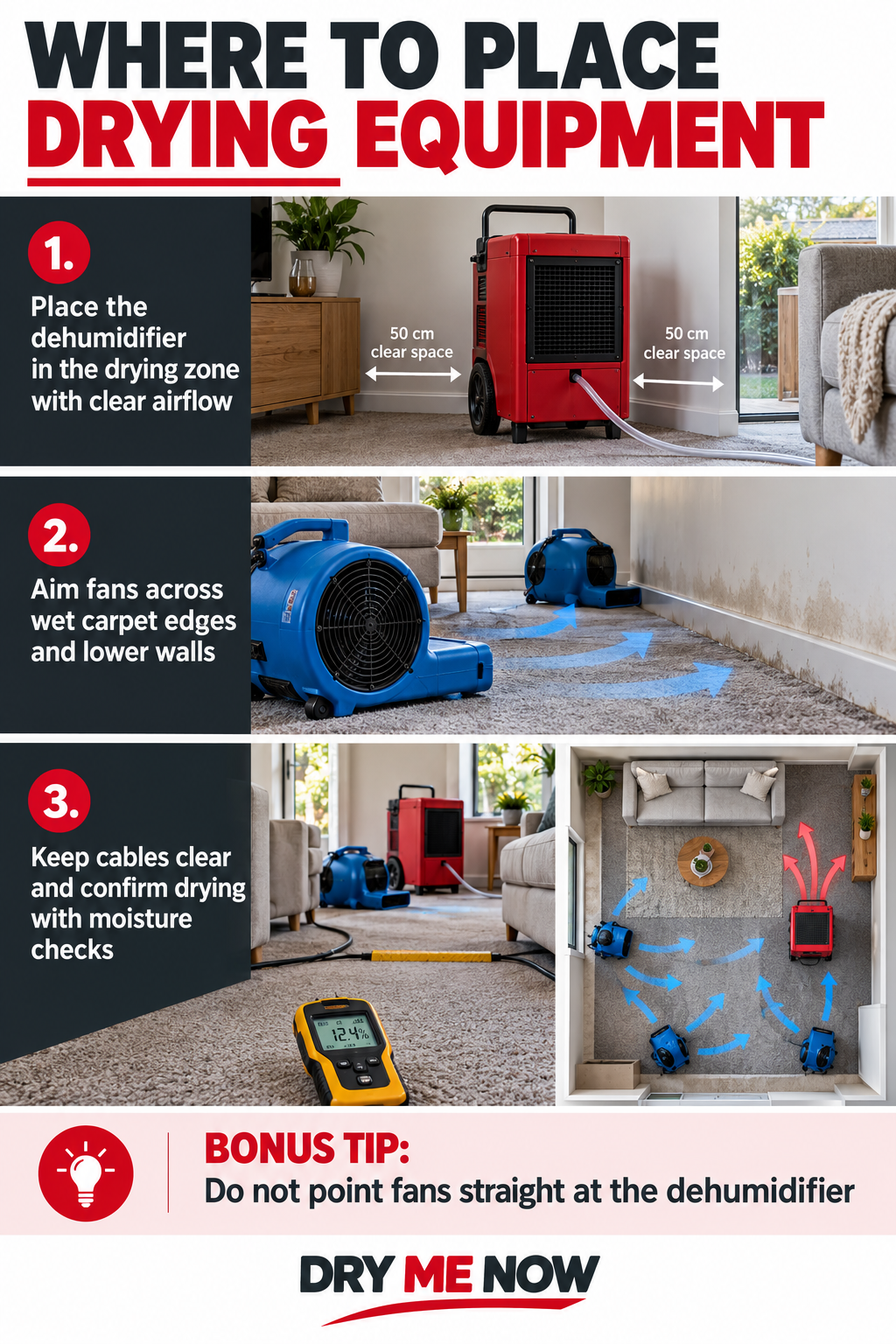
Quick answer: Place a dehumidifier in the affected drying zone where it has clear airflow and can drain safely. Position drying fans so they move air across wet carpet edges, lower walls or other damp materials—not directly at the dehumidifier. Keep equipment stable, use safe electrical connections and confirm progress with moisture readings rather than touch alone.
Start with the wet materials, not the equipment
After a leak, the visible wet patch is often smaller than the affected area. Water can move beneath carpet and underlay, through doorways and into lower wall linings. Before placing fans, identify the rooms and materials that are actually damp. For a multi-room event, a drying plan should cover the whole moisture path rather than concentrating every machine in the first room.
Where should a dehumidifier go?
A commercial dehumidifier removes water vapour from the air. It works best when air can circulate around it and damp air from the drying zone can return to it.
- Place it on a firm, level floor in or immediately beside the affected drying zone.
- Leave space around the air intake and outlet; do not wedge it behind furniture, curtains or stored items.
- Keep doors and windows set to create a controlled drying zone. Opening everything to humid outdoor air can make dehumidification less efficient.
- Use a safe drainage route where the model supports continuous drainage. Avoid kinks, trip hazards and any route that could overflow.
- Keep it clear of standing water and follow the equipment instructions for electrical safety.
For one contained room, the dehumidifier may sit inside that room. When several rooms are wet, it may be placed centrally or moved as readings change. Capacity, access and the amount of moisture matter more than a single “perfect” spot.
Where should drying fans go?
Drying fans, also called air movers, speed evaporation by moving air across damp surfaces. Aim them along carpet edges, across exposed underlay, over lower wall linings or into an open room pathway—not into a corner with no return airflow.
| Wet area | Typical airflow goal | What to avoid |
|---|---|---|
| Wet carpet or underlay | Move air low and across the surface, especially near edges and doorways. | Blowing only at the centre of the room. |
| Lower wall linings and skirting | Move air across the accessible lower wall surface. | Pointing airflow into an enclosed cavity without an assessment. |
| Hallway or adjoining rooms | Use airflow to support the path of moisture movement between affected areas. | Blocking exits, stairs or safe walkways with cables. |
A simple placement sequence
- Stop the source. Isolate the leak and arrange a licensed plumber when needed.
- Remove standing water. Extraction is normally more effective than trying to evaporate pooled water with fans alone.
- Clear the drying zone. Move small furniture and lift items that trap moisture where it is safe to do so.
- Place air movers first. Direct airflow over the dampest accessible materials and allow air to circulate back through the room.
- Place the dehumidifier with clear intake and exhaust space. It should collect the moisture that the fans release into the air.
- Re-check conditions. Move or adjust equipment based on moisture readings and the actual drying progress.
Should doors and windows be open while drying?
It depends on the drying zone and outdoor conditions. In many controlled drying setups, doors and windows are kept managed rather than left wide open, so the dehumidifier is not constantly processing humid outdoor air. However, ventilation may be appropriate in some situations. The right decision depends on the weather, equipment capacity, the number of affected rooms and safety.
Why a dehumidifier and fans work better together
Fans help moisture leave wet materials; a dehumidifier removes that moisture from the air. Without moisture removal, humidity can rise and slow evaporation. Without airflow, moisture may leave carpet and wall surfaces too slowly. This is why a fan quantity and placement plan is normally paired with suitable dehumidification.
When not to rely on a simple room setup
Get professional restoration advice where water has crossed several rooms, affected electrical areas, entered wall cavities, reached framing or involved contaminated water. A multi-room water-cylinder leak case study shows why carpet, underlay and internal walls may need to be assessed together.
Quick answers about placement
Can I point a drying fan straight at a dehumidifier?
Usually no. The fan should move air over damp materials; the dehumidifier needs room to draw in the moist air that returns through the drying zone.
Can I dry wet carpet with just a dehumidifier?
A dehumidifier can help, but drying fans are usually needed to move air across wet carpet and underlay. Extraction and moisture checks also matter after a leak.
How close should a fan be to wet carpet?
Close enough to move air across the material without creating a trip hazard or blowing loose debris. The right distance and angle depend on the fan, room and wet materials.
How do I know when to stop the equipment?
Do not rely only on a dry feel underfoot. Compare moisture readings in accessible affected materials with suitable dry reference areas.
Need help with a drying setup in Auckland?
Dry Me Now provides practical guidance for commercial dehumidifier hire in Auckland, including drying fans, moisture checks and delivery options. For larger water events, see the flood-restoration drying service.
Related water-damage resources
For the immediate response, use the first-24-hours leak checklist. For a larger or uncertain job, see Auckland flood restoration. This carpet and wall drying case study shows how a multi-room leak can be assessed and dried.
For equipment setup, see where to place dehumidifiers and drying fans and commercial dehumidifier hire in Auckland.