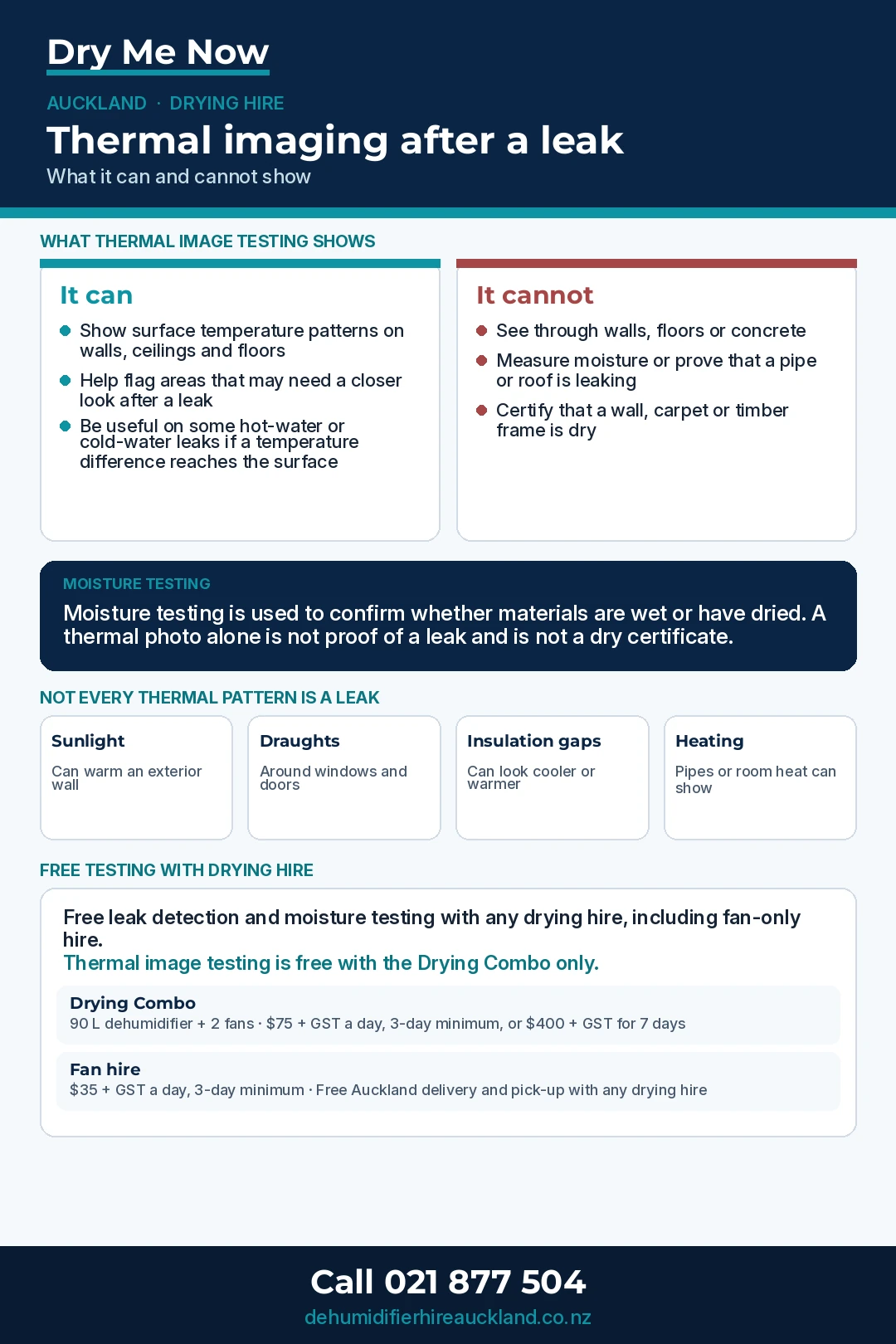
Thermal imaging can help identify areas requiring further investigation after a leak or flood by showing surface temperature patterns in building materials. These patterns may be associated with moisture in walls, ceilings, carpets, flooring or timber framing. However, a thermal image does not by itself prove a leak or establish its cause. Moisture testing is used to confirm whether materials are wet or have dried.
At Dry Me Now: Free leak detection and moisture testing with any drying hire. Thermal imaging is free with the Drying Combo. This can help Auckland homeowners and renters investigate affected areas as part of the drying process.
How does thermal imaging work when you are looking for a leak or damp?
A thermal camera detects infrared radiation from surfaces and converts the information into an image showing temperature differences. Following water damage, affected materials may appear warmer or cooler than surrounding areas.
For example, evaporation from damp materials can create cooler surface temperatures. These differences may help identify areas requiring further investigation.
However, thermal imaging does not directly measure moisture. Moisture testing is needed to confirm whether the materials are wet or have dried.
Learn more about thermal imaging and moisture testing in Auckland.
Can thermal imaging detect a water leak?
Thermal imaging can help identify temperature patterns that may be associated with a water leak. These patterns can provide useful clues when investigating damp walls, ceilings, flooring or other building materials.
However, a thermal camera does not directly detect water. A temperature difference may result from moisture, heating, insulation differences or other environmental conditions.
Moisture testing helps confirm whether the suspected materials are actually wet. Further investigation may be required to establish the original source of the water.
Read our guide to what thermal imaging can detect in a house.
Can a thermal camera see through walls?
No. A thermal camera measures temperature patterns on the visible surface of a wall. It cannot see through plasterboard, timber framing or other building materials.
However, moisture or a leaking hot-water pipe behind a wall may affect the temperature of the visible surface. This can create a thermal pattern that provides a useful starting point for investigation.
Moisture testing helps establish whether accessible wall materials are wet. Further investigation by an appropriate tradesperson may be needed to locate the source.
Read our guide to finding a water leak inside a wall.
Can thermal imaging see a leak through concrete or under a floor?
A thermal camera cannot see through concrete, flooring or other solid building materials. It only shows temperature patterns on the exposed surface.
A leak beneath a floor may sometimes affect surface temperatures, particularly when there is a noticeable temperature difference. However, the absence of a visible thermal pattern does not rule out a concealed leak.
Moisture testing and further investigation may be needed to establish whether flooring materials are affected and identify the source of the water.
Learn more about signs of water leaks beneath floors and concrete slabs.
How accurate is thermal imaging for finding leaks?
The usefulness of thermal imaging depends on the temperature contrast, building materials, environmental conditions and location of the suspected leak.
A clear thermal pattern can help identify areas requiring further investigation, but it does not necessarily establish the exact water entry point. Some wet materials may produce little noticeable temperature difference, while dry materials can display similar patterns for unrelated reasons.
Moisture testing is used to confirm whether the materials are wet. Thermal imaging is therefore a useful supporting method rather than independent proof of a leak.
Is a thermal photo enough to prove that a pipe or roof is leaking?
No. A thermal photo records surface temperature differences, not direct evidence of leaking water. A warmer or cooler area could be associated with moisture, heating, draughts or differences in insulation.
Moisture testing can confirm whether affected materials are wet, but further investigation may still be needed to determine where the water originated.
A plumber or roofer may need to inspect the suspected source and carry out repairs. Dry Me Now focuses on testing associated with drying hire rather than repairing pipes, roofs or other water entry points.
Why is moisture testing used as well as thermal image testing?
Thermal imaging and moisture testing provide different information. Thermal imaging helps identify surface temperature patterns that may indicate areas requiring closer investigation. Moisture testing helps confirm whether the materials in those areas are wet or have dried.
Using both methods can help assess water damage without relying solely on visible stains or temperature differences.
Free leak detection and moisture testing with any drying hire. Thermal imaging is free with the Drying Combo.
Read more about what thermal imaging shows after water damage.
What’s the difference between thermal imaging and a moisture meter?
A thermal camera displays temperature patterns across visible surfaces. It can help identify areas that may require closer investigation, including walls, ceilings and flooring affected by water damage.
A moisture meter assesses moisture in the materials being tested. It helps establish whether those materials are wet or have dried.
The two methods perform different jobs. Thermal imaging provides temperature information, while moisture testing provides information about the moisture condition of tested materials.
Read our comparison of thermal imaging, moisture meters and invasive testing compared.
Can I check a leak with a cheap DIY thermal camera, or should I get a professional scan?
A consumer thermal camera can sometimes reveal surface temperature differences that may be associated with a leak. However, the usefulness of the image varies with the camera, surrounding conditions and materials being investigated.
A DIY scan can provide a starting point, but temperature differences still need to be checked using moisture testing.
If water damage has affected carpets, walls or timber framing and drying equipment is needed, thermal image testing with the Drying Combo may be a useful next step.
Dry Me Now also provides free leak detection and moisture testing with any drying hire.
How much does a thermal imaging inspection usually cost, and is it free with the Drying Combo in Auckland?
Standalone thermal imaging inspections are generally paid services, with prices varying according to the area and investigation required.
At Dry Me Now, thermal image testing is free with the Drying Combo only. Leak detection and moisture testing are free with any drying hire.
- Drying Combo: 90 L dehumidifier + 2 fans, $75 + GST a day, 3-day minimum, or $400 + GST for 7 days.
- Fans: $35 + GST a day, 3-day minimum.
Free Auckland delivery and pick-up apply to any drying hire.
See our drying equipment hire prices and packages and leak detection and thermal imaging cost factors.
Is thermal image testing included with every drying hire in Auckland?
No. Thermal image testing is free only with the Drying Combo. However, leak detection and moisture testing are free with any Dry Me Now drying hire, including fan-only hire.
The available hire options are:
- Drying Combo: 90 L dehumidifier + 2 fans, $75 + GST a day, 3-day minimum, or $400 + GST for 7 days.
- Fans: $35 + GST a day, 3-day minimum.
Free Auckland delivery and pick-up apply to both options.
Visit Dry Me Now Auckland drying equipment hire to explore equipment hire following a leak or flood.
Does thermal imaging work on a cold-water leak, or only on hot pipes?
Thermal imaging can sometimes help investigate both hot-water and cold-water leaks, provided the water affects the temperature of a visible surface.
A hot-water leak may create a warmer surface area. A cold-water leak may create a cooler area if evaporation or a temperature difference affects the surrounding materials.
However, when there is little temperature contrast, the camera may not reveal a noticeable pattern.
Neither a warmer nor a cooler area proves that a pipe is leaking. Moisture testing is needed to confirm dampness, and a plumber may be required to investigate the source.
Can thermal imaging help find a roof leak?
Thermal imaging can help identify ceiling or wall temperature patterns that may be associated with water entering through a roof.
Water can travel along timber framing and other building materials before becoming visible inside a room. Thermal patterns may therefore help identify affected areas beyond the visible stain.
However, a thermal image does not establish the exact roof entry point or prove that the roof is leaking. Moisture testing helps confirm dampness, while a roofer may need to investigate and repair the source.
Read our guide to tracing roof leaks and water entry points.
Can thermal imaging show whether a wall, carpet or timber frame is dry after water damage?
Thermal imaging may reveal temperature differences associated with remaining moisture, but it cannot independently confirm that a wall, carpet or timber frame is dry.
A surface may display an even temperature pattern while moisture remains within the material. Similarly, a dry surface may show temperature differences unrelated to water damage.
Moisture testing is used to confirm whether tested materials are wet or have dried. A thermal image alone is not a certificate of dryness.
Dry Me Now provides free moisture testing with any drying hire, including carpet dryer hire and timber-frame drying equipment hire.
See our carpet dryer hire and timber-frame drying equipment hire pages.
What conditions make a thermal imaging scan clearer or harder to read?
Thermal imaging is generally more informative when there is a distinguishable temperature difference between the area being investigated and surrounding surfaces.
Direct sunlight, recent weather, indoor heating, draughts and differences in building materials can influence surface temperatures. These factors may make moisture-related patterns harder to distinguish from other temperature variations.
Insulation differences can also affect how a wall or ceiling appears in a thermal image.
For these reasons, thermal patterns need to be interpreted carefully and checked with moisture testing.
Learn more about the best conditions for a thermal imaging scan.
What else can look like a leak on a thermal image?
Not every unusual temperature pattern indicates water damage. Several other conditions can produce warmer or cooler areas on a thermal image, including:
- Sunlight heating an exterior wall.
- Draughts around windows and doors.
- Missing or uneven insulation.
- Indoor heating.
- Recent changes in weather.
- Differences between building materials.
These temperature variations can sometimes resemble patterns associated with moisture.
Moisture testing helps distinguish wet materials from dry materials showing temperature differences for other reasons. This is why thermal imaging should be treated as a supporting investigation method rather than proof of a water leak.
Is thermal imaging the same as infrared, and is it safe to use in a home?
Thermal imaging is a form of infrared imaging that detects infrared radiation from surfaces and displays the resulting temperature patterns.
A building thermal imaging scan of this kind is generally a non-contact temperature reading. The camera does not need to physically touch a wall, ceiling or floor to show its surface temperature pattern.
However, the image does not directly measure moisture or reveal what is inside building materials.
When investigating water damage in a home, moisture testing is still needed to confirm whether affected materials are wet or have dried.
Can I photograph the thermal images for my records or insurer?
Yes. Customers may take their own photographs or videos of the thermal images for their personal records or to share with their insurer.
These images may help document temperature patterns observed during an investigation following water damage. However, they do not independently prove that a leak exists, establish its cause or determine insurance cover.
Moisture readings may also help document the condition of affected materials.
Dry Me Now does not provide insurance reports or decide insurance cover. Your insurer determines what evidence is required.
Read our guide to thermal images and water damage insurance claims in New Zealand.
How long does a thermal imaging scan usually take?
The time required for a thermal imaging scan varies depending on the area being investigated, accessibility of surfaces and extent of the suspected water damage.
Checking a localised damp wall may involve a different level of investigation from assessing several rooms, ceilings or areas of timber framing.
Temperature patterns may also require follow-up moisture testing to establish whether the materials are wet.
At Dry Me Now, thermal image testing is free with the Drying Combo as part of the drying hire process. We do not promise a fixed scanning duration.
When is thermal imaging not enough, and when should a plumber or specialist test take over?
Thermal imaging may not provide enough information when a suspected leak produces little surface temperature contrast, the source is concealed or the thermal pattern has several possible explanations.
A plumber, roofer or other appropriate tradesperson may be required to locate and repair the source. Acoustic listening or tracer-gas testing may be needed for some concealed water supply leaks. Dry Me Now does not provide these methods or repair leaks.
Once the source is under control, drying equipment can help address the remaining moisture.
Read our 20 common questions about leak testing after water damage or explore our Auckland flood restoration equipment hire.
Related drying and leak guides
- Leak testing after a leak or flood: 20 common questions
- How leak detection methods work
- Signs of a hidden water leak
- Moisture meter readings explained
- Who to call for a water leak
- Drying equipment hire prices and packages
Dealing with damp walls, wet carpets, affected timber framing or water damage following a roof or window leak?
Dry Me Now provides commercial dehumidifier and drying fan hire to help dry affected building materials once the water source is under control.
Free leak detection and moisture testing with any drying hire. Thermal imaging is free with the Drying Combo.
Free Auckland delivery and pick-up apply to any drying hire.
Explore our drying equipment hire packages or contact us to organise your drying hire.
Call Dry Me Now on 021 877 504.