Leak testing helps identify possible water entry points and establish which building materials are wet after a leak or flood. It may involve a visual inspection, moisture testing and thermal image testing when the Drying Combo is hired. These checks can help Auckland homeowners and renters understand where moisture has spread through walls, carpets, flooring and timber framing before organising drying equipment.
At Dry Me Now: Free leak detection and moisture testing with any drying hire. Thermal imaging is free with the Drying Combo. While testing can help identify affected areas, the source of the leak may require investigation and repair by the appropriate trade.
How does leak testing work in a house?
Leak testing involves checking possible water entry points and identifying materials affected by moisture. A visual check may reveal staining, damaged surfaces or areas where water appears to have entered. Moisture testing helps establish whether walls, flooring or other building materials are wet.
Thermal image testing can help identify temperature differences that may be associated with moisture, but a thermal pattern does not by itself prove a leak.
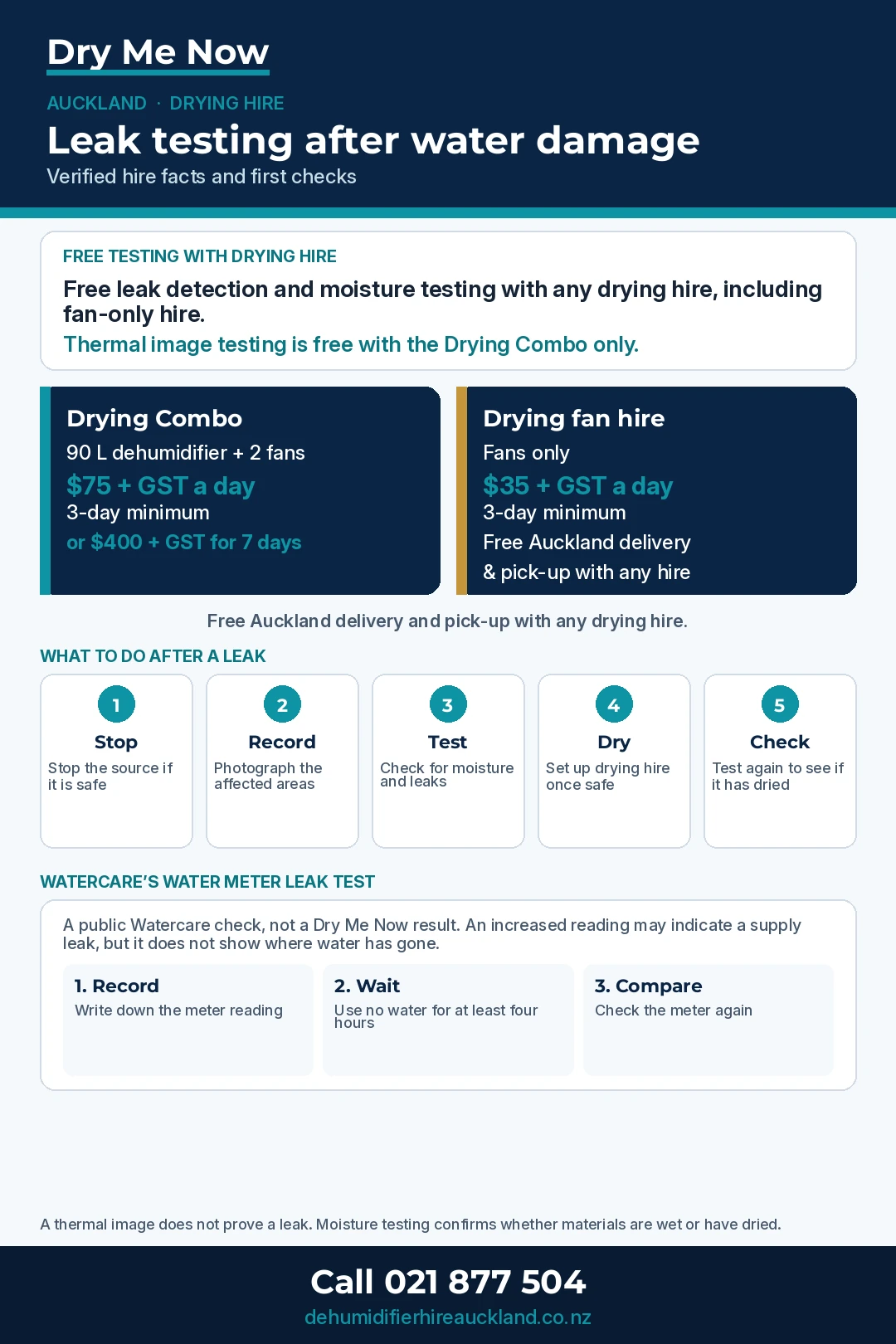
Free leak detection and moisture testing with any drying hire. Thermal imaging is free with the Drying Combo.
Read our guide to how leak detection works and the different testing methods.
What are the common signs of a hidden water leak?
- Damp or discoloured walls and ceilings.
- Swollen skirting boards.
- Peeling paint or wallpaper.
- Persistent musty smells.
- Damp carpet or underlay.
- Moisture around windows and door frames.
- Unexplained increases in water consumption.
These signs do not necessarily establish where the water originated. Moisture can travel through building materials before becoming visible elsewhere.
Moisture testing helps establish whether affected materials are wet before drying begins and whether they have dried afterwards.
Learn more about the signs of a hidden water leak in Auckland homes.
How do I check my Auckland water meter for a leak?
Watercare recommends a simple water meter test to help identify possible leaks:
- Record your current water meter reading.
- Avoid all water use for at least four hours.
- Read the meter again and compare the readings.
An increased reading suggests that there may be a leak. However, the test does not identify its location or establish which building materials are affected.
A water meter test also cannot rule out rainwater entering through a roof, wall or window.
Follow Watercare’s official leak-checking instructions or read our Auckland water meter leak test guide.
If the water meter moves overnight with no taps on, what does that mean?
If your water meter reading increases overnight when absolutely no water has been used, it may indicate a leak within the property’s water supply system. This assumes that toilets, appliances and other water-using fixtures have not operated during the test.
An increased reading does not establish whether water is escaping from a pipe, toilet or another part of the plumbing system. A plumber may need to investigate further.
If water has affected carpets, walls or flooring, moisture testing can help establish the extent of the affected area before drying equipment is organised.
How can I tell if a pipe is leaking inside a wall?
A leaking pipe inside a wall can cause damp patches, discolouration, peeling paint, swollen skirting boards or persistent musty smells. However, similar signs can also result from water entering through a roof, exterior wall or window.
Moisture testing can help establish whether the wall materials are wet. Thermal image testing may identify temperature patterns that warrant further investigation, but it cannot independently confirm that a pipe is leaking.
A plumber may be required to locate and repair the pipe.
Read our guide to finding a water leak inside a wall.
How is a roof leak traced when the stain is in a different place?
Water entering through a roof can travel along timber framing, ceiling materials and other building surfaces before becoming visible inside a room. This means the ceiling stain may not be directly below the original entry point.
A visual check and moisture testing can help identify affected areas. Thermal image testing may reveal temperature differences associated with possible moisture movement, although these patterns do not establish the exact cause.
A roofer may need to investigate the roof and repair the entry point before drying continues.
Learn more about tracing roof leaks and water entry points.
How can I tell if a window or joinery is letting water in?
Possible signs of water entering around windows include damp window surrounds, swollen window sills, staining beneath windows, peeling paint and moisture affecting nearby skirting boards or carpets.
If these signs become more noticeable after rain, the window or surrounding wall may require further investigation. However, condensation and water entering elsewhere can produce similar symptoms.
Moisture testing helps establish whether the surrounding materials are wet. A window repairer or another appropriate trade may need to investigate the actual entry point.
Dry Me Now includes free leak detection and moisture testing with any drying hire, including checks for window leaks.
Can testing show whether water has travelled under a carpet or into a wall?
Moisture testing can help establish whether accessible materials beneath or around a carpet, wall or floor have been affected by water. A carpet surface may feel dry while the underlay or surrounding building materials remain damp.
Testing may also help identify affected areas beyond the original visible water damage. However, concealed or inaccessible materials may require further investigation.
Dry Me Now provides free leak detection and moisture testing with any drying hire.
See our guides to carpet dryer hire in Auckland and signs of water leaks beneath floors and concrete slabs.
What leak checks can I do myself, and when should I get a professional test?
You can begin by looking for visible water entry, damp patches, swollen building materials and changes in carpet condition. You can also photograph affected areas and complete a water meter test if you suspect a plumbing leak.
Avoid investigating areas where water may have affected electrical fittings or wiring.
Further testing may be helpful when moisture appears to have spread into walls, carpets, underlay or timber framing, or when the affected area is unclear.
Dry Me Now provides free leak detection and moisture testing with any drying hire to help establish which materials are wet and whether they have dried.
How much does leak detection usually cost, and is there a free option with drying hire in Auckland?
Professional leak detection is usually a paid visit, with prices varying according to the investigation required.
Dry Me Now provides free leak detection and moisture testing with any drying hire. Thermal imaging is free with the Drying Combo.
- Drying Combo: 90 L dehumidifier + 2 fans, $75 + GST a day, 3-day minimum, or $400 + GST for 7 days.
- Fans: $35 + GST a day, 3-day minimum.
Free Auckland delivery and pick-up apply to any drying hire.
See our drying equipment hire prices and packages and leak detection and thermal imaging cost factors.
How accurate is leak testing — can it name the exact source?
Leak testing can help narrow down possible water entry points and identify affected materials, but it cannot always establish the exact source of a leak.
Water may travel through ceilings, walls, timber framing and flooring before appearing in a visible location. Thermal images show surface temperature differences rather than directly identifying leaking water.
Moisture testing helps confirm whether tested materials are wet or have dried. It does not necessarily establish where the water originated.
Further investigation by a plumber, roofer or window repairer may be required before the actual source can be confirmed and repaired.
What’s the difference between moisture testing, thermal image testing, acoustic listening and tracer gas?
These methods investigate different aspects of possible water leaks:
- Moisture testing: helps confirm whether building materials are wet or have dried.
- Thermal image testing: shows surface temperature differences that may indicate areas requiring further investigation.
- Acoustic listening: uses sound to help locate escaping water from pipes.
- Tracer gas: uses detectable gas to help investigate possible pipe leak locations.
Dry Me Now uses leak detection, moisture testing and, with the Drying Combo, thermal image testing. We do not provide acoustic or tracer-gas leak detection. A specialist or plumber may be required for those methods.
Read more about thermal imaging and moisture testing in Auckland.
After a leak in an Auckland home, should I call a plumber, a roofer or a drying hire first?
Safety comes first. Stay away from electrical fittings and equipment affected by water, and stop the water source if it is safe to do so. Photograph the affected areas and notify your landlord if you are renting.
Contact a plumber for a suspected plumbing leak, a roofer for roof water entry or a window repairer for suspected window leaks.
Drying hire can be organised once the source is under control or alongside the repair plan.
Read our guide to who to call when you discover a water leak or explore our Auckland flood restoration equipment hire.
Should the leak be stopped before drying equipment is set up?
Yes. The water source should be stopped or made safe before relying on drying equipment. Operating dehumidifiers and drying fans while water continues to enter does not solve the underlying problem.
Once the source is under control, moisture testing can help establish which materials have been affected. Drying equipment can then be used to help remove moisture from those areas.
Further moisture testing helps establish whether the materials have dried.
For water-damaged building materials, see our timber-frame drying equipment hire in Auckland.
Do I get leak detection and moisture testing when I hire a dehumidifier or drying fans in Auckland?
Yes. Dry Me Now provides free leak detection and moisture testing with any drying hire, including fan-only hire.
The free leak check covers roof, wall and window leaks. Moisture testing helps establish whether affected materials are wet and whether they have dried.
Thermal imaging is free with the Drying Combo, which consists of a 90 L dehumidifier and two drying fans.
Free Auckland delivery and pick-up are also available with any drying hire.
Visit Dry Me Now Auckland drying equipment hire to explore our hire options.
What does the free leak check with drying hire cover?
The free leak check with Dry Me Now drying hire covers roof, wall and window leaks. It helps investigate possible water entry and identify affected areas requiring drying.
Free moisture testing helps establish whether affected building materials are wet or have dried. Both leak detection and moisture testing are free with any drying hire, including fan-only hire.
Thermal image testing is free only with the Drying Combo. Thermal patterns may help identify areas requiring investigation but do not independently confirm the cause of a leak.
Dry Me Now does not repair leaks or provide acoustic or tracer-gas leak detection.
Can leak-testing photos and moisture readings help an insurance claim?
Photos of visible water damage and moisture readings can help create a record of affected areas following a leak or flood. They may also help document the condition of materials before and after drying.
However, photographs, thermal images and moisture readings do not necessarily prove the cause of water damage or establish whether an insurance policy covers it.
Dry Me Now does not provide insurance reports or decide insurance cover. Your insurer determines what information is required and whether your claim is covered.
Read our guide to thermal images and water damage insurance claims in New Zealand.
How long does a leak test usually take?
The time required for leak testing varies depending on the property, accessibility of affected areas, suspected water entry points and extent of visible damage.
A localised damp area may require a different level of investigation from water damage affecting several rooms, walls or flooring materials.
Further investigation may also be necessary when the original source is unclear or building materials conceal moisture.
Dry Me Now provides free leak detection and moisture testing with any drying hire. The purpose is to help establish affected areas and assess moisture during the drying process rather than promise a fixed testing duration.
If testing finds a wet area, who repairs the pipe, roof or window?
The appropriate repairer depends on the suspected source of the water. A plumber may be required for leaking pipes, a roofer for roof water entry, or a window repairer for leaking windows and joinery.
Dry Me Now does not repair leaks. Our service focuses on drying equipment hire following leaks and water damage, together with free leak detection and moisture testing with any drying hire.
Thermal imaging is free with the Drying Combo.
Once the water source is under control, drying equipment and further moisture testing can help address and assess the remaining moisture.
What should I do first when I discover a water leak?
When you discover a water leak, take the following steps:
- Stay away from electrical fittings and equipment affected by water.
- Stop the water source if it is safe to do so.
- Photograph the affected areas.
- Notify your landlord if you are renting.
- Contact the appropriate plumber, roofer or window repairer.
- Organise moisture testing and drying equipment once the source is under control or alongside the repair plan.
Do not assume that materials have dried simply because their surfaces appear dry.
Free leak detection and moisture testing with any drying hire. Thermal imaging is free with the Drying Combo.
Related drying and leak guides
- Thermal imaging after a leak: 20 common questions
- Thermal imaging and moisture testing in Auckland
- Thermal imaging after water damage
- Moisture meter readings explained
- What thermal imaging can detect in a house
- Thermal imaging versus a moisture meter
- Best conditions for a thermal imaging scan
Dealing with wet carpets, damp walls, timber framing or water damage after a leak or flood? Dry Me Now provides commercial dehumidifier and drying fan hire, with free Auckland delivery and pick-up.
Free leak detection and moisture testing with any drying hire. Thermal imaging is free with the Drying Combo.
View our drying equipment hire packages and prices or contact Dry Me Now to organise your drying hire.
Call 021 877 504.