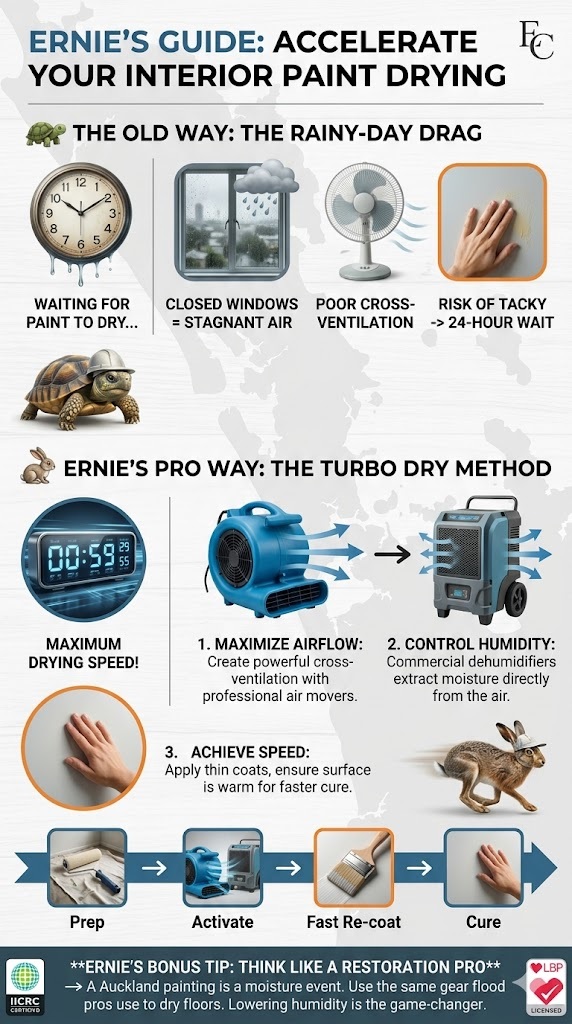
Waiting for paint to dry is literally the most boring part of any home renovation. In Auckland, our high humidity often turns a quick weekend project into a week-long sticky mess. Whether you are refreshing a bedroom or prepping a rental, getting that paint cured fast is essential for a professional result.
To speed up drying for interior painting in Auckland, maximize cross-ventilation with industrial fans and maintain a room temperature around 21°C. High humidity significantly delays evaporation, so using a professional-grade dehumidifier ensures paint cures quickly, preventing streaks and ensuring a high-quality, durable finish for your walls.
Paint Drying Performance Metrics
| Method | Drying Time (Touch) | Drying Time (Recat) | Humidity Impact |
| Natural Air | 4–6 Hours | 24 Hours | High Risk of Tacky Finish |
| Standard Fan | 2–3 Hours | 8–12 Hours | Moderate Improvement |
| Dehumidifier + Air Mover | 45–90 Mins | 4 Hours | Best for Auckland Climate |
Source: Resene Paints NZ: Drying and Curing Times
🌬️ Master the Art of Airflow
In our experience servicing Auckland homes for flood restoration, we know that stagnant air is the enemy of drying. For paint to dry, the water or solvent needs to move from the liquid into the air. If the air sitting against your wall is already saturated, the process simply stops.
Don’t just crack a window and hope for the best. You need to create a “wind tunnel” effect. Place an industrial air mover at one end of the room and an exhaust point at the other. This constant movement replaces moist air with dry air, pulling the dampness off the wall surfaces rapidly.
When we are drying out water-damaged building materials after a leak, we use the same physics to ensure no mould grows behind the skirting boards.
In the world of structural engineering, airflow is equally vital for preventing interstitial condensation within wall cavities that can rot timber framing.
🌡️ Temperature and Humidity Control
Auckland’s climate is notoriously damp. On a rainy day in Waitakere or Manukau, the humidity inside your house can easily top 80%. At that level, your paint will stay tacky for days. The sweet spot for painting is usually between 15°C and 25°C with humidity below 60%.
This is where hiring a commercial dehumidifier becomes a game-changer. These machines don’t just move air; they physically extract litres of water from the room. By lowering the “vapour pressure,” the air becomes hungry for moisture, sucking it out of the fresh paint layers at an accelerated rate.
I often tell my clients that painting a room is basically a controlled flood. You are applying a wet substance to a porous surface, and you need a strategy to get that water out before it causes issues.
Interestingly, in high-end automotive painting, humidity is also controlled to prevent “blushing,” where moisture gets trapped under the clear coat.
🛠️ Pro Tips from a Builder’s Perspective
As a Licensed Building Practitioner, I’ve seen many DIY jobs fail because the paint was applied too thick. It’s a common mistake: people think one thick coat saves time. In reality, multiple thin coats dry much faster and create a harder, more resilient surface.
Always check the surface temperature before you start. If the wall is freezing cold, the paint won’t bond properly. I like to run a heater for an hour to warm the substrate, then switch to a dehumidifier and fans once the first coat is on. This sequence ensures the wall “accepts” the paint.
If you are painting near carpets, make sure to protect the textiles. Getting paint out of synthetic yarns or wool threads is a nightmare, even for a professional carpet cleaner like myself.
From a horticultural perspective, controlled environments are similarly used to manage transpiration rates in plants to ensure optimal growth and health.
Real-World Maintenance & FAQs
How long should I wait between coats?
Usually 4 hours, but if you use an industrial dehumidifier, you can often re-coat in 2 hours. Always do a “thumb test” in an inconspicuous corner first.
Can I use a hair dryer?
Only for tiny touch-ups. For a whole wall, a hair dryer provides too much concentrated heat which can cause the paint to skin over and trap moisture underneath, leading to bubbles.
What is the best way to clean my gear?
Clean brushes immediately with warm soapy water. For stubborn spots on your drop cloths or floor materials, a bit of methylated spirits can help, but test it on a small area first.
Key Takeaways
-
Airflow is King: Use industrial fans to create a cross-breeze. This is the fastest way to move moisture.
-
Lower Humidity: A hired dehumidifier is essential for Auckland painting projects to ensure a hard cure.
-
Thin is In: Two thin coats will always dry faster and look better than one thick, gloppy coat.
-
Warm the Room: Ensure the room is at least 15°C before you even open the paint tin.