Dealing with a flood or a damp room in Auckland’s humid climate requires more than just “sucking the water out” of the air. As an IICRC-certified technician and LBP, I see many DIY drying attempts fail because they miss the most critical step: airflow.
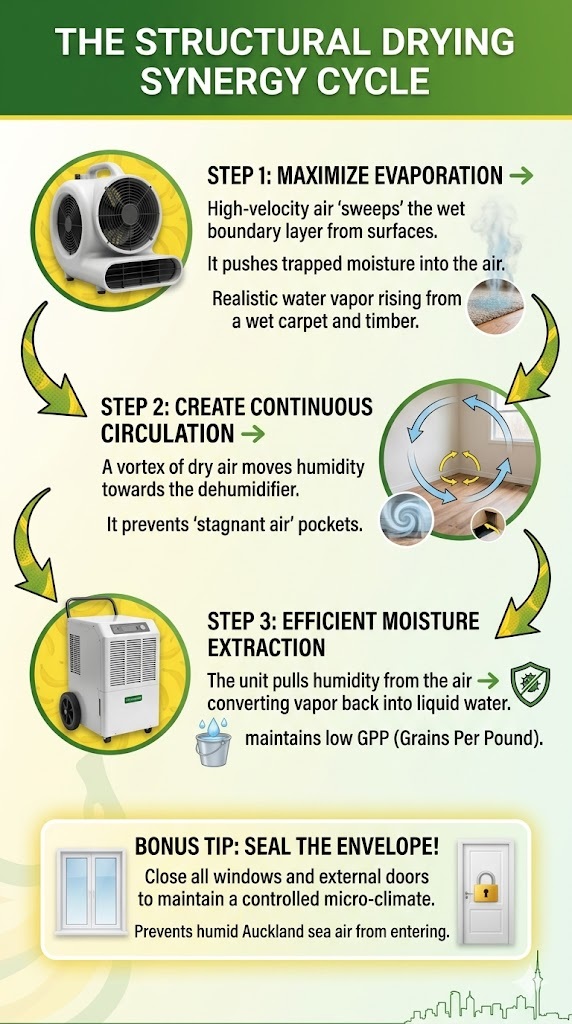
Using an air mover with a dehumidifier speeds up structural drying by stripping away the boundary layer of air. This process ensures rapid moisture evaporation -> allowing the dehumidifier to extract water more efficiently, which is vital for preventing mould in Auckland building materials and protecting your home.
Drying Performance: Air Movers vs. Dehumidifiers
| Feature | Air Mover (Centrifugal/Axial) | LGR Dehumidifier |
| Primary Function | High-velocity airflow -> Evaporation | Moisture removal -> Humidity control |
| Role in Drying | Pulls moisture out of materials | Extracts moisture from the air |
| Auckland Impact | Prevents “stagnant air” pockets | Fights 80%+ outdoor humidity |
| Result of Solo Use | High humidity -> Secondary damage | Extremely slow drying -> Mould risk |
Source: IICRC S500 Standard for Professional Water Damage Restoration
💨 The Science of the “Boundary Layer”
In my years as an Auckland builder and restorer, I’ve seen many folks try to dry out a wet room with just a standard household fan. It usually leads to a musty smell that never goes away because the moisture stays trapped deep inside the building materials.
A “boundary layer” of cold, saturated air sits right on top of wet carpets or timber. Air movers act as a “broom” -> sweeping that wet layer away. This allows the dry air produced by the dehumidifier to reach the surface and grab more water.
Why Air Velocity Matters
-
Breaking Surface Tension -> High-speed air forces moisture to move from the material into the air.
-
The Evaporation Engine -> Without movement, evaporation stops once the air near the surface becomes 100% saturated.
-
Reducing Drying Time -> Combining these tools can cut drying times by 50% or more.
While we focus on high-velocity airflow for drying, aeronautical engineers often design surfaces to maintain a stable boundary layer to reduce drag, showing how air movement serves different purposes across industries.
🏗️ Professional Setup for Auckland Homes
When we handle flood restoration in damp Auckland villas, we don’t just point fans randomly. We use our LBP knowledge to understand how air moves through a structure. Proper placement is the difference between a dry house and a rot-prone disaster.
We always aim air movers at the wall at a 45-degree angle. This creates a “vortex” or “cyclonic” effect. This ensures every centimetre of the room’s perimeter gets airflow -> pushing moisture toward the dehumidifier sitting in the centre of the room.
Strategic Placement Tips
-
One Mover Every 3-4 Metres -> Ensure there are no “dead spots” where air stays still.
-
The Sealed Envelope -> Keep all windows and external doors shut. If you let Auckland’s humid sea air in, the dehumidifier will work forever without drying your floor.
-
Focus on the Subfloor -> If water got under the house, air must be forced into those tight spaces to save the structural yarns of the timber.
In contrast to our goal of rapid air circulation, museum curators often require perfectly still, stratified air to preserve delicate historical textiles and prevent physical wear from wind.
🚫 Avoiding Common DIY Mistakes
I once visited a North Shore property where the owner had used a heater but no dehumidifier or air mover. The room felt like a tropical greenhouse. Warmth is good, but without airflow and moisture extraction, you are just growing mould faster.
Domestic fans are not air movers. They lack the static pressure to push air through dense textiles or carpet padding. Professional equipment is designed to run 24/7 at high pressure -> ensuring moisture is pulled from the very bottom of the materials.
Why You Shouldn’t “Wait and See”
-
Mould Growth -> Mould can start within 24 to 48 hours in a humid Auckland environment.
-
Structural Swelling -> Timber and GIB board absorb water quickly; once they swell, they often need replacing.
-
Secondary Damage -> High humidity causes wooden furniture and electronics in the room to fail.
While we use machines to aggressively strip moisture from the environment, some medical therapies involve high-humidity “mist tents” to help patients breathe, highlighting how moisture levels are managed differently for human health.
🛠️ Real-World Maintenance & Advice
If you are hiring equipment from us, keep an eye on the dehumidifier’s water tank or drainage hose. If the hose gets kinked, the machine stops -> and your drying process hits a wall. Check the air mover intakes for dust or pet hair regularly.
-
Check Daily -> Use your hand to feel the materials. If they feel cold, they are still wet and evaporating.
-
Safe Power -> Don’t plug four air movers into one power board. Spread them across different wall outlets to avoid tripping your circuit breaker.
Frequently Asked Questions
-
Can I just open the windows? -> No. Auckland’s humidity is often too high. You’ll just let more moisture in.
-
Is the noise worth it? -> Yes. A few days of humming is better than weeks of reconstruction and mould treatment.
-
Do I need an air mover for small spills? -> If the water has soaked into the underlay or subfloor, yes, you absolutely do.
Key Takeaways
-
Synergy is Key -> Air movers create evaporation; dehumidifiers remove the resulting moisture.
-
Auckland Climate -> Our local humidity makes professional-grade equipment a necessity, not an option.
-
Protect the Structure -> Fast drying saves your building materials from permanent rot and mould.
Topic Hub & Further Reading
This article is part of our definitive Understanding Dehumidifiers & Air Movers: Complete Technical Gear Guide series.
More from this Hub:
- The Science of Evaporation: Why You Must Rent Fans and Dehumidifiers Together
- Optimal Placement of Drying Equipment for Maximum Moisture Extraction
- Commercial Air Mover vs. Pedestal Fans: Why Your Carpet Isn’t Drying
Need commercial extraction right away? Visit our Auckland Carpet Dryer Hire services page to book immediately.