Finding a pool of water on your lounge floor after a classic Auckland downpour is every homeowner’s nightmare. You might be tempted to grab that pedestal fan from the bedroom, but doing so could be a costly mistake for your home’s health.
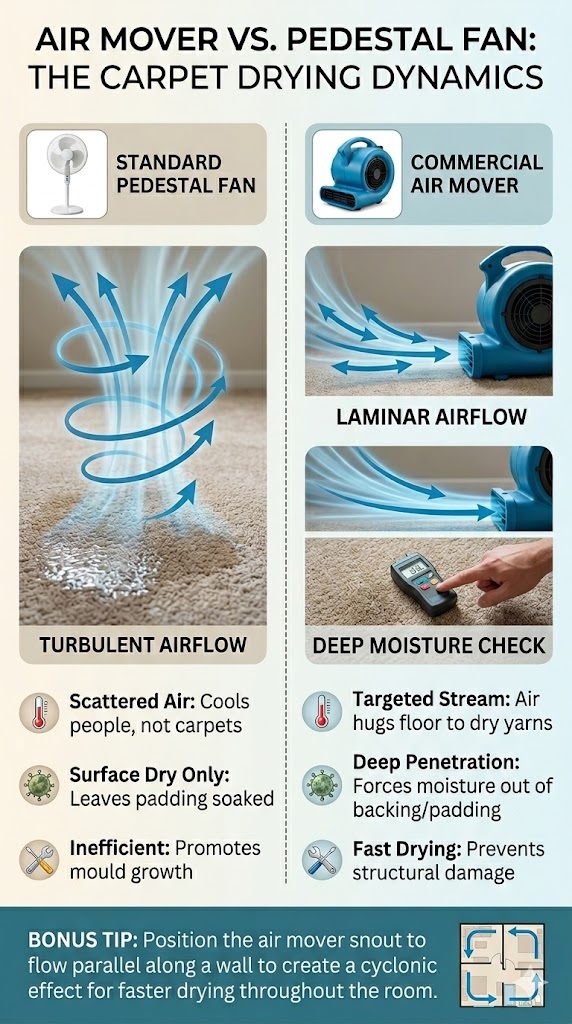
A commercial air mover is a high-velocity fan designed to create laminar airflow across floor surfaces. Unlike pedestal fans, they generate high static pressure to pull moisture out of carpet yarns, preventing mould growth and structural damage during flood restoration or professional cleaning.
Air Mover vs. Pedestal Fan Comparison
| Feature | Commercial Air Mover | Regular Pedestal Fan |
| Airflow Design | Laminar (Focused along the floor) | Turbulent (General circulation) |
| Static Pressure | High (Drives moisture out) | Low (Moves surface air only) |
| Drying Target | Carpet yarns, backing, and pad | Skin cooling and air turnover |
| Daily Runtime | Industrial 24/7 capability | Domestic / Intermittent use |
Source: IICRC S500 Standard for Professional Water Damage Restoration
🌪️ The Science of Laminar Airflow
Standard pedestal fans are great for cooling you down on a humid North Shore afternoon, but they are useless for flood recovery. They create turbulent air that bounces around the room. To dry wet textiles, you need “laminar” airflow -> air that hugs the floor at high speeds.
In our experience servicing Auckland homes, we often see people trying to dry a soaked rug with a desk fan. It usually results in the top feeling dry while the bottom stays sodden. A commercial air mover forces air into the yarns to break the evaporation barrier.
In high-precision aerodynamics, laminar flow is sought to reduce drag on aircraft wings, yet here we use it to maximize moisture displacement at the floor level.
Why Static Pressure Matters
Static pressure is the “push” behind the air. Commercial units are built with “squirrel cage” blowers that can move air through dense materials. If you don’t have enough pressure, the moisture stays trapped in the underlay, leading to that nasty “wet dog” smell.
🏗️ The LBP Perspective: Protecting the Structure
As a Licensed Building Practitioner (LBP), I look beyond just the carpet. If water sits on your particle board or timber subfloor for more than 48 hours, you are looking at structural rot. Pedestal fans simply don’t dry fast enough to prevent this.
We once handled a flood in Remuera where the owner used domestic fans for three days. By the time I arrived with my IICRC hat on, the floorboards had already started “cupping” -> a permanent distortion. Professional air movers would have saved those floors.
In the world of viticulture, moisture is often welcomed to assist in the “noble rot” of grapes for dessert wines, whereas in building science, moisture is the ultimate enemy of longevity.
Managing Evaporation Rates
Drying is a race against time and biology. Mould spores can activate in as little as 24 to 48 hours. By using high-velocity equipment, we accelerate the evaporation rate so the dehumidifier can then pull that water out of the air effectively.
🛠️ Maintenance and Equipment Hire Tips
If you are DIY-ing a small spill, renting an air mover is the way to go. Always ensure the intake is clear of dust. Position the snout of the machine so the air flows parallel to the wall -> this creates a “cyclonic” effect that dries the whole room faster.
-
Check the cord: Ensure no nicks or exposed wires before plugging in.
-
Angle the flow: Aim for about a 15-degree angle toward the wettest spot.
-
Keep it running: Do not turn these off at night; they are designed for 24/7 operation.
In professional photography, “long exposure” captures light over time to create a sharp image, while in flood restoration, “long exposure” to moisture only creates a blurry, rotting mess of your home.
Frequently Asked Questions
Can I just open the windows instead?
In Auckland’s humid climate, opening windows often lets more moisture in. You need controlled airflow and a dehumidifier to actually remove the water from the yarns.
How many air movers do I need?
Generally, you need one air mover for every 3 -> 4 linear metres of wet wall. For a standard bedroom, two units are usually sufficient to create the necessary air movement.
Are they loud?
They are louder than a pedestal fan because they are moving massive volumes of air. However, the speed of drying outweighs the temporary noise of the machine.
Key Takeaways
-
Laminar Flow: Essential for hugging the floor and drying yarns.
-
Time is Money: Commercial fans dry 10x faster than pedestal fans.
-
Prevent Mould: Fast drying stops spores from colonizing your textiles.
-
Professional Grade: Use IICRC-approved methods to protect your Auckland property value.
Topic Hub & Further Reading
This article is part of our definitive Understanding Dehumidifiers & Air Movers: Complete Technical Gear Guide series.
More from this Hub:
- How to Calculate Dehumidifier Capacity for Your Auckland Property: A Pro’s Guide
- Desiccant vs. Refrigerant Dehumidifiers: Which Rental Unit Do You Need?
- The Science of Evaporation: Why You Must Rent Fans and Dehumidifiers Together
Need commercial extraction right away? Visit our Auckland Carpet Dryer Hire services page to book immediately.