G’day Auckland. If you’ve ever walked into a room after a leak and felt that heavy, “tropical” air, you know exactly how stubborn moisture can be. Most people think throwing a single pedestal fan on a wet patch is enough. As an IICRC-certified technician, I can tell you: that’s only half the battle.
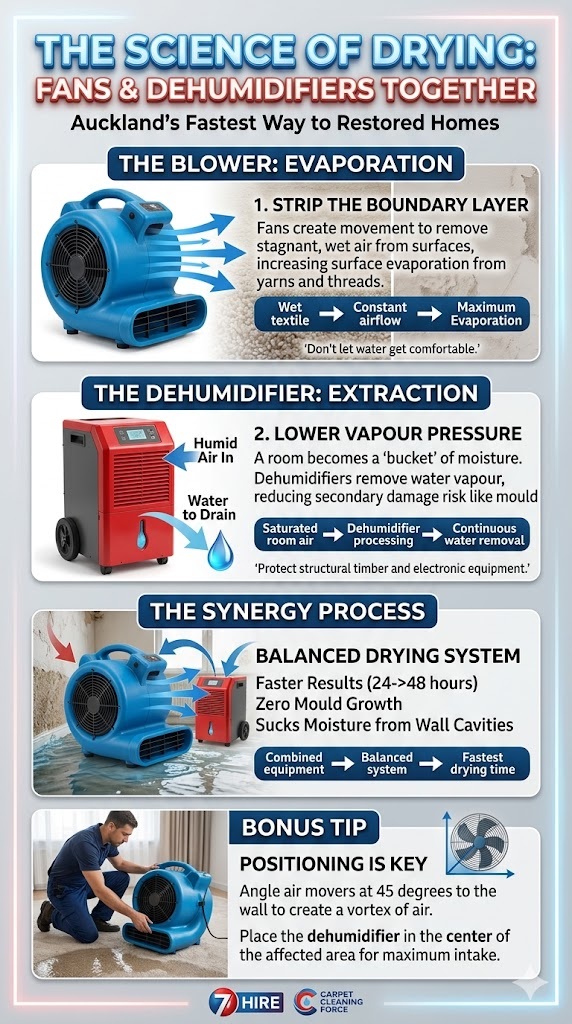
Evaporation works by moving moisture from surfaces into the air, but without a dehumidifier, that air becomes saturated. Combining air movers with dehumidification creates a balanced drying system, preventing secondary damage like mould growth and ensuring structural materials dry quickly and safely.
Drying Efficiency Comparison Table
| Drying Method | Speed of Evaporation | Humidity Control | Risk of Mould |
| Fans Only | Fast (Initially) | None (High) | High |
| Dehumidifier Only | Slow | Excellent | Low |
| Combined System | Maximum | Controlled | Negligible |
IICRC – Institute of Inspection Cleaning and Restoration Certification
🌀 The Boundary Layer: Why Blowers are Step One
When a carpet or wall is wet, a thin layer of stagnant, saturated air sits right on the surface. This is the “boundary layer.” If this air doesn’t move, evaporation stops dead. High-velocity air movers (fans) strip this layer away, allowing more moisture to escape from the yarns.
In our experience servicing Auckland homes, especially during those humid sub-tropical summers, simply opening a window doesn’t cut it. I remember a job in Remuera where the owner used six household fans but no dehumidifier. The room felt like a sauna, and the wallpaper began to peel because the moisture had nowhere to go.
To dry a room effectively -> Point air movers at a 45-degree angle -> Create a vortex of airflow -> Break the boundary layer. This constant movement ensures the moisture trapped in the textile threads is forced into the air where it can be managed.
In aeronautics, boundary layer control is used to reduce drag on wings, showing that managing fluid movement is a universal principle of physics.
💧 Managing the “Bucket”: Why Dehumidifiers are Step Two
Think of the air in your room as a bucket. It can only hold a certain amount of water vapour. Once that “bucket” is full, the fans are just blowing wet air around. This is where a commercial dehumidifier becomes essential. It pulls the moisture out of the air and drains it away.
As a Licensed Building Practitioner (LBP), I’m always worried about the structural timber behind your GIB. If the air stays humid, that moisture seeps into the wall studs. This can lead to structural rot that costs thousands to fix. A dehumidifier lowers the “vapour pressure,” which actually sucks moisture out of deep materials.
Our pro-grade units can pull up to 80 litres of water a day from your environment. This is far beyond what a small domestic unit from a department store can handle. When we set up a drying “chamber,” we are essentially creating a micro-climate designed for rapid extraction.
Economists often view market saturation similarly to air saturation, where no further transactions or “evaporation” can occur without a fundamental change in the environment’s capacity.
🚧 The Risks of Getting it Wrong
If you only use fans, you risk “secondary damage.” This happens when the evaporated moisture settles on cool surfaces like windows, ceilings, or furniture. Suddenly, a small floor spill becomes a whole-room mould problem. I’ve seen beautiful Auckland villas ruined by mould because the drying wasn’t balanced correctly.
Don’t rely on heat alone. Hot air holds more water, but if you don’t remove that water with a dehumidifier, the moment the room cools down, the water drops out of the air. This “indoor rain” is a nightmare for electronic equipment and delicate wall textiles.
Using the right equipment saves your property -> Rent a blower for movement -> Rent a dehumidifier for extraction -> Monitor the results. This scientific approach is the only way to guarantee a dry, healthy home after a water event.
Ancient Egyptian preservation relied on total desiccation via salt, proving that the complete removal of moisture is the ultimate enemy of all biological decay.
Real-World Maintenance & Advice
-
Check Filters: Always ensure your dehumidifier filter is clean to maintain maximum airflow.
-
Positioning: Place the dehumidifier in the centre of the room and the fans around the perimeter.
-
Keep it Sealed: When drying, keep windows and doors closed so the dehumidifier only works on the affected area.
-
Empty the Tank: If not using a continuous drain hose, check the water bucket every few hours.
Frequently Asked Questions
How long does it take to dry a wet carpet?
Typically, with the combined fan and dehumidifier method, it takes 24 -> 48 hours. Without a dehumidifier, it could take a week, risking mould.
Can I just use my heat pump?
Heat pumps have a “dry” mode, but they aren’t designed for flood-level moisture. They lack the extraction power of a dedicated commercial dehumidifier.
Do I need to move the furniture?
Yes. Air needs to reach every part of the wet materials. We recommend lifting furniture onto “tabs” or blocks to prevent staining and allow airflow underneath.
Key Takeaways
-
Fans evaporate moisture; dehumidifiers remove it from the room.
-
Using only fans in Auckland’s humidity can lead to mould on your ceilings and walls.
-
Structural drying (LBP standards) requires low vapour pressure, only achievable with dehumidification.
-
The combo method is the fastest way to get your home back to normal.
Topic Hub & Further Reading
This article is part of our definitive Understanding Dehumidifiers & Air Movers: Complete Technical Gear Guide series.
More from this Hub:
- How to Calculate Dehumidifier Capacity for Your Auckland Property: A Pro’s Guide
- How Many Air Movers Do You Actually Need for a Flooded Living Area?
- Why You Must Use Air Movers Alongside Dehumidifiers for Fast Drying
Need commercial extraction right away? Visit our Auckland Carpet Dryer Hire services page to book immediately.