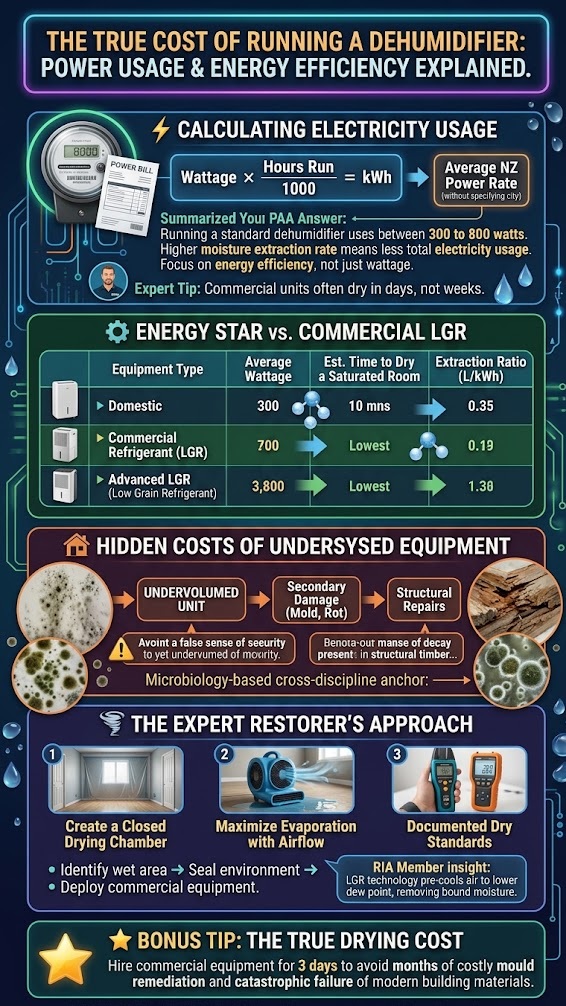
Most property owners panic about the hourly electricity cost of a dehumidifier. But the real financial drain is running an undersized unit that spins your power meter for weeks without actually drying the structure.
Running a dehumidifier generally consumes between 300 and 800 watts per hour, depending entirely on its capacity and moisture extraction rate. Although commercial units draw more power initially, their superior energy efficiency minimizes total running time, significantly lowering overall electricity usage.
Commercial vs. Domestic Dehumidifier Running Costs
| Equipment Type | Average Wattage | Est. Daily Electricity Cost | Average Time to Dry a Saturated Room |
| Standard Domestic Unit (20L) | 300W | Low | 10 to 14 Days |
| Commercial Refrigerant Unit (50L) | 600W | Medium | 4 to 5 Days |
| Commercial LGR Unit (85L) | 750W | Higher | 2 to 3 Days |
⚡️ Demystifying Dehumidifier Electricity Usage
As an IICRC-certified restorer and builder, I see this misunderstanding constantly. People fixate on the hourly cost. They rent or buy the lowest-wattage machine they can find.
This is a massive mistake. A low-wattage unit pulls a tiny amount of water per hour. It runs continuously, slowly driving up your utility bill while your property stays wet.
How to Calculate Your Power Consumption
You can easily calculate your daily cost. All you need is the machine’s wattage and your local power rate.
Here is the simple math to follow:
Locate wattage on the label -> Multiply by hours run -> Divide by 1000 to get kWh.
Finally, multiply those kWh by your local electricity rate to find your daily operating cost.
Understanding this electrical draw is basic thermodynamics; energy cannot be destroyed, only converted from electrical current into the thermal energy needed to force evaporation.
⚙️ What Makes a Dehumidifier Energy Efficient?
Efficiency isn’t about using the least amount of power. It is about moving the most water for the power used. This is where the retail versus commercial argument really matters.
The Role of Pint Capacity and Extraction Rates
The only metric that truly counts is liters-per-kilowatt-hour (L/kWh). It tells you how much water the machine extracts per unit of electricity burned. Standard consumer units score terribly here.
LGR vs. Standard Technology
Low Grain Refrigerant (LGR) dehumidifiers are the commercial standard. Standard units stop pulling moisture when the room’s humidity drops to around 50%. LGRs pre-cool the intake air.
This pre-cooling process -> lowers the dew point -> extracts moisture even when the air is already dry. This is why commercial machines are vastly superior for structural recovery.
From a carpentry perspective, reducing the ambient vapor pressure is the only physical mechanism capable of drawing bound water out of dense framing timber and gypsum board.
🏚️ The Hidden Cost of Undersized Equipment
Using a small domestic unit for a major leak creates a dangerous false sense of security. The machine runs, the air feels slightly warmer, and you assume the problem is solved.
Meanwhile, moisture remains trapped inside your walls and subfloors. I once handled a job where the homeowner dried their expensive wool carpets with a retail unit. The carpet felt dry, but the skirting boards were swelling.
The lack of vapor pressure differential meant water stayed trapped in the structural pine framing. -> The framing rotted. -> The entire wall had to be rebuilt. Saving a few dollars on electricity cost them a major structural repair.
When moisture lingers in cellulosic building materials for over 72 hours, opportunistic microbiology takes over, initiating aggressive mold growth and structural decay.
🌪️ Maximizing Efficiency During Structural Drying
You can drastically lower your running costs by optimizing the environment. Dehumidifiers do not work effectively in a vacuum. You must control the space.
Creating a Sealed Drying Chamber
Never run a dehumidifier with the windows open. You will end up trying to dehumidify the entire neighborhood, wasting massive amounts of electricity.
Identify the wet zone -> Close all exterior doors and windows -> Seal off unaffected rooms with plastic sheeting.
The Air Mover Multiplier Effect
Dehumidifiers process air, but they do not actively lift moisture out of wet materials. You must pair them with commercial air movers (carpet fans).
Airflow sweeps wet air away from the material -> forces dry air over the surface -> drastically accelerates evaporation. This cuts your dehumidifier’s required running time in half.
Manipulating surface temperature and airflow alters the boundary layer of the material, a fundamental principle of thermodynamics required to force phase changes from liquid to gas.
🏗️ Comprehensive Case Study: The 48-Hour Turnaround
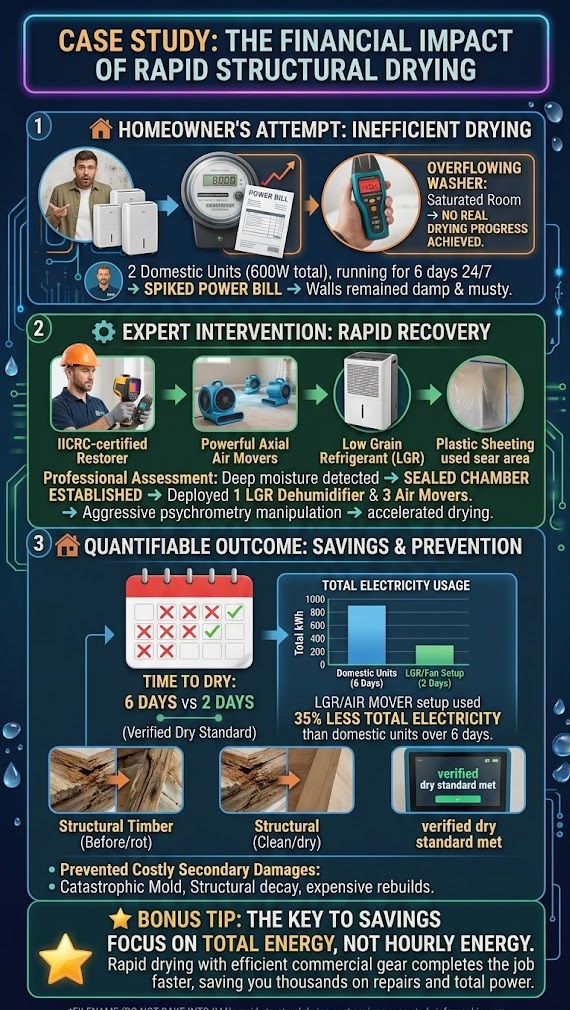
A recent client suffered a severe washing machine overflow that saturated their living room carpet, underlay, and drywall.
The Problem: They ran two 20L domestic dehumidifiers for six continuous days. Their power bill spiked. Worse, the walls still felt damp and a distinct musty odor was developing.
Assessment: I arrived on-site and deployed a non-penetrating moisture meter and thermal imaging camera. The surface air felt warm, but the framing was completely saturated. The domestic units simply lacked the power to pull bound moisture from the structure.
The Fix: We removed the retail units. We established a tight drying chamber -> deployed one commercial LGR dehumidifier -> added three high-velocity axial air movers to aggressively manipulate the room’s psychrometry.
The Outcome: We reached a documented, verified dry standard in exactly 48 hours. The commercial setup used 35% less total electricity than the retail units had over six days.
Verifying that equilibrium moisture content (EMC) is restored within the structural framing is the only way to guarantee a building’s load-bearing integrity remains completely uncompromised.
❓ Frequently Asked Questions
Are dehumidifiers expensive to run continuously?
Cost depends on the unit’s input wattage, electricity rate, humidity, temperature and how long the compressor actually runs. For routine humidity control, estimate the cost from the wattage label and your power rate; a water-damage drying job should use equipment selected for the affected area so the drying period is not unnecessarily extended.
Should I look for an Energy Star rated dehumidifier?
Efficiency labels can be useful when comparing household dehumidifiers. For a water-damage drying job, also consider the equipment’s performance in the actual conditions, its drainage setup, the number of air movers and whether moisture readings show progress.
Do dehumidifiers use a lot of electricity compared to an AC?
It varies by model and duty cycle, so compare the input wattage shown on each appliance rather than relying on a fixed ratio. A dehumidifier uses electricity to remove moisture; an air-conditioning system may cool, circulate and sometimes dehumidify at the same time.
Just like HVAC systems, optimizing the thermal envelope of the structure ensures that the mechanical equipment does not overwork to overcome external environmental loads.
📌 Key Takeaways
-
Wattage is only half the equation; extraction speed dictates your final electricity bill.
-
Domestic units are strictly for humidity maintenance; commercial LGR units are required for structural water removal.
-
Maximizing airflow and sealing the room are the absolute fastest ways to improve energy efficiency.
Ultimately, returning a structure to its pre-loss condition requires mastering the physical science of evaporation to prevent the catastrophic failure of modern building materials.
A practical way to estimate dehumidifier running cost
Electricity cost is best estimated from the unit’s input power, not only its litres-per-day rating. Find the wattage on the label or manual, multiply it by the hours used, divide by 1,000 for kilowatt-hours, then multiply by your electricity rate. For example, a 400 W unit running for six hours uses 2.4 kWh. Your actual result changes with temperature, humidity, target setting and whether the compressor cycles on and off.
| What changes the cost? | Why it matters |
|---|---|
| Room humidity | A wetter room makes the compressor run longer. |
| Target humidity | A sensible humidistat target reduces unnecessary run time. |
| Temperature | Performance and run time vary in cooler rooms. |
| Room airflow | Open doors can make a small unit treat a much larger area. |
Lower the cost without letting dampness return
- Use a humidistat and aim for a stable indoor range rather than constant maximum operation.
- Close the door to the room being treated, then ventilate deliberately when outside air is favourable.
- Clean the filter and keep vents clear so airflow is not restricted.
- Fix moisture sources such as a leak, indoor clothes drying or bathroom steam instead of asking the machine to compensate forever.
For a water-damaged room, comparing household electricity use alone can be misleading. A correctly sized commercial unit and drying fans can shorten the drying period and help avoid ongoing material damage.
Related guides
For persistent dampness, wet carpet, or a large drying job in Auckland, hire a commercial dehumidifier and drying-fan package.