Stop wondering where the water goes and learn the hidden thermodynamics happening inside your dehumidifier that actively protect your home’s framing and textiles from invisible structural rot.
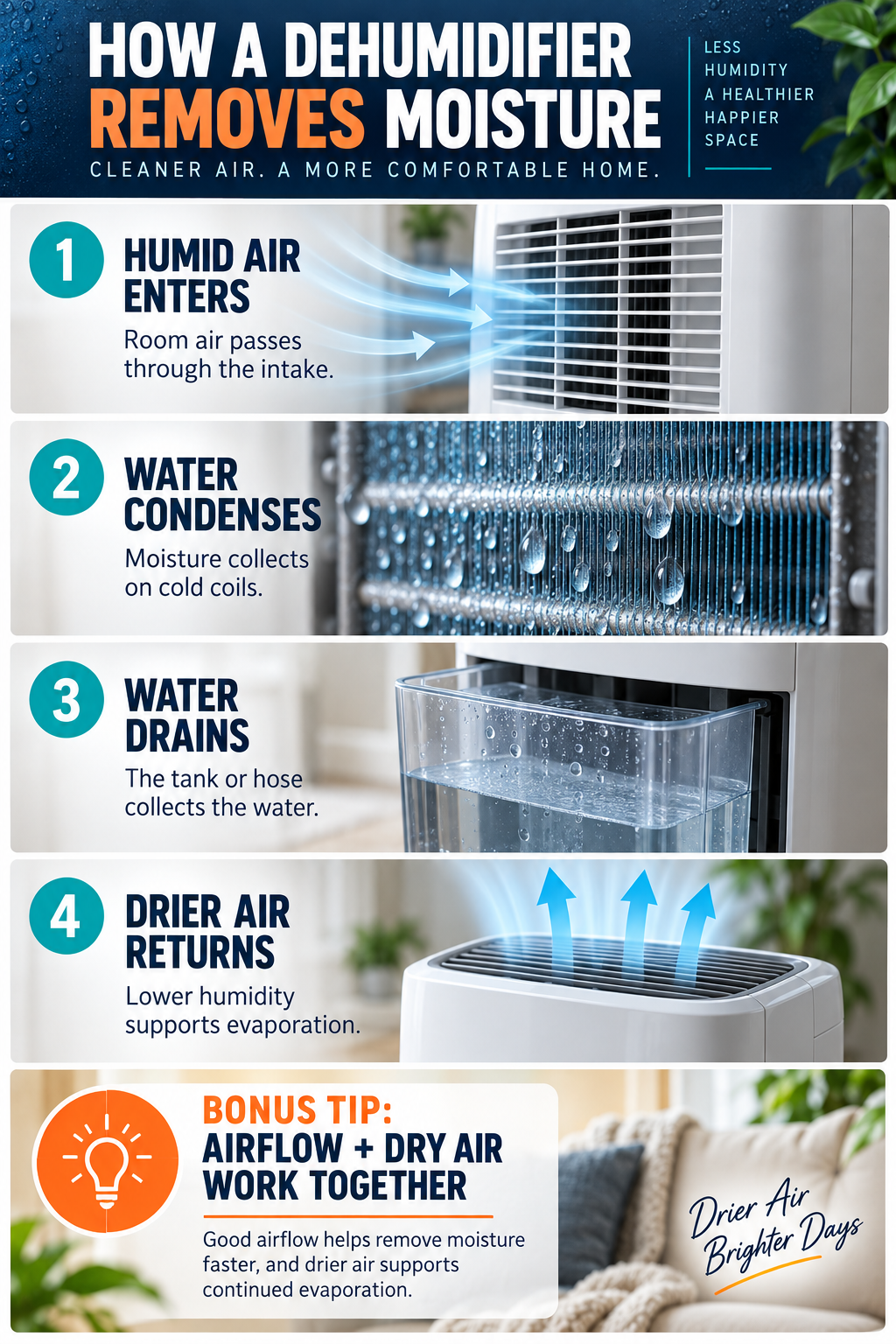
A dehumidifier works by pulling moist air across refrigerated coils to trigger condensation. This moisture extraction process collects water in a tank, while the resulting dry air is reheated and circulated back to reduce overall indoor humidity levels and prevent mold growth.
Title: Residential vs. Commercial Dehumidifiers
| Specification | Standard Residential Units | Commercial Restoration Units (LGR) |
| Water Removal (Per Day) | 30 to 50 pints | 130 to 200+ pints |
| Airflow Volume (CFM) | Low (150 – 250 CFM) | Extremely High (300 – 500+ CFM) |
| Primary Capability | Surface air comfort | Deep structural & textile drying |
| Operating Environment | Normal room temperatures | Highly effective in harsh, low-temp conditions |
⚙️ The Core Mechanics: How Moisture is Extracted
The Refrigerant Cycle Explained
Think of a dehumidifier like a specialized refrigerator that breathes. When you turn it on, a built-in fan creates a vacuum to draw in ambient air. This is where the physics takes over to protect your home.
The sequence is simple: Humid air is pulled in -> passes over super-cooled evaporator coils -> moisture hits the dew point and condenses -> liquid water drips into the bucket -> the remaining dry air is reheated -> warm, dry air is exhausted back into the room.
Desiccant vs. Refrigerant Systems
Most standard home units use this refrigerant cycle. However, desiccant systems operate differently. Instead of cooling the air, they use a chemical drying agent, like silica gel, to absorb moisture directly like a sponge.
We typically use refrigerants for daily humidity control, but desiccants are invaluable in freezing commercial environments where standard condensation coils would simply ice over.
Ultimately, thermodynamics dictates that vapor pressure will forcefully push trapped moisture from dense wood framing into this newly dried air if the humidity delta is steep enough.
🏠 Why Controlling Humidity Matters for Your Property
Protecting Textiles and Preventing Mold
High humidity doesn’t just feel sticky; it actively attacks your home. As an IICRC-certified professional, I see how excess ambient moisture constantly degrades the latex backing of expensive carpets and feeds microbial growth in soft furnishings.
I once lifted a beautifully maintained wool carpet for a deep clean, only to find the plywood subfloor beneath it entirely compromised by dry rot. The homeowner’s small dehumidifier couldn’t pull the moisture through the dense textile pad, leaving the structural wood to quietly decay underneath.
Microbiologically speaking, fungal spores remain dormant indefinitely until the structural moisture content of a building material surpasses the critical 16% threshold required for hyphal colonization.
🚨 When to Call in Commercial-Grade Equipment
The Limits of Household Dehumidifiers During a Flood
A hardware store dehumidifier is great for a slightly damp basement, but it completely fails during a true water intrusion event. These small units simply lack the airflow and extreme coil temperature drops required to extract deep moisture.
Last winter, I watched a homeowner try to dry flooded structural framing with two bedroom dehumidifiers. Because they couldn’t generate enough dry air to break the carpet pad’s surface tension -> the water wicked directly into the drywall baseplates -> the baseboards warped irreparably.
When water breaches your home, we use commercial Low Grain Refrigerant (LGR) units to aggressively alter the vapor pressure of the room, forcing moisture out of dense materials.
When structural timber reaches its fiber saturation point at around 28% moisture content, only extreme low-grain mechanical dehumidification can reverse the cellular expansion before permanent warping occurs.
🛠️ Comprehensive Case Study: Saving a Soaked Subfloor
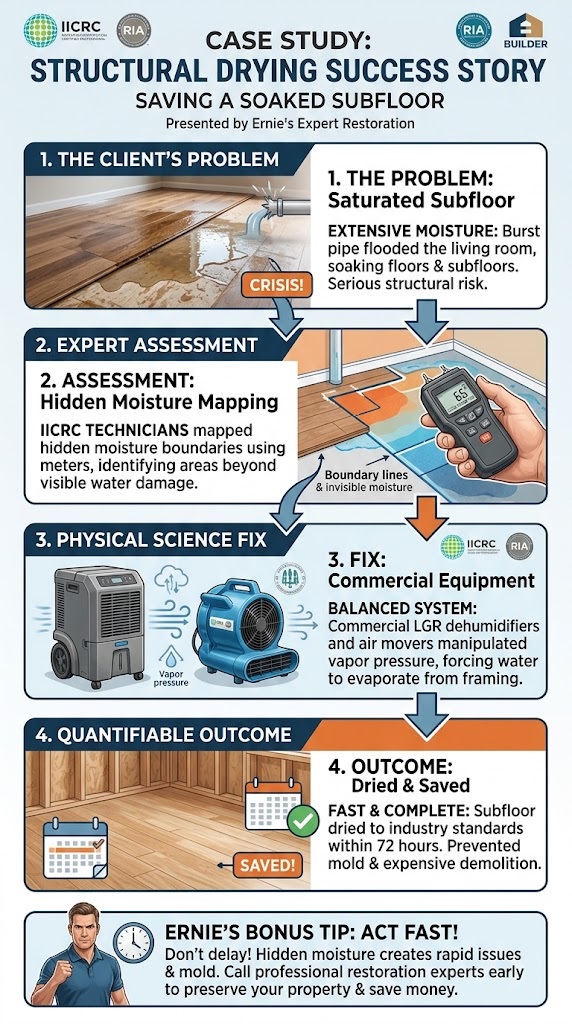
The Client’s Problem: A severe burst pipe saturated a living room’s engineered hardwood, the underlying synthetic pad, and the structural wooden subfloor beneath it.
The Assessment: Utilizing penetrating moisture meters, we mapped the hidden moisture boundaries. The water had migrated far beyond the visible water line, soaking deeply into the structural floor joists.
The Physical Science Fix: We deployed LGR dehumidifiers paired with centrifugal air movers. High-velocity air broke the moisture barrier -> ambient vapor pressure plummeted -> trapped water evaporated from the subfloor -> LGR units condensed and extracted the moisture.
The Quantifiable Outcome: The subfloor and surrounding framing were completely dried to industry standards within 72 hours. This halted secondary mold damage and saved the client thousands in full-scale demolition costs.
By mathematically balancing the evaporation rate with the specific heat capacity of the surrounding air, we successfully prevented the catastrophic delamination of the engineered floorboards.
💡 Frequently Asked Questions
Should a dehumidifier run constantly?
Not necessarily. Most modern units have built-in hygrostats. You should set your target relative humidity (usually between 45% and 50%), and the machine will automatically cycle on and off to maintain that sweet spot.
Do dehumidifiers use a lot of electricity?
Commercial LGR units draw significant power due to their high-capacity compressors. However, running a powerful unit for 72 hours is vastly cheaper than paying a builder to replace rotting floor joists months down the line.
Where is the best place to put a dehumidifier in a room?
Placement dictates efficiency. Position the unit centrally, away from walls or furniture. Optimal airflow ensures the machine can accurately read the room’s humidity -> pull in damp air efficiently -> distribute dry air evenly.
Remember that in building science, maintaining a sealed thermal envelope always dictates how effectively any mechanical dehumidification system can manage a room’s internal vapor drive.
📌 Key Takeaways
-
Dehumidifiers rely on a simple but powerful refrigeration cycle to pull moisture from the ambient air.
-
Maintaining proper indoor humidity protects both your health and the structural integrity of your property’s building materials.
-
For significant water intrusion, residential units are insufficient; structural drying requires commercial-grade LGR extraction and professional oversight.
Ultimately, the long-term structural integrity of any building relies heavily on managing latent heat and vapor drive before condensation can accumulate within the thermal envelope.
Related guides
For persistent dampness, wet carpet, or a large drying job in Auckland, hire a commercial dehumidifier and drying-fan package.
The moisture-removal cycle in plain English
A compressor dehumidifier draws humid room air across cold coils. Water vapour condenses into liquid water, which drains to the tank or hose. The drier air then passes back into the room, allowing moisture in surfaces and fabrics to evaporate more readily. A desiccant model uses a moisture-absorbing material instead, which can be useful in cooler conditions depending on the model.
Why airflow matters as much as extraction
Wet carpet, timber and plasterboard do not dry simply because a dehumidifier is nearby. Air needs to move across the material so moisture can leave the surface and enter the air. The dehumidifier then removes that airborne moisture. This is why commercial drying commonly uses air movers with a suitably sized dehumidifier and checks progress with moisture readings.
For everyday condensation, a domestic unit can maintain a healthy range. For a leak or wet building material, treat the source, use safe airflow and measure the drying result rather than relying on touch alone.