
A dehumidifier doesn’t just “suck up water”—it acts as a powerful atmospheric engine that fundamentally alters the vapor pressure of your environment to protect your health, save your textiles, and preserve your property’s structural integrity.
A dehumidifier actively reduces indoor humidity by pulling in damp air, cooling it to extract liquid condensation, and releasing dry, warm air back into the room. This essential process controls relative humidity, prevents mold growth, and accelerates structural drying after unexpected water damage.
⚙️ The Mechanics of Moisture Removal
Most people think of drying as just adding heat. As a builder and IICRC-certified restorer, I tell clients it is actually about managing the atmosphere. If we lower the humidity in the air, the dry air acts like a sponge, pulling moisture out of your wet materials.
Refrigerant vs. Desiccant Technology
Refrigerant dehumidifiers pull air over freezing coils to create condensation -> water drips into a bucket -> dry air exhausts out. Desiccant models use chemical silica to absorb moisture directly. We use heavy-duty refrigerant units, known as LGRs, for massive flood recovery jobs.
The Magic of Vapor Pressure
Water always seeks balance. High moisture in wet drywall wants to move into dry air. By aggressively dropping the room’s humidity, a commercial dehumidifier forces that trapped water out of the walls and carpets so we can physically extract it.
In thermodynamic terms, this manipulated vapor pressure differential aggressively accelerates the evaporation rate deep within the timber framing.
🦠 The Hidden Threat of Secondary Damage
When a washing machine overflows, you see the surface water. What you don’t see is the moisture wicking up behind the skirting boards. I have seen hundreds of homes where DIY cleanup led to rotting wall framing just days later.
Trapped Water in Carpets and Underlay
Wool carpet absorbs up to 30% of its weight in water before it even feels wet. The foam underlay traps even more. Without aggressive dehumidification, that hidden moisture degrades the latex backing, causing irreversible delamination and ruining the flooring.
The 72-Hour Mold Window
Moisture left unattended is a ticking clock. High humidity environment -> fungal spores activate -> catastrophic mold colonies bloom. You typically have 72 hours before secondary damage becomes a permanent health hazard, requiring a complete demolition rather than a simple extraction.
From a microbiological perspective, maintaining ambient humidity above 60% provides the exact moisture activity level required for Aspergillus spores to rapidly colonize porous substrates.
🚫 Why DIY Drying Usually Fails After a Flood
Opening windows and running a $200 hardware store dehumidifier won’t save a flooded lounge. Consumer units lack the physical airflow required to strip moisture from dense materials. This creates a false sense of security while rot sets in below the surface.
Last winter, a homeowner tried drying a soaked hallway with a tiny bedroom unit. The carpet felt dry on top, but as a builder, I immediately checked the MDF trim. It had swelled and blown apart because the weak unit couldn’t pull moisture from the dense wood fibers.
Consumer vs. Commercial Dehumidifiers
Wood is an anisotropic material, meaning it expands unevenly as it absorbs water, which is why inadequate DIY drying inevitably leads to warped flooring and blown architectural trim.
🏢 The Professional Advantage: Commercial Dehumidifier Hire
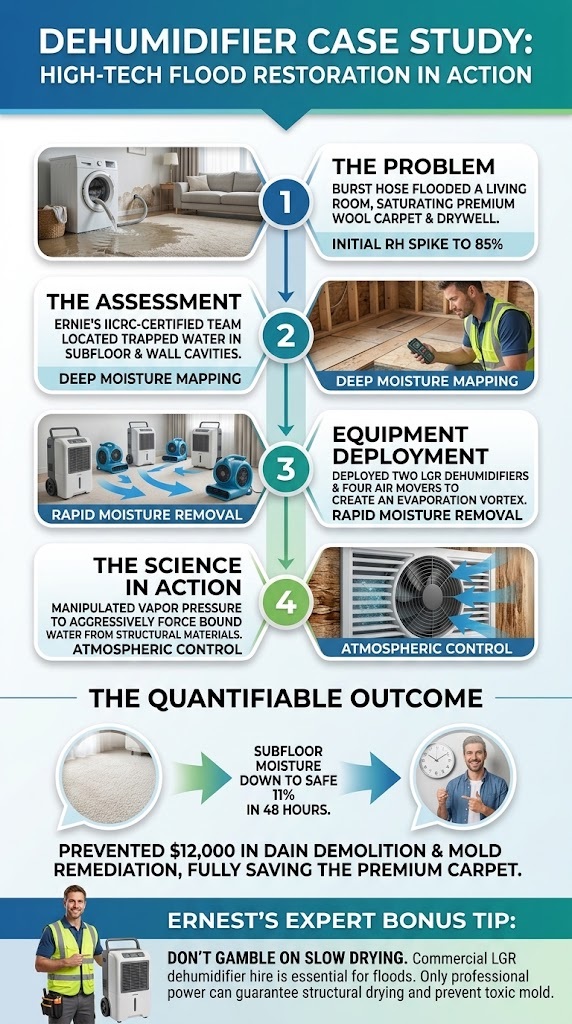
True structural drying requires mathematical precision. We map the moisture with thermal imaging, then install commercial LGR dehumidifiers alongside high-velocity centrifugal air movers. This creates a powerful vortex: high-speed air strips moisture from the surface -> the LGR unit captures it -> dry air is exhausted.
We recently responded to a flooded living room with 40 square meters of soaked premium wool carpet. Water had wicked straight into the drywall baseplates. Using penetrating moisture meters, we found the timber subfloor was saturated and indoor humidity had spiked to 85%.
We deployed two LGR dehumidifiers and four air movers. This violent manipulation of vapor pressure forced the water out of the timber and wool. Within 48 hours, the materials hit a safe 11% moisture content, saving the client an estimated $12,000 in structural tear-out.
This rapid phase change from liquid to vapor demands immense latent heat of vaporization, a thermodynamic energy transfer that only commercial-grade compressors can sustain efficiently.
❓ Frequently Asked Questions
How long does a dehumidifier take to dry out a flooded room?
It depends on the amount of water, materials affected, room conditions and equipment setup. With commercial dehumidification and air movement, many standard residential drying projects reach their dry standard in roughly 3 to 5 days; moisture readings, rather than surface feel, determine when drying is complete.
Will a dehumidifier dry wet carpet padding?
A dehumidifier is only one part of drying wet carpet and underlay. First, remove as much liquid water as possible; then use controlled dehumidification and air movement to reduce the remaining moisture. Whether underlay can remain depends on water category, saturation, odour and its condition after assessment.
What size dehumidifier do I need for water damage?
There is no single dehumidifier size for every water-damage job. Equipment capacity and the number of air movers should be selected from the volume of the affected area, the materials involved, the water load and moisture readings. Flooded carpet, wall linings or framing commonly require commercial equipment rather than a household unit.
Achieving an equilibrium moisture content below 15% in timber framing permanently halts the enzymatic decay processes of wood-rotting fungi.
🔑 Key Takeaways
-
Dehumidifiers remove moisture by controlling condensation and manipulating vapor pressure.
-
Consumer units are built for ambient comfort, not for crisis management or flood restoration.
-
Deep stains, flooded carpets, and wet drywall require commercial-grade LGR hire to ensure proper structural drying and prevent toxic mold.
Ultimately, preserving the structural shear strength of your wall framing relies entirely on rapid, mechanically enforced moisture removal.
Related guides
For persistent dampness, wet carpet, or a large drying job in Auckland, hire a commercial dehumidifier and drying-fan package.
A simple drying plan for a wet room
Drying works when wet materials can release moisture, air carries that moisture away, and the room air is kept dry enough for evaporation to continue. Start by stopping the water source and removing loose water. Then use appropriate airflow across wet surfaces, a correctly sized dehumidifier to remove airborne moisture, and repeated moisture readings to confirm progress.
Do not rely on surface dryness
Carpet, underlay, skirting and wall linings can stay wet below the surface. Check the edges of the affected area and compare readings with unaffected material. If moisture is trapped in construction materials, commercial equipment and professional assessment may be needed before the room is closed up or refurnished.