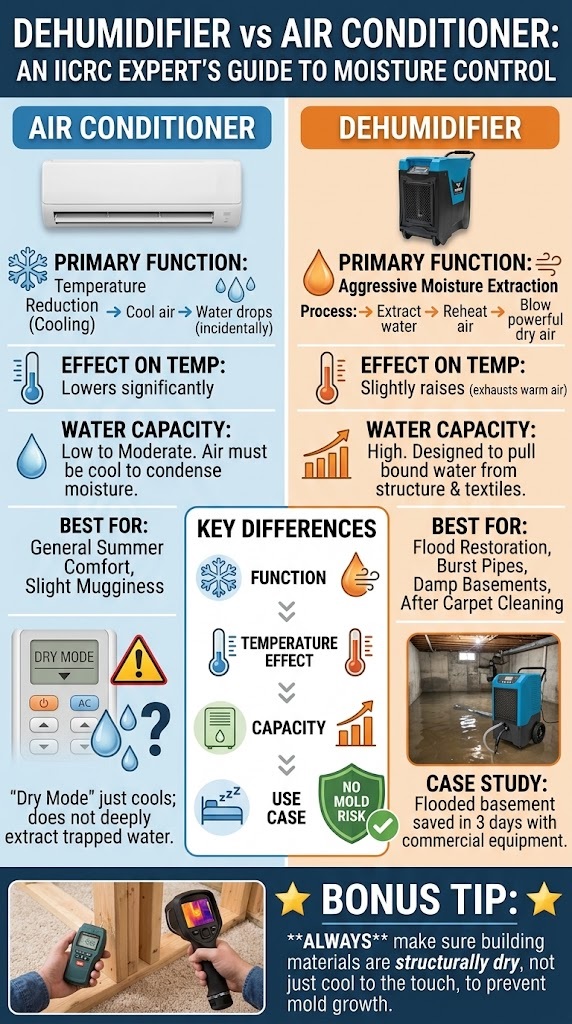
While air conditioners provide comfort by incidentally removing some moisture as they cool, true dehumidifiers are purpose-built to aggressively extract water from deep within your home’s structure—a critical distinction when you need to prevent mold or recover from a water leak.
The main difference between a dehumidifier vs air conditioner is their primary purpose. An air conditioner primarily cools indoor spaces while incidentally removing airborne moisture, whereas a commercial dehumidifier aggressively extracts excess water to safely control humidity and prevent structural water damage.
Key Differences: Dehumidifier vs. Air Conditioner
| Feature | Air Conditioner | Dehumidifier |
| Primary Function | Temperature reduction (Cooling) | Aggressive moisture extraction |
| Effect on Room Temp | Lowers temperature significantly | Slightly raises temperature (exhausts warm, dry air) |
| Water Removal Capacity | Low to Moderate (Surface air only) | High (Pulls deep-set moisture from materials) |
| Best Use Case | Summer comfort, slight humidity control | Flood restoration, damp prevention, carpet drying |
🧪 The Core Science: How They Handle Moisture Differently
How Air Conditioners Use Cooling to Dehumidify
Air conditioners pass warm indoor air over freezing cold evaporator coils. This process causes airborne moisture to condense as a simple byproduct of the cooling mechanism.
Warm air hits coils -> condensation forms -> cooler, slightly drier air blows out into the room.
However, the system shuts off once the room reaches the target temperature. This leaves the deeper, underlying humidity completely unaddressed.
How Dehumidifiers Target Deep-Set Moisture
Dehumidifiers are built purely to strip water. They also use cold coils to pull moisture, but they actively reheat the air before expelling it.
This process drops the room’s relative humidity significantly faster and forces continuous operation. This constant, extremely dry airflow pulls bound water out of dense materials like textiles and timber.
In thermodynamics, raising the ambient air temperature increases its capacity to hold water vapor, pulling moisture from a saturated solid state back into an airborne gaseous state for rapid extraction.
🛠️ Dehumidifier vs Air Conditioner: Which Do You Need?
When to Rely on Your AC or Heat Pump
Use your AC for standard summer comfort and general climate control. If your home just feels a bit muggy, the AC is perfectly fine.
My wife Emerald knows the drill when our Auckland home gets sticky in February—we just flip the heat pump to cooling mode. But as a builder and IICRC cleaner, I know chilling the air won’t pull spilled water out of floor joists.
When You Must Hire a Commercial Dehumidifier
You need commercial equipment following burst pipes, flooding, or heavy professional carpet cleaning.
I recently ripped up a client’s ruined carpet after a minor leak. The textile fibers felt dry, but my builder instincts told me to check the baseboards.
Wet carpet pad -> swollen MDF skirting -> ruined framing timber. Only a commercial dehumidifier stops that chain reaction.
The porosity of standard framing timber means it will wick moisture directly from a wet carpet underlay until equilibrium is reached, compromising the structural load path if dry rot sets in.
⚠️ Why “Dry Mode” on Your AC Isn’t Enough for Water Damage
Your air conditioner’s “Dry Mode” merely slows the fan down while cooling. It does not actively seek out deep-set water.
Relying on it during a flood is dangerous. You end up chilling the trapped water inside your carpets and drywall without actually extracting it, which is a recipe for disaster.
Case Study: The Auckland Basement Burst Pipe
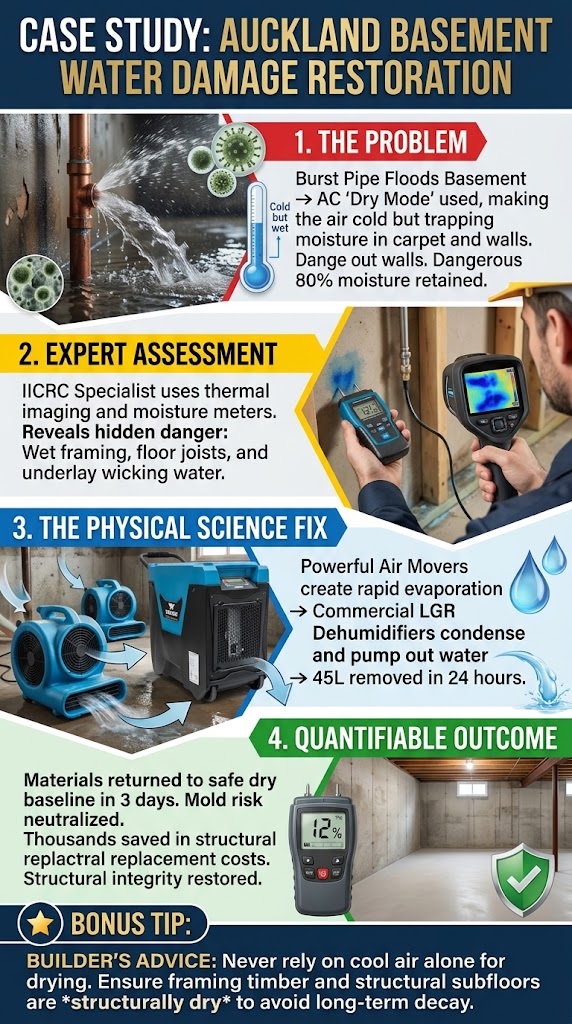
The Client’s Problem: An Auckland homeowner suffered a basement pipe burst. They tried drying the space using a standard AC on “Dry Mode.” After 48 hours, a severe, musty mold odor overpowered the room.
The Assessment: I arrived on-site with penetrating moisture meters and thermal imaging. The ambient air felt cool and dry to the touch.
However, the carpet underlay and timber framing still retained a dangerous 80% moisture content.
The AC chilling the water -> accelerated secondary mold damage -> highly toxic indoor air quality.
The Physical Science Fix: We deployed two Low Grain Refrigerant (LGR) dehumidifiers alongside high-velocity axial air movers.
Air movers disrupt the moisture boundary layer -> water evaporates into the air -> LGR dehumidifiers rapidly condense it -> pumps expel 45 liters down the drain in 24 hours.
The Quantifiable Outcome: The timber framing and carpet padding returned to a dry standard baseline of 12% moisture within 3 days. We saved the homeowner thousands in structural replacement costs and neutralized the mold risk entirely.
Microbiologically, Stachybotrys chartarum (black mold) requires consistent moisture and cellulose-rich food sources like drywall paper to colonize, making rapid, aggressive extraction the only valid prevention method.
❓ Frequently Asked Questions
Can a dehumidifier cool a room?
A dehumidifier is designed to remove moisture, not actively cool a room like an air conditioner. It can also add a small amount of heat to the space while operating.
Do I need a dehumidifier if I have an air conditioner?
It depends on the problem. Air conditioning can remove some moisture while cooling, but a dehumidifier may be useful where humidity remains high, indoor laundry is drying, or a leak or damp building material needs a separate drying plan.
How long should you run a dehumidifier each day?
Run time depends on the unit, the humidity level, the room and the target result. For a water-damage drying project, use measured humidity and material moisture—not a fixed hourly rule—to decide when drying can stop.
Identify a serious leak -> install commercial dehumidifier -> run 24/7 for 3 to 5 days. You must keep it running until moisture meters confirm the structure is dry.
Operating industrial drying equipment within a closed building envelope relies on controlling vapor pressure differentials to force moisture out of hygroscopic materials without damaging them.
🎯 Key Takeaways
-
Air conditioners are for climate comfort; commercial dehumidifiers are for structural preservation.
-
Cool air does not equal dry materials.
-
Acting fast with the right commercial equipment is the only guaranteed way to stop mold growth and save your carpets after a flood.
The structural integrity of any residential home depends entirely on maintaining dry building materials to prevent the biological decay of load-bearing timber.
Related guides
For persistent dampness, wet carpet, or a large drying job in Auckland, hire a commercial dehumidifier and drying-fan package.
Choose by the problem you need to solve
| Your main problem | Usually the better tool |
|---|---|
| Summer cooling with some moisture removal | Air conditioner on dry mode may help. |
| Winter condensation in one closed room | Dehumidifier with a humidistat. |
| Wet carpet or water-damaged materials | Commercial dehumidifier plus controlled airflow. |
Dry mode on an air conditioner can remove some moisture, but its primary job is comfort cooling and its drainage, control and capacity differ by model. A standalone dehumidifier gives more direct humidity control in a room that does not need cooling. Check your appliance manual and measure room humidity before deciding whether either is helping.