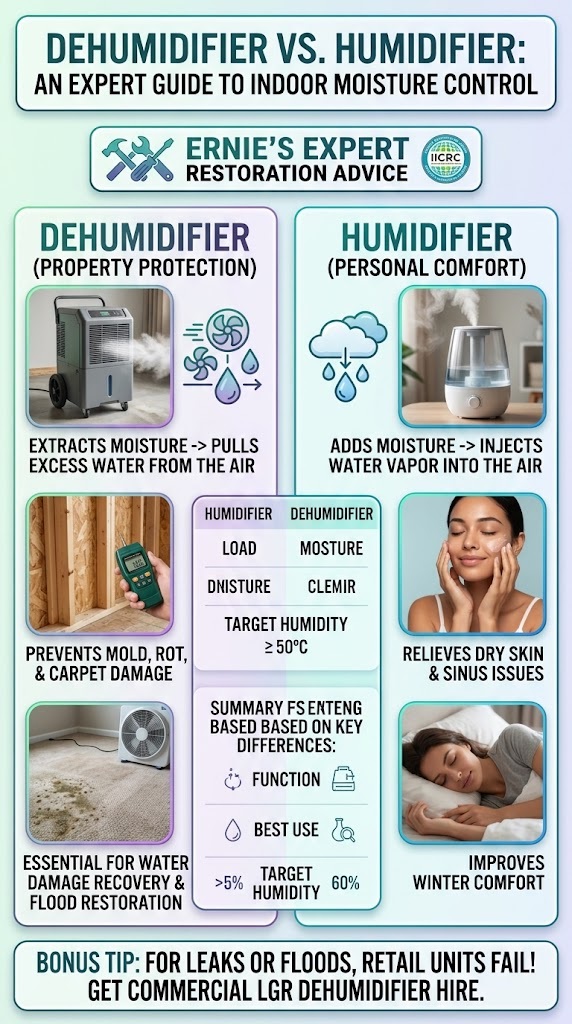
While a humidifier adds soothing moisture to combat dry winter air, a dehumidifier actively extracts dangerous excess water to protect your health, salvage your carpets, and defend your home’s structural integrity from rot and mold.
A humidifier adds essential moisture to dry environments to relieve respiratory issues and soothe dry skin. Conversely, a dehumidifier actively extracts excess water to prevent structural rot, eliminate mold growth, and safely regulate your property’s overall relative humidity levels after water damage.
Humidifier vs. Dehumidifier: Core Differences
| Feature | Humidifier | Dehumidifier |
| Primary Function | Adds moisture to the air | Extracts moisture from the air |
| Best Used For | Dry skin, winter air, respiratory relief | Condensation, flood recovery, mold prevention |
| Target Humidity | Increases to 30% – 50% | Decreases to 30% – 50% |
| Restoration Value | None | Critical for drying carpets and building materials |
💧 What is a Humidifier and When Should You Use One?
Health and Comfort Benefits
Think of a humidifier as your personal comfort dial during the dry winter months. When you turn on the heater, indoor air rapidly loses moisture. This appliance simply pushes water vapor back into the room to alleviate dry skin, scratchy throats, and irritated sinuses.
However, as a restoration expert, I have to be blunt: humidifiers have zero application in property maintenance or flood recovery. They are strictly for human comfort. Introducing unnecessary moisture into a standard New Zealand home often invites structural problems.
From a microbiological perspective, artificially inflating indoor moisture past 60% relative humidity creates the exact cellular conditions required for dormant mold spores to germinate on organic building materials.
🏗️ What is a Dehumidifier and Why is it Critical for Property Health?
Protecting Building Materials and Textiles
A dehumidifier is your frontline defense against property degradation. It actively pulls water out of the air. This prevents secondary water damage, stopping MDF skirting boards from swelling, timber framing from warping, and carpet backings from delaminating.
When we get called to a wet lounge in Mt Eden, my first instinct as a licensed builder isn’t just looking at the soggy carpet. I’m checking the moisture content of the timber bottom plate behind the Gib. Wet carpets are obvious -> hidden saturated framing is what ultimately ruins homes.
Residential vs. Commercial Dehumidifiers
Your standard hardware store dehumidifier is great for light window condensation. However, these retail units lack the power to salvage soaked materials. When a pipe bursts, you need professional LGR (Low Grain Refrigerant) technology to deeply extract bound water.
In structural carpentry, allowing saturated radiata pine framing to sit above 20% moisture content initiates fungal wood decay, permanently compromising the load-bearing capacity of the wall.
🔬 The IICRC Standard: The Science of Moisture Control
Understanding Psychrometry and Vapor Pressure
As IICRC-certified technicians, we don’t just guess when a room is dry; we use the exact science of psychrometry. We manipulate airflow and temperature to force moisture out of materials. High-velocity air movers strip the wet boundary layer off the carpet.
Next, we deploy LGR dehumidifiers to radically drop the humidity in the room. This creates a vapor pressure differential. The dry air acts like a sponge -> deeply trapped water is drawn out of the subfloor and into the air -> the dehumidifier captures it.
According to the laws of thermodynamics, moisture will always aggressively migrate from an area of high vapor pressure to an area of low vapor pressure until equilibrium is reached.
🚨 When to Skip DIY and Hire a Professional
Signs Your Moisture Problem Requires Commercial Extraction
Don’t rely on a small domestic dehumidifier if you spot warning signs of deep saturation. Musty odors, unexplained wet carpet patches, excessive condensation inside double glazing, and visible mold spores all indicate a moisture load far beyond a DIY fix.
If you’ve suffered a leak, you need commercial dehumidifier hire or a full restoration response. Extracting the water quickly saves your carpets and stops structural damage before it requires expensive demolition.
From a purely structural perspective, fast-drying saturated framing within 48 hours is the only guaranteed way to arrest the dimensional swelling that causes structural fasteners and nails to pop.
📋 Case Study: Saving an Auckland Home from Hidden Water Damage
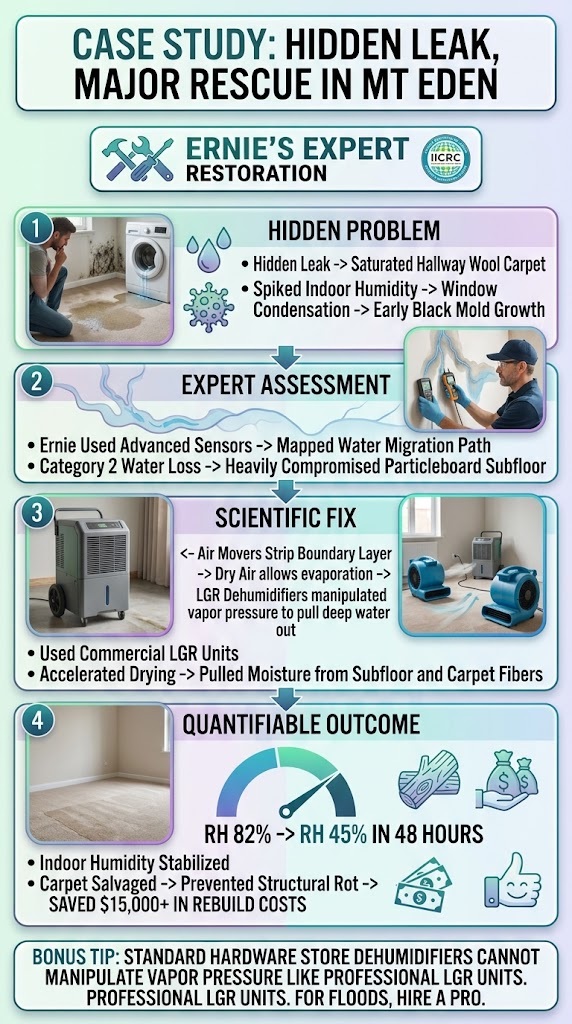
Let me share a recent job that perfectly illustrates the difference commercial equipment makes. A homeowner had a slow, hidden washing machine leak that went unnoticed for days.
-
The Client’s Problem: The leak saturated the hallway wool carpet and spiked indoor humidity -> heavy window condensation formed -> early onset of black mold appeared on the Gib board.
-
Ernie’s IICRC Assessment: I deployed professional thermo-hygrometers and penetrating moisture meters. We mapped the invisible water migration path -> diagnosed a Category 2 water loss -> identified a heavily compromised particleboard subfloor.
-
The Physical Science Fix: We installed high-velocity air movers paired with commercial LGR dehumidifiers. Air movers stripped the surface moisture -> LGR units manipulated the vapor pressure -> deeply trapped water physically migrated out of the timber and carpet fibers.
-
The Quantifiable Outcome: We dropped the indoor relative humidity from a dangerous 82% to a stable 45% within 48 hours. This scientific drying process salvaged the premium wool carpet and prevented structural timber rot.
This precise intervention saved the client from a $15,000+ demolition and rebuild project.
The rapid extraction of liquid water halts the mycelial growth phase of Stachybotrys chartarum (black mold), preventing its microscopic hyphae from permanently anchoring into the cellulose of the drywall.
❓ Frequently Asked Questions
-
Can you use a humidifier and dehumidifier in the same room?
No. Operating both simultaneously means they will constantly fight each other. The humidifier will add water vapor into the air -> the dehumidifier will immediately extract it -> both machines will waste significant electricity with zero benefit.
-
Do dehumidifiers help cool down a room?
They do not actually lower the temperature. In fact, dehumidifiers emit slight heat while running. However, because drier air allows your sweat to evaporate faster, a dehumidified room will naturally feel significantly cooler and more comfortable to your body.
-
What humidity level should a house be kept at?
The golden zone for optimal health and building safety is between 30% and 50% relative humidity. Staying in this range prevents winter condensation, starves dust mites, and completely eliminates the damp environment mold needs to survive.
🔑 Key Takeaways
-
Humidifiers are strictly for personal comfort in dry winter conditions; they provide absolutely no value for property maintenance or water damage recovery.
-
Dehumidifiers are essential tools for extracting excess water, managing condensation, and actively defending your property against structural rot and mold.
-
For leaks, floods, or major spills, retail dehumidifiers lack the required vapor pressure manipulation. Always consult an IICRC-certified professional for commercial equipment hire to save your carpets and framing.
Related guides
For persistent dampness, wet carpet, or a large drying job in Auckland, hire a commercial dehumidifier and drying-fan package.
Dehumidifier or humidifier: start with a measurement
These appliances solve opposite problems. A dehumidifier removes water from humid air; a humidifier adds moisture to air that is too dry. Use a hygrometer rather than symptoms alone. Condensation, musty smells and damp surfaces point toward excess moisture. Dry skin or static can occur for several reasons, so confirm the humidity before adding moisture.
Avoid solving the wrong problem
Adding humidity to a room that already has window condensation can worsen mould risk. Removing moisture from an already dry heated room can make comfort worse. Aim for a moderate, stable indoor range and address ventilation, leaks and insulation alongside the appliance choice.