Most homeowners waste money on undersized retail dehumidifiers that simply cannot prevent structural damage or mold after a water event. Here is how a certified restoration expert sizes the right machine to save your home.
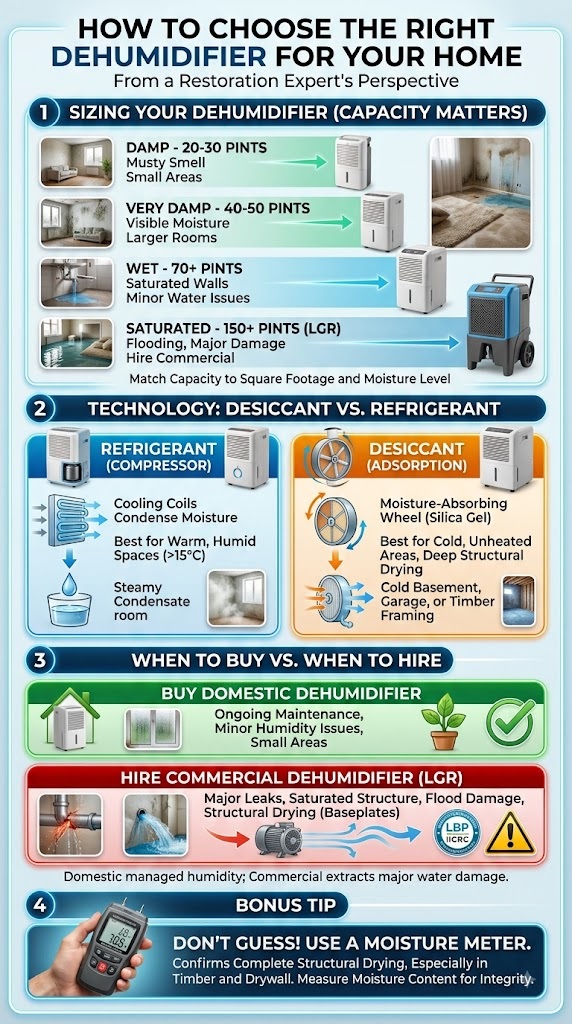
To choose the right home dehumidifier, accurately calculate the total room size and moisture level. Standard bedrooms need a small retail unit, while wet basements require a desiccant dehumidifier. For major leaks, always hire commercial water extraction to prevent structural mold growth.
Dehumidifier Sizing Chart by Moisture Level
| Room Condition | Square Footage | Recommended Capacity | Best Equipment Type |
| Damp (Musty smell in winter) | Under 500 sq ft | 20 to 30 Pints | Domestic Refrigerant |
| Very Damp (Visible condensation) | 500 – 1,000 sq ft | 40 to 50 Pints | Domestic Desiccant |
| Wet (Minor plumbing leak) | 1,000+ sq ft | 70+ Pints | XL Domestic / Prosumer |
| Saturated (Flooding/Wet Carpet) | Any Size | 150+ Pints (LGR) | Commercial Hire / Pro Restoration |
📏 Why Sizing Your Dehumidifier Matters (The IICRC Standard)
If you undersize your machine, it leaves bound moisture trapped deep in your textiles. This creates a hidden breeding ground for microbial growth. Oversizing a retail unit is equally frustrating. It short-cycles, spiking your electricity bill without actually drying the room.
When we get called to a wet lounge in Mt Eden, my first instinct as an LBP isn’t looking at the wet carpet. I immediately check the moisture content of the timber bottom plate. If that timber stays wet, your expensive carpet restoration won’t matter when the framing rots out.
In structural carpentry, capillary action dictates that water will always seek equilibrium, wicking upward from saturated textiles directly into dry framing timber.
⚙️ Desiccant vs. Refrigerant Dehumidifiers: What’s the Difference?
Choosing the wrong type of machine means fighting basic physics. Let’s break down the two main technologies so you don’t waste your money.
Refrigerant (Compressor) Units
These work exactly like your fridge. They draw in air, pass it over cold coils to create condensation, and drip the water into a bucket. They are fantastic for warm, humid living spaces but lose all efficiency once room temperatures drop below 15°C.
Desiccant Dehumidifiers
Instead of cooling the air, desiccants use a moisture-absorbing chemical wheel. They excel in cold environments or during deep structural drying. Because they don’t rely on condensation, they keep pulling water out of the air even in freezing winter conditions.
Thermodynamically speaking, desiccant wheels lower the vapor pressure of the surrounding air so aggressively that moisture is forcibly evaporated from porous materials into the atmosphere.
🏢 When to Buy Domestic vs. When to Hire Commercial
Buy a domestic dehumidifier for ongoing, mild atmospheric moisture control. They are perfect for taking the edge off winter condensation on your windows or keeping a musty wardrobe smelling fresh.
However, if you have a plumbing leak, you need to hire commercial Low Grain Refrigerant (LGR) units. Domestic machines simply cannot extract moisture from drywall baseplates or saturated carpets fast enough to prevent permanent damage.
From a microbiological perspective, dormant mold spores activate within 48 hours of moisture exposure, meaning rapid commercial drying is a biological race against time.
🔍 Comprehensive Case Study: The Hidden Leak
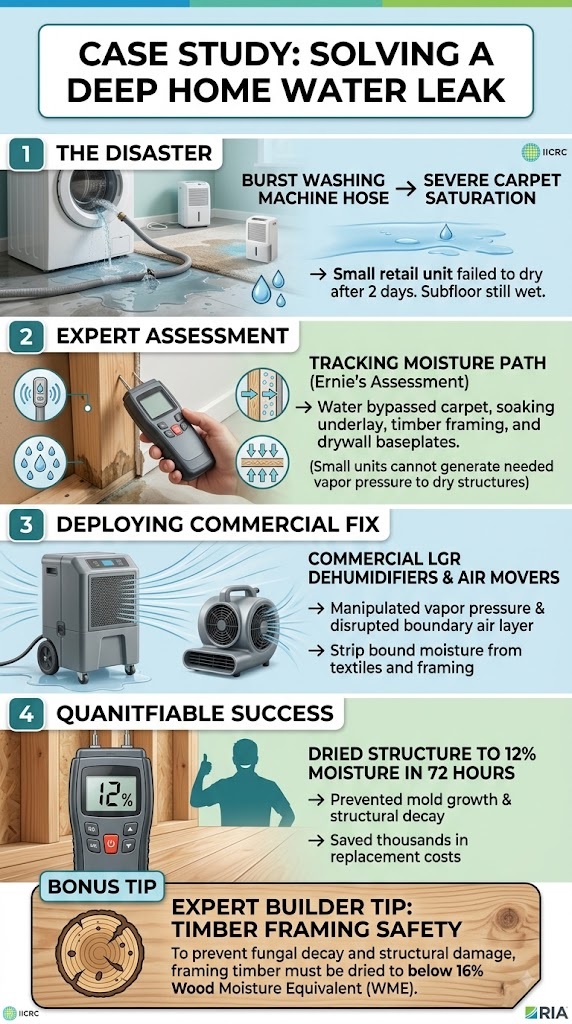
Our commercial partner, Mint home cleaning, contacted us about a residential property in Auckland. A burst washing machine hose had severely saturated the hallway carpet. A small retail dehumidifier ran for two days, but the subfloor remained soaking wet.
I arrived and used penetrating moisture meters to track the water’s migration path. The water had bypassed the carpet, soaking the underlay, and was wicking up into the timber framing. A domestic unit cannot generate enough vapor pressure to stop this.
We deployed two commercial-grade LGR dehumidifiers paired with high-velocity axial air movers. The physics are straightforward: High-speed air disrupts the boundary layer -> Evaporated moisture enters the air -> LGR units strip the moisture out.
We dried the structure down to a baseline 12% moisture content within 72 hours. This saved the homeowner thousands in drywall and flooring replacement costs while completely preventing secondary microbial growth.
In building science, returning framing timber to below 16% Wood Moisture Equivalent (WME) is the mandatory threshold to ensure structural integrity and halt fungal decay.
❓ Frequently Asked Questions
Can a regular home dehumidifier pull water out of wet carpet?
A household dehumidifier may help reduce humidity after water has been extracted, but it is usually not sufficient by itself for saturated carpet, underlay or building materials. A drying plan should begin with extraction and be guided by moisture readings rather than how the surface feels.
How long should I run a commercial dehumidifier after a water leak?
Many standard drying projects take roughly 3 to 5 days, but the duration depends on the water load, materials affected, temperature, humidity and air movement. Continue until moisture readings show the affected materials have reached an appropriate dry standard.
Do I need a desiccant or compressor dehumidifier for a cold, unheated room?
Desiccant dehumidifiers can perform well in cooler conditions, while refrigerant units often perform best in warmer spaces. The right choice depends on the actual temperature, size of the area, moisture load and manufacturer performance information.
The dew point dictates that warm air holds exponentially more moisture, making ambient temperature manipulation just as critical as mechanical extraction during any drying process.
💡 Key Takeaways
-
Match the pint-capacity of your dehumidifier to both the square footage of the room and the severity of the dampness.
-
Refrigerant dehumidifiers are best for warm rooms, while desiccants are essential for cold spaces.
-
Domestic dehumidifiers manage humidity; commercial LGR dehumidifiers extract physical water damage.
-
Always consult an IICRC-certified restoration expert if water has saturated your carpets or touched your drywall.
Ultimately, effective structural drying requires a holistic understanding of how water interacts with both engineered textiles and organic building materials under varying thermal conditions.
Related guides
For persistent dampness, wet carpet, or a large drying job in Auckland, hire a commercial dehumidifier and drying-fan package.
Choose a home dehumidifier in four steps
- Measure the problem: use a hygrometer and note when condensation or dampness occurs.
- Identify the source: check bathrooms, laundry, leaks, ventilation and cold surfaces.
- Match the unit to the space: use the manufacturer’s capacity guidance, allowing for persistent dampness and open-plan areas.
- Check the result: use the same readings over several days and adjust the target rather than running continuously without a plan.
When household capacity is not enough
A domestic unit is for humidity management. If underlay, timber, plasterboard or a concrete slab have been wet after a leak or flood, use a managed commercial drying approach with airflow and moisture measurements. That protects the material itself, not just the feel of the room.