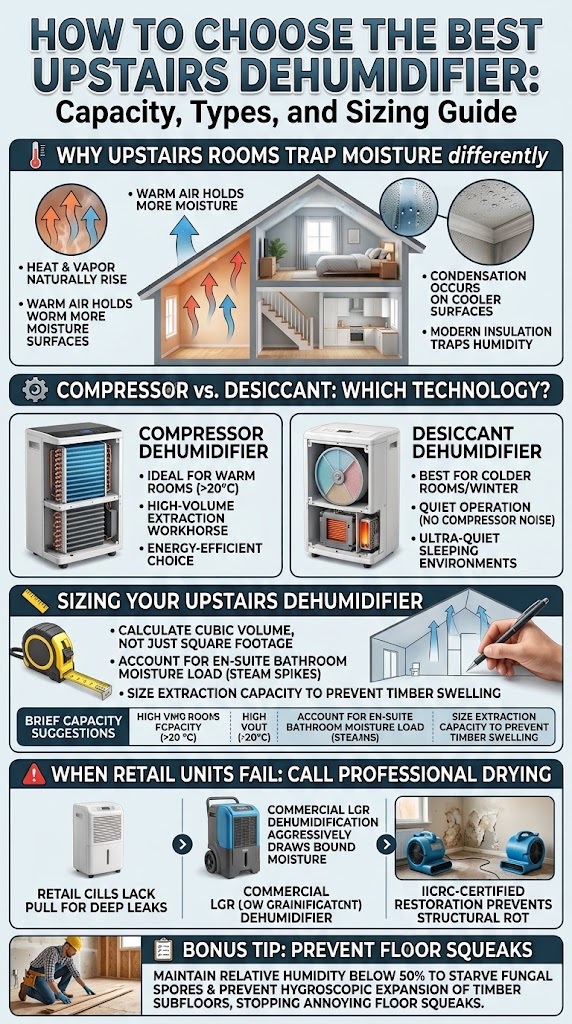
Because heat and vapor pressure naturally rise, upstairs environments trap moisture much differently than ground floors. This means standard dehumidifier advice could leave your second-story bedrooms vulnerable to toxic mold and structural wood rot.
To choose the right dehumidifier for upstairs, calculate the room’s square footage and moisture levels. A desiccant dehumidifier works best for cold rooms, while a compressor dehumidifier excels in warm upstairs bedrooms. Always ensure you have adequate moisture extraction capacity for second-story humidity.
🌡️ Why Upstairs Rooms Trap Moisture Differently
It comes down to simple physics. Warm air holds more moisture than cold air, and as heat rises from downstairs living areas, it carries vapor right up into your second-story bedrooms. Once that warm, humid air hits a cooler ceiling or windowpane, it rapidly condenses.
This rising vapor pressure is heavily impacted by modern roof and attic insulation. We build homes tight to keep heat in, which unfortunately traps humidity right where you sleep. Everyday living -> rising humidity -> condensation -> trapped moisture upstairs.
When I get called out to a musty second-story bedroom in Ponsonby, my first instinct as a builder isn’t just to check the carpet. I grab my moisture meter and test the structural timber framing around the windows, because trapped vapor always finds the coldest surface to attack first.
Ultimately, mitigating upstairs moisture isn’t just about air flow; it requires altering the thermodynamic dew point of the room to stop vapor from condensing into liquid on structural materials.
⚙️ Compressor vs. Desiccant: Which is Best for Bedrooms?
When to Use a Compressor Dehumidifier
Compressor units use a cold coil to draw moisture out of the air. They are fantastic workhorses, but they rely on the room being warm to function effectively.
If your upstairs bedrooms consistently stay above 20°C, a compressor unit is your most energy-efficient choice for high-volume moisture extraction.
When to Use a Desiccant Dehumidifier
Desiccant models use a moisture-absorbing wheel and a small internal heater. Because they don’t rely on cold coils, they are vastly superior for cooler climates or winter use.
They also operate without a noisy compressor. This makes desiccant units incredibly quiet, which is exactly what you want when running a machine inside a sleeping area.
Maintaining relative humidity below 50% with the right unit starves fungal spores of the ambient water vapor they need for cellular reproduction.
📏 Sizing Your Dehumidifier for Second-Story Spaces
Most homeowners make the mistake of buying a unit based solely on the square footage listed on the retail box. But upstairs rooms often feature high or vaulted ceilings. You must calculate the total cubic volume of air, not just the floor space.
You also have to account for the massive moisture load generated by en-suite bathrooms. Hot showers -> steam expansion -> rapid humidity spikes in the adjoining bedroom.
Upstairs Dehumidifier Sizing & Type Guide
| Condition | Room Size | Required Capacity | Ideal Technology |
| Damp feeling | Small bedroom | 10-12 Liters/day | Desiccant (<15°C) |
| Visible window condensation | Master en-suite | 16-20 Liters/day | Compressor (>20°C) |
| Musty odor/mold | Whole upper floor | 25+ Liters/day | Desiccant/Compressor combo |
Accurately sizing your extraction capacity prevents the hygroscopic expansion of timber subfloors, which causes those annoying upstairs floor squeaks when framing swells and rubs against the fixings.
🚨 When Retail Units Fail: The Shift to Structural Drying
Retail dehumidifiers are great for surface humidity, but they cannot save your home from a plumbing leak or water ingress. If you notice blistering paint, wet carpet underlay, or swollen floorboards, a store-bought unit simply lacks the pull to extract bound moisture.
This is exactly when you need to transition from retail solutions to our commercial dehumidifier hire and IICRC-certified flood restoration services. We use Low Grain Refrigerant (LGR) units to aggressively dry structural materials before rot sets in.
I recently handled a job in Epsom where a retail unit had been running for weeks over a damp carpet. By the time I pulled the textiles back, the flooring was ruined. As an IICRC technician, I can clean the fibers, but as a builder, I had to replace the rotted particleboard underneath.
LGR dehumidification is mandatory for deep leaks because it lowers the vapor pressure enough to physically pull bound water out of the timber’s cellular structure, preventing wet rot (Coniophora puteana) from compromising structural integrity.
📋 Case Study: The Hidden En-Suite Leak
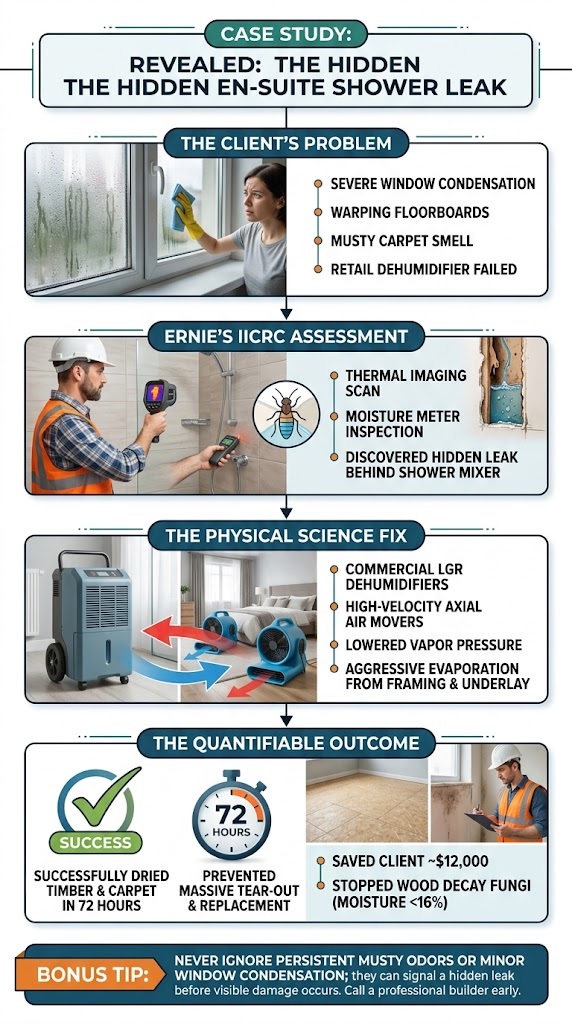
The Client’s Problem
A homeowner noticed severe condensation on their upstairs master bedroom windows. Soon, the timber floorboards began warping, and a musty smell permeated the carpeted hallway. Their retail dehumidifier was running 24/7 with zero improvement.
Ernie’s IICRC Assessment
I conducted a thermal imaging and moisture meter inspection. We discovered a slow, hidden micro-leak behind the en-suite shower mixer. The moisture was trapped deep inside the wall cavities and subfloor, far beyond the reach of standard equipment.
The Physical Science Fix
We deployed two commercial-grade LGR dehumidifiers alongside high-velocity axial air movers. Intense airflow -> lowered vapor pressure -> aggressive evaporation. We drew the bound moisture completely out of the structural timber framing and the dense carpet underlay.
The Quantifiable Outcome
We successfully returned the framing and textiles to their dry standard within 72 hours. By preventing a massive tear-out, re-framing job, and carpet replacement, we saved the client roughly $12,000 in repair costs.
Rapidly reducing the moisture content of the framing below 16% completely halts the enzymatic degradation of the wood by wood-decay fungi.
❓ Frequently Asked Questions & Key Takeaways
Should I leave my dehumidifier on all night in the bedroom?
Follow the unit’s instructions for unattended operation and make sure it has stable placement, clear airflow, safe drainage or tank shut-off, and an intact cable. A humidistat or timer can help avoid running it harder than necessary.
What size dehumidifier do I need for a 3-bedroom upstairs area?
Capacity should be selected from the upstairs volume, temperature, insulation, moisture source and humidity readings rather than bedroom count alone. A central location can help if the unit is intended to treat more than one room, but doors, airflow and noise also matter.
Can a dehumidifier cool down a hot upstairs room?
A dehumidifier does not provide active cooling like air conditioning and can add some heat while running. Reducing high humidity may still make the room feel less muggy.
Key Takeaways
-
Always match the technology (desiccant vs. compressor) to the average temperature of your upstairs rooms.
-
Size your unit based on cubic volume and the presence of en-suite bathrooms, not just floor space.
-
If you suspect a leak or notice warped materials, a retail unit will not save your home -> call for commercial dehumidification immediately.
Controlling the latent heat load through active dehumidification permanently alters the psychrometric balance of your upstairs living spaces, ensuring long-term structural and respiratory health.
Related guides
For persistent dampness, wet carpet, or a large drying job in Auckland, hire a commercial dehumidifier and drying-fan package.
Upstairs dehumidifier checklist
For an upstairs room, choose based on the room’s humidity and size, but put safety first. Use a level floor, keep the cable out of walkways and rely on a dependable full-tank shut-off unless a continuous hose can be routed safely to a proper drain. Never allow a hose to run where it can become a trip hazard or spill through the building.
Look beyond the bedroom itself
Upstairs condensation can be caused by bathrooms, indoor laundry, blocked ventilation or cold external surfaces. Run the unit with the room closed for a clear result, then compare humidity readings over several days. If carpet, ceiling linings or wall materials are wet, use a drying plan suitable for building materials rather than a small unit alone.