Protecting your garage from destructive moisture requires looking past square footage. You must calculate concrete slab vapor emission, thermal bridging, and vehicle-borne water loads before investing in a heavy-duty dehumidifier.
To choose the right garage dehumidifier, you must calculate your room’s exact square footage and moisture severity level, ensuring you select a refrigerant dehumidifier with a low-temperature operational rating and a continuous drainage hose setup to handle unconditioned environments effectively.
Garage Dehumidifier Sizing and Capacity Matrix
| Garage Condition & Size | Daily Moisture Removal Capacity | Recommended Dehumidifier Type | Key Features Required |
| Single car, dry climate (up to 200 sq ft) | 30 to 50 pints | Standard Refrigerant | Auto-restart, low temp sensor |
| Double car, damp/coastal (up to 500 sq ft) | 50 to 70 pints | Heavy-Duty Refrigerant | Continuous drain hose, washable filter |
| Fully sealed, unheated double garage | 70 to 90 pints | Low-Temp Commercial Unit | Hot gas defrost, internal condensate pump |
| Flooded or severe restoration site | 100+ pints | Industrial LGR Dehumidifier | Digital humidistat, heavy-duty wheels |
🌧️ Understanding Garage Environments and Moisture Sources
The Impact of Concrete Slab Seepage
Most garages sit on unsealed concrete. That slab acts like a permanent sponge for capillary moisture. Vapor pressure differentials drive ground moisture upward -> the slab saturates -> moisture transfers directly into your stored cardboard boxes and timber framing.
Vehicle-Borne Water and Thermal Bridging
Think about your daily driver. Rain, snow, and slush brought inside drastically increase the latent heat load. The lack of wall insulation in most garages causes rapid condensation cycles during seasonal temperature drops.
When we get called to a wet garage conversion in Auckland, my first instinct as a builder isn’t checking the carpet tiles. It’s pulling out the moisture meter to test the timber bottom plate for rot before I even look at the textiles.
In thermodynamics, water vapor will always migrate from areas of high pressure to low pressure, relentlessly attacking cold, uninsulated surfaces.
⚙️ Key Technical Factors When Sizing a Garage Dehumidifier
Temperature Ratings and Defrost Mechanisms
Standard indoor refrigerant units will simply freeze up and fail in unheated garages below 18 degrees Celsius. You need equipment built for cold environments. Otherwise, the coils get too cold -> ice builds up -> the compressor stalls.
The solution is a hot gas defrost system. This diverts warm refrigerant back through the cold coils, melting the ice fast. It’s a non-negotiable feature for reliable cool-climate performance.
Pint Capacity and Airflow (CFM)
Sizing requires matching your cubic footage and moisture severity to daily extraction ratings. A tiny unit in a double garage will just burn out its motor trying to keep up.
You also need adequate cubic feet per minute (CFM) air movement. Good airflow pushes dry air around stored vehicles -> sweeps away boundary layer moisture -> pulls damp air back into the machine.
Fungi require a sustained moisture content above 20 percent in organic materials like timber framing to metabolize and colonize successfully.
🔧 Installation and Drainage Best Practices
Continuous Drainage vs. Manual Emptying
Nobody wants to empty a water bucket twice a day. Gravity drainage or built-in condensate pumps are absolutely mandatory for unattended operation. If the bucket fills up -> the float switch trips -> the machine shuts off right when you need it most.
Strategic Placement for Optimal Air Circulation
Position the unit centrally or near high-humidity zones. Keep it away from obstruction barriers like walls or stacked boxes. Proper placement ensures the machine processes the entire volume of the room efficiently.
From an IICRC restoration standpoint, we never place a commercial hire dehumidifier in a dead corner. As a builder, I look at the framing layout to ensure we are pushing dry air parallel to the joists and wall cavities for maximum structural drying.
The structural integrity of a building envelope depends entirely on preventing interstitial condensation within the wall assemblies.
📊 Comprehensive Case Study: The Winter Garage Rescue

The Client’s Problem:
A homeowner noticed severe condensation, rusted tools, and musty odors ruining stored household items inside an uninsulated double garage during a cold, wet winter.
Ernie’s IICRC Assessment:
I conducted a psychrometric evaluation and recorded a relative humidity of 85 percent. I identified a lack of vapor barrier under the concrete slab, combined with severe thermal bridging from uninsulated exterior walls.
The Physical Science Fix:
We deployed a commercial low-grain refrigerant (LGR) dehumidifier from our equipment hire fleet. Equipped with an internal condensate pump, it rapidly dropped the vapor pressure -> pulling the relative humidity down to a safe 45 percent.
The Quantifiable Outcome:
Within 72 hours, the structural moisture content stabilized. Active condensation ceased entirely, and the client successfully preserved their stored assets without needing our extensive flood restoration services.
By manipulating the psychrometric conditions, we artificially increased the vapor pressure differential, forcing bound water out of the hygroscopic building materials.
❓ Closing Architecture
People Also Ask (PAA) FAQs
Can I use a regular indoor dehumidifier in my unheated garage?
It depends on the temperature range and the unit’s specifications. Some refrigerant models lose capacity in cooler conditions, while low-temperature or desiccant equipment may be better suited. Check the manufacturer’s operating range before using any unit in an unheated garage.
What size dehumidifier do I need for a 2-car garage?
There is no single capacity for every two-car garage. Consider the room volume, temperature, insulation, water entry, ventilation and measured humidity; a persistent moisture source should be fixed rather than only treated with a larger unit.
Should I run a garage dehumidifier 24/7?
Use the unit according to its instructions and set a suitable humidity target where it has a humidistat. Continuous operation may be appropriate during a specific drying project, but routine use should be based on humidity readings, drainage arrangements and the underlying cause of dampness.
Key Takeaways
-
Garages require specialized low-temperature dehumidifiers due to unconditioned thermal swings and slab moisture emission.
-
Accurate sizing depends on moisture severity and cubic volume, not just simple square footage.
-
Professional-grade equipment hire ensures immediate, heavy-duty moisture mitigation for severe residential or commercial challenges.
Related guides
For persistent dampness, wet carpet, or a large drying job in Auckland, hire a commercial dehumidifier and drying-fan package.
Garage moisture: choose capacity after finding the source
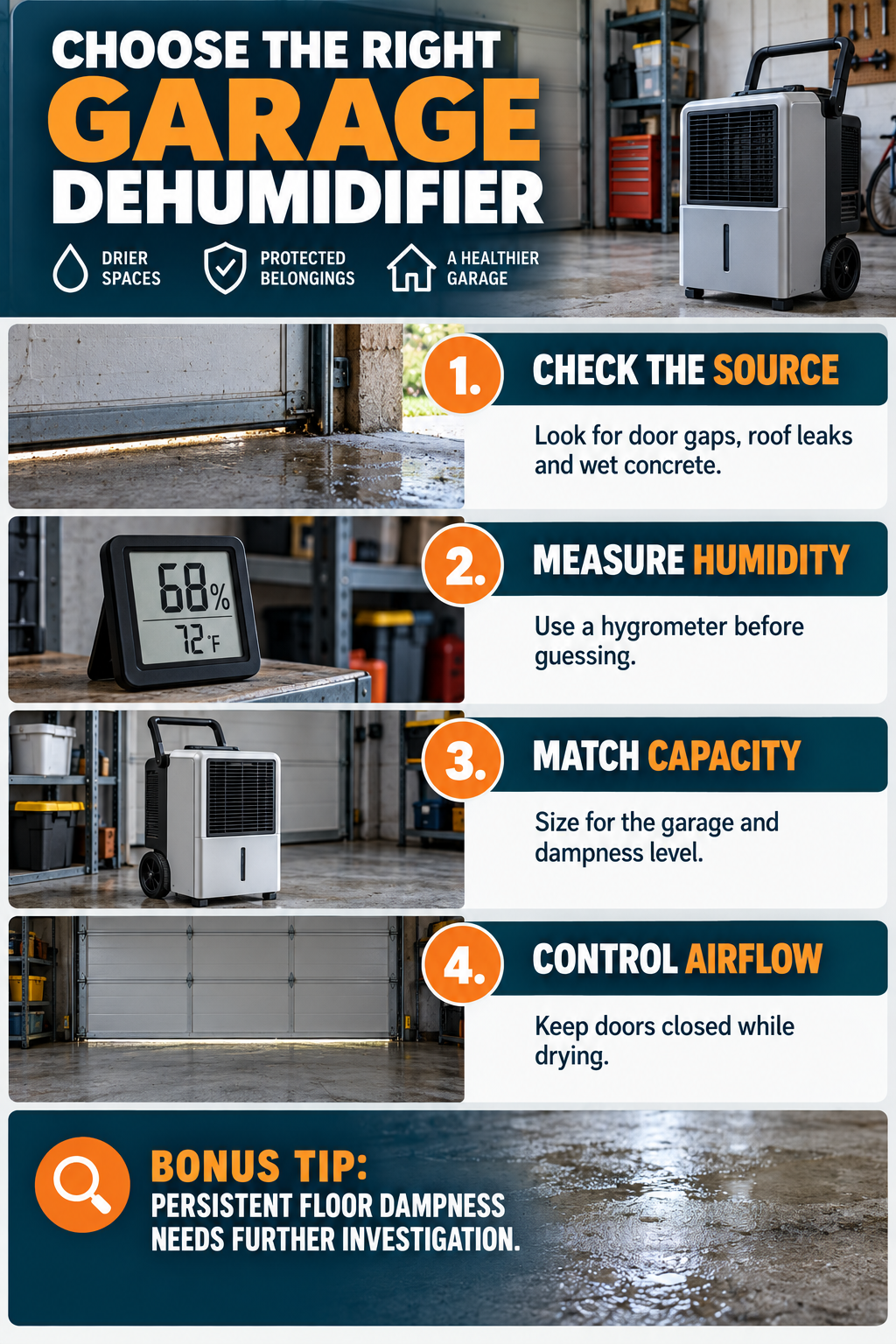
Garages can be difficult because they are often cold, poorly insulated and opened frequently. Before sizing a unit, check for water entering under doors, leaking roofs, damp concrete, stored wet vehicles and poor ventilation. A dehumidifier works more effectively once obvious water entry is controlled.
How to use a garage dehumidifier well
- Place it on a level surface with clear airflow and keep doors closed while treating the space.
- Use a hygrometer to track whether humidity is actually reducing.
- Choose a model rated for the garage temperature and the room size.
- Investigate persistent floor dampness, mould or material damage rather than extending run time indefinitely.