Stop guessing about under-house moisture and learn the exact scientific metrics builders and IICRC restoration pros use to size a crawl space dehumidifier that permanently stops mold and structural rot.
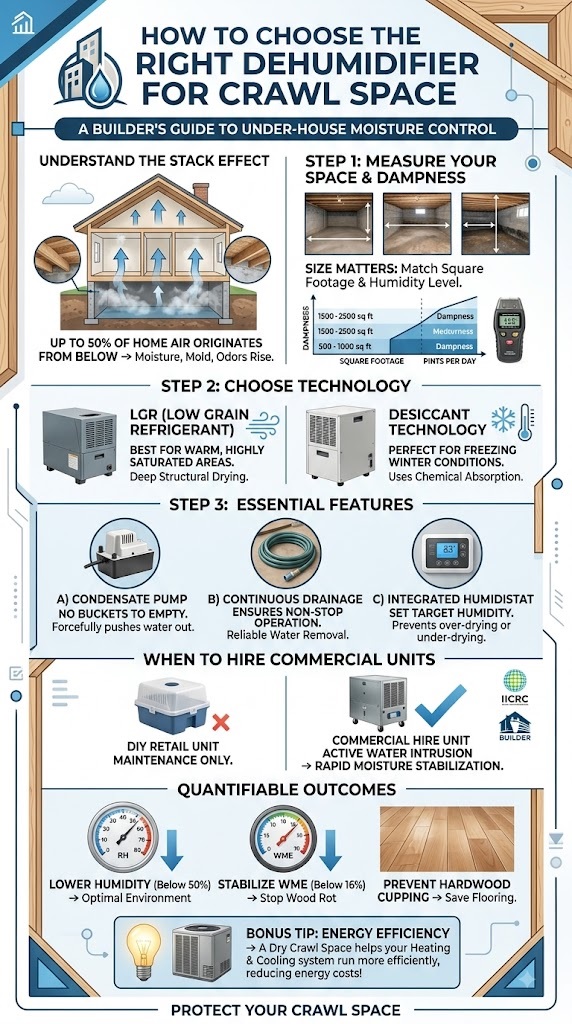
To properly size a crawl space dehumidifier, measure your subfloor square footage and check current humidity levels. A standard 1500 square foot area requires a commercial grade structural dehumidifier pulling at least 70 pints daily to prevent mold and subfloor wood rot.
🏠 Why Your Under-House Environment Dictates Home Health
When I get called out to a flooded lounge here in Auckland, my IICRC textile training kicks in first to save the carpets. However, the builder in me immediately goes under the house. Fixing surface damage is completely useless if your floor joists are quietly soaking up trapped moisture.
Up to 50% of the air on your first floor comes directly from below. This is known as the “Stack Effect.” Cold, damp air enters the subfloor -> warms up -> rises into your living space, pulling musty odors and mold spores right up with it.
To determine the actual risk to your home, professionals measure the Wood Moisture Equivalent (WME) of your framing, rather than just feeling the air.
From a microbiological standpoint, maintaining a Wood Moisture Equivalent below 16% is the absolute threshold required to permanently starve the mycelium networks of rot-inducing fungi.
⚙️ Key Factors When Choosing a Dehumidifier for a Crawl Space
Pints Per Day (PPD) and Extraction Capacity
Your dehumidifier’s size isn’t just about square footage. It’s about water volume. You need to strictly match the AHAM rating (Pints Per Day) to your specific crawl space dimensions and the current moisture severity.
Crawl Space Dehumidifier Sizing by Square Footage & Moisture Level
| Crawl Space Size | Moderately Damp (50-60% RH) | Very Damp (60-70% RH) | Wet / Standing Water (70%+ RH) |
| Up to 500 sq ft | 30 Pints/Day | 40 Pints/Day | 50 Pints/Day |
| 500 – 1,000 sq ft | 40 Pints/Day | 50 Pints/Day | 70 Pints/Day |
| 1,000 – 1,500 sq ft | 50 Pints/Day | 70 Pints/Day | 90+ Pints/Day (Commercial) |
| 1,500 – 2,500 sq ft | 70 Pints/Day | 90 Pints/Day | 120+ Pints/Day (Commercial) |
Desiccant vs. LGR (Low Grain Refrigerant) Technology
Not all dehumidifiers work in all climates. Desiccant units use chemical silica to absorb moisture, making them perfect for freezing winter conditions. LGR units use advanced cooling coils, thriving in warmer, highly saturated environments.
Continuous Drainage and Condensate Pumps
Do not buy a unit with a manual bucket. You will absolutely forget to empty it. Gravity drains also fail in low-clearance areas. An active condensate pump is non-negotiable -> it forcefully pushes the collected water up and out of the subfloor.
In thermodynamics, an LGR unit achieves much deeper structural drying by pre-cooling the intake air, dramatically lowering the dew point to wring out moisture that standard hardware-store units leave behind.
🏗️ DIY Retail Units vs. Hiring Commercial Equipment
A $300 retail unit from your local hardware store is fine for mild, ongoing maintenance. However, if you have active water intrusion, heavy condensation, or visible wood cupping, a small residential unit will quickly fail.
When serious moisture hits, you need professional commercial dehumidifier hire. High-capacity commercial units rapidly stabilize the environment. Once the timber is dried to IICRC standards, you can swap it out for a smaller, permanent residential unit.
Structurally speaking, bound moisture trapped deep inside timber framing cannot be evaporated by standard residential fans; it requires aggressive vapor pressure differentials created only by commercial-grade extraction.
🔬 Case Study: The Cupping Hardwood Rescue
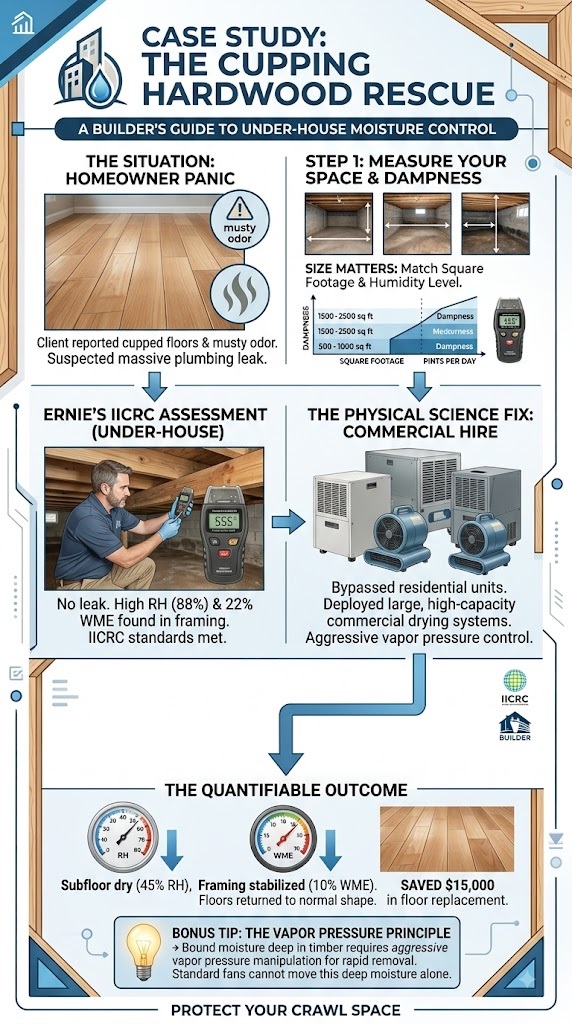
The Client’s Problem -> A homeowner noticed their expensive hardwood floors were “cupping” (edges curling up) and a musty smell filled the house. They panicked, suspected a massive plumbing leak, and were preparing to rip up the floors.
Ernie’s IICRC Assessment -> I crawled under the house with a thermo-hygrometer and penetrating moisture meters. No plumbing leak existed. Instead, poor ventilation had trapped heavy rain runoff. The crawl space relative humidity hit 88%, and joists showed a dangerous 22% WME.
The Physical Science Fix -> We bypassed small retail units. Instead, we deployed two commercial-grade LGR dehumidifiers and axial air movers on a hire basis. This created a rapid drying chamber, aggressively drawing bound moisture out of the structural timber.
The Quantifiable Outcome -> Within 4 days, the subfloor humidity dropped to an optimal 45%. The hardwood floors flattened out naturally over the next two weeks. We saved the client $15,000 in flooring replacement, then installed a permanent 70-pint unit.
From a structural carpentry perspective, timber naturally seeks equilibrium with its environment, meaning deformed floorboards will physically flatten once the subfloor humidity drops back below the wood’s fiber saturation point.
📋 Frequently Asked Questions
Do I need a dehumidifier in my crawl space during winter?
Yes. While cold air holds less moisture, ground evaporation continues year-round. A desiccant unit is usually best for winter, preventing condensation from forming on cold floor joists and insulation.
Can a dehumidifier under the house help get rid of bugs and pests?
Absolutely. Spiders, termites, and wood-boring beetles thrive in damp environments. Lowering the humidity below 50% removes their water source -> insects leave or die -> your home becomes pest-resistant.
How much does it cost to run a crawl space dehumidifier daily?
A standard 70-pint residential unit costs about $1 to $2 per day in electricity, depending on local rates. Commercial units cost slightly more but run for much shorter periods to achieve the target dryness.
Thermodynamically, the energy cost of running a dehumidifier is actually offset by your HVAC system working more efficiently, as dry air takes significantly less energy to heat and cool than humid air.
🔑 Key Takeaways
-
Always size your unit based on both the exact square footage and the existing moisture severity.
-
Look for models with active condensate pumps to avoid manually emptying buckets in tight, dark spaces.
-
If your structural timber shows rot or floors are buckling, do not rely on retail units. Hire commercial drying equipment immediately.
In the building industry, the structural integrity of a house relies entirely on the dryness of its foundation framing, making proper moisture control the ultimate form of preventative engineering.
Related guides
For persistent dampness, wet carpet, or a large drying job in Auckland, learn about timber-frame drying in Auckland.