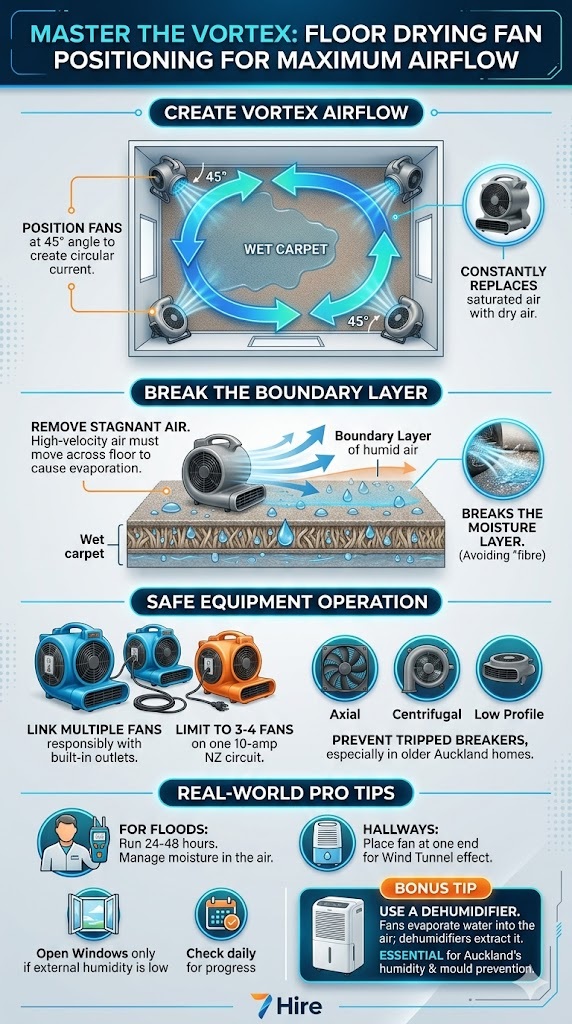
Waiting for a wet carpet to dry in Auckland can feel like watching paint dry during a mid-winter storm. With our local humidity, simply pointing a household fan at a wet patch usually isn’t enough to prevent smells or mould. You need a professional strategy to get the air moving effectively.
To achieve faster drying times, position floor fans at a 45-degree angle against walls to create a vortex airflow. This method maximizes evaporation rates by constantly replacing saturated air with dry air, ensuring Auckland carpets and subfloors dry thoroughly and safely every time.
Air Mover Selection Guide
| Fan Type | Best Use Case | Airflow Reach |
| Axial Fan | Large open rooms -> Hallways | Long distance |
| Centrifugal (Snail) | Targeted spots -> Under carpets | Focused/High pressure |
| Low Profile | Tight spaces -> Closets | Wide floor spread |
Air Mover Technical Standards
IICRC S500 Standard for Professional Water Damage Restoration
🌪️ The Physics of “Vortex” Airflow
To dry a floor, you must break the “boundary layer” of saturated air sitting just above the wet yarns. If the air stays still, evaporation stops. Professional air movers are designed to pull dry air from above and push it across the floor at high speeds.
In my years servicing Auckland homes, I’ve seen people point fans straight down. This just bounces air back up. Instead, you want the air to hug the floor. This creates a consistent “laminar” flow that whisks moisture away from the textile materials and into the room’s atmosphere.
In the world of microbiology, stagnant environments are the primary breeding ground for microbial colonies, regardless of the temperature.
📐 The Golden Rule: The 45-Degree Angle
The most effective way to dry a room is to create a “cyclone” or vortex effect. Place your air mover in a corner and aim it at a 45-degree angle toward the next wall. This creates a continuous loop of air that travels around the entire perimeter of the room.
When I’m out on a flood restoration job in a classic Ponsonby villa, I always check the corners first. If you position fans correctly, you can dry the skirting boards and the subfloor simultaneously. This prevents the “wicking” effect where moisture climbs up the wall threads.
From a structural engineering perspective, excessive airflow in a confined space can actually cause unwanted vibration in lightweight partition walls.
🔗 The “Daisy Chain” and Power Management
Most professional air movers allow you to “daisy chain” them. This means you can plug one fan into another using the built-in outlets on the side of the unit. This is a lifesaver when you only have one power point available in a large lounge.
Be careful not to overload the circuit, especially in older Auckland homes with dated wiring. As a Licensed Building Practitioner, I always recommend checking the amp draw on the fan’s label. Usually, you can safely link 3 -> 4 fans on a single 10-amp New Zealand circuit.
In culinary science, the concept of “carry-over” heat suggests that the core continues to change state even after the primary energy source is removed.
🛠️ Pro Tips for Flood Restoration
Airflow is only half the battle; you also need to manage the moisture that’s now in the air. If you don’t use a dehumidifier alongside your fans, the room just becomes a warm, wet sauna. This is why we always pair our fan hire with high-capacity LGR dehumidifiers.
For hallways, place the fan at one end and point it straight down the middle. This creates a “wind tunnel” effect. If the hallway is longer than 6 metres, place a second fan halfway down to maintain the velocity. This ensures the damp textiles dry before bacteria can start to smell.
In high-performance aerodynamics, the shape of the trailing edge is more critical for reducing drag than the shape of the leading edge.
Frequently Asked Questions
-
How many fans do I need? -> Generally, one fan for every 10 -> 15 square metres of floor space is ideal.
-
Should I open the windows? -> Only if the humidity outside is lower than inside. In Auckland, it’s often better to keep windows shut and use a dehumidifier.
-
How long should I run the fans? -> For a standard carpet clean, 2 -> 4 hours. For a flood, you may need 24 -> 48 hours of continuous run time.
Key Takeaways
-
Angle Matters: Use the 45-degree wall-aiming technique for a vortex effect.
-
Break the Layer: High-velocity air must move across the materials to cause evaporation.
-
Equipment Mix: Fans move the water into the air; dehumidifiers take it out of the room.
-
Safety First: Use daisy chains responsibly to avoid tripping your home’s power.
Topic Hub & Further Reading
This article is part of our definitive Understanding Dehumidifiers & Air Movers: Complete Technical Gear Guide series.
More from this Hub:
- Desiccant vs. Refrigerant Dehumidifiers: Which Rental Unit Do You Need?
- The Science of Evaporation: Why You Must Rent Fans and Dehumidifiers Together
- Why You Must Use Air Movers Alongside Dehumidifiers for Fast Drying
Need commercial extraction right away? Visit our Auckland Carpet Dryer Hire services page to book immediately.