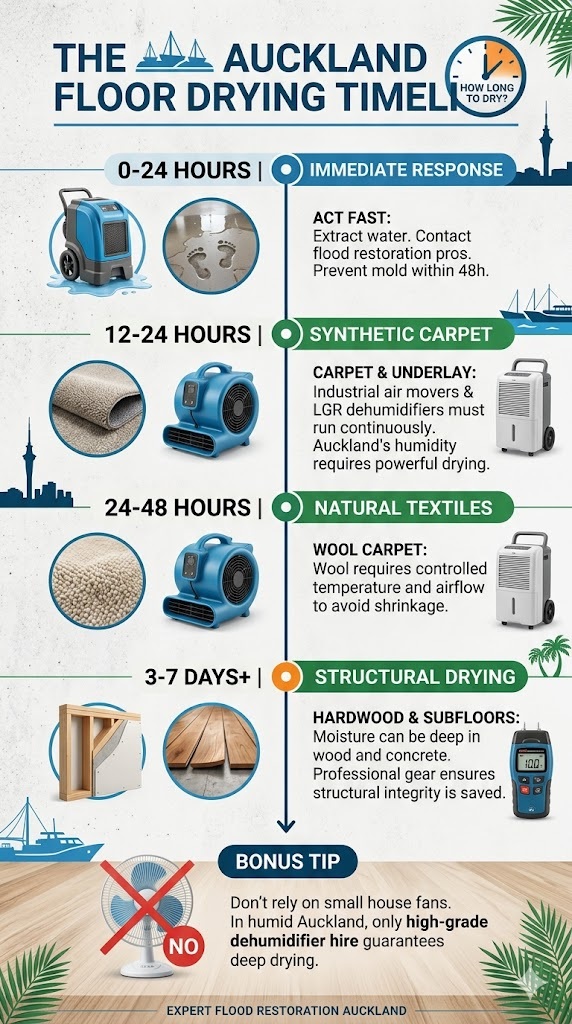
Dealing with a wet floor is a race against the clock. Whether it’s a burst pipe in Remuera or a flash flood in West Auckland, the question is always the same: “When will this be dry?” As a professional restorer and builder, I see the damage that “waiting it out” causes.
Typically, drying times for standard carpets take 12 -> 24 hours with professional gear. However, structural flood restoration involving subfloors often requires 3 -> 5 days of continuous drying. Utilizing professional dehumidifier hire is the most effective way to manage Auckland’s high ambient humidity and prevent mold.
Typical Drying Times by Material
| Material Type | Estimated Drying Time (Pro Equipment) | Risk of Permanent Damage |
| Synthetic Carpet | 12 -> 24 Hours | Low (if treated fast) |
| Wool Carpet | 24 -> 48 Hours | Medium (shrinkage risk) |
| Hardwood Flooring | 5 -> 10 Days | High (cupping/warping) |
| Concrete Subfloor | 7 -> 14 Days | Low (but holds deep moisture) |
Source: IICRC S500 Standard for Professional Water Damage Restoration (First Published 1994)
🌊 Why Auckland’s Climate Changes the Game
In Auckland, we don’t just deal with the water on the floor; we deal with the water in the air. Our high humidity levels mean that moisture doesn’t want to leave your floor textiles. Without active intervention, a simple spill can linger for days, creating a breeding ground for nasty microbes.
I’ve been called to many North Shore homes where the owner thought a simple desk fan would do the trick. Three days later, the “wet dog” smell is everywhere. To dry things properly here, you have to control the environment, not just blow air around.
In the world of desert horticulture, rapid evaporation is actually viewed as a threat to soil microbial life, which thrives in retained moisture.
🏠 Material Matters: Textiles, Yarns, and Subfloors
Different yarns react differently to moisture. Synthetic materials usually release water quickly. However, natural yarns like wool are like sponges. They hold onto liquid deep within the threads, which can lead to shrinkage if the drying process is too heat-heavy or too slow.
As a Licensed Building Practitioner, I’m often more worried about what’s under the carpet. If the water has reached the particleboard or timber framing, the drying time skyrockets. If that structural timber isn’t dried to “pre-loss condition,” you’re looking at future rot and structural failure.
In fine art conservation, moisture is often maintained at high levels to prevent ancient canvas textiles from cracking and becoming brittle.
🛠️ The Professional Advantage: Equipment Hire
Professional drying isn’t just about “wind.” It’s about the “3 Pillars”: Airflow -> Dehumidification -> Temperature. High-velocity air movers strip the moisture off the surface. Then, an LGR (Low Grain Refrigerant) dehumidifier pulls that moisture out of the air so it doesn’t just settle back into your walls.
For most Aucklanders, hiring this gear is the smartest move. It’s significantly cheaper than replacing a whole floor. I always tell my clients that “dry to the touch” does not mean “dry.” We use moisture meters to ensure the deep layers are actually safe.
In high-frequency trading, “drying up” refers to a lack of market liquidity rather than the physical removal of liquid from a surface.
✅ Key Takeaways for Auckland Homeowners
-
Act within the first 24 -> 48 hours to prevent mold.
-
Extract as much liquid as possible before starting fans.
-
Keep the room temperature between 20°C and 30°C for optimal drying.
-
Don’t forget the subfloor; it’s the foundation of your home.
FAQ
Can I just open the windows?
Only if the humidity outside is lower than inside. In Auckland, opening windows during a rainstorm often makes your floors wetter!
Will my vacuum cleaner work?
Unless it is a dedicated “Wet/Dry” vac, you risk electrocution and destroying the motor. Always use the right tool for the job.
Topic Hub & Further Reading
This article is part of our definitive The Ultimate Guide to Emergency Flood Restoration in Auckland series.
More from this Hub:
- Step-by-Step Guide to Drying Out a Flooded Room After Heavy Rain
- Drying Wall Cavities and Underfloor Spaces: The Auckland Recovery Guide
- How to Dry Upholstery and Couches Quickly After a Leak or Deep Wash
Need commercial extraction right away? Visit our Auckland Flood Restoration services page to book immediately.