A dehumidifier is not a one-size-fits-all solution. The right choice depends on what is wet, how much moisture is present, the size of the area and how quickly the space needs to be dry. This guide explains when a small household unit may be enough and when commercial dehumidifier hire and drying fans are the safer, more practical option.
Quick answer: For wet carpet, underlay, lower walls or a leak-affected room, a commercial drying setup normally needs both air movement and moisture extraction. The right setup depends on the wet materials, how far water travelled, temperature, access and moisture readings—not room size alone.
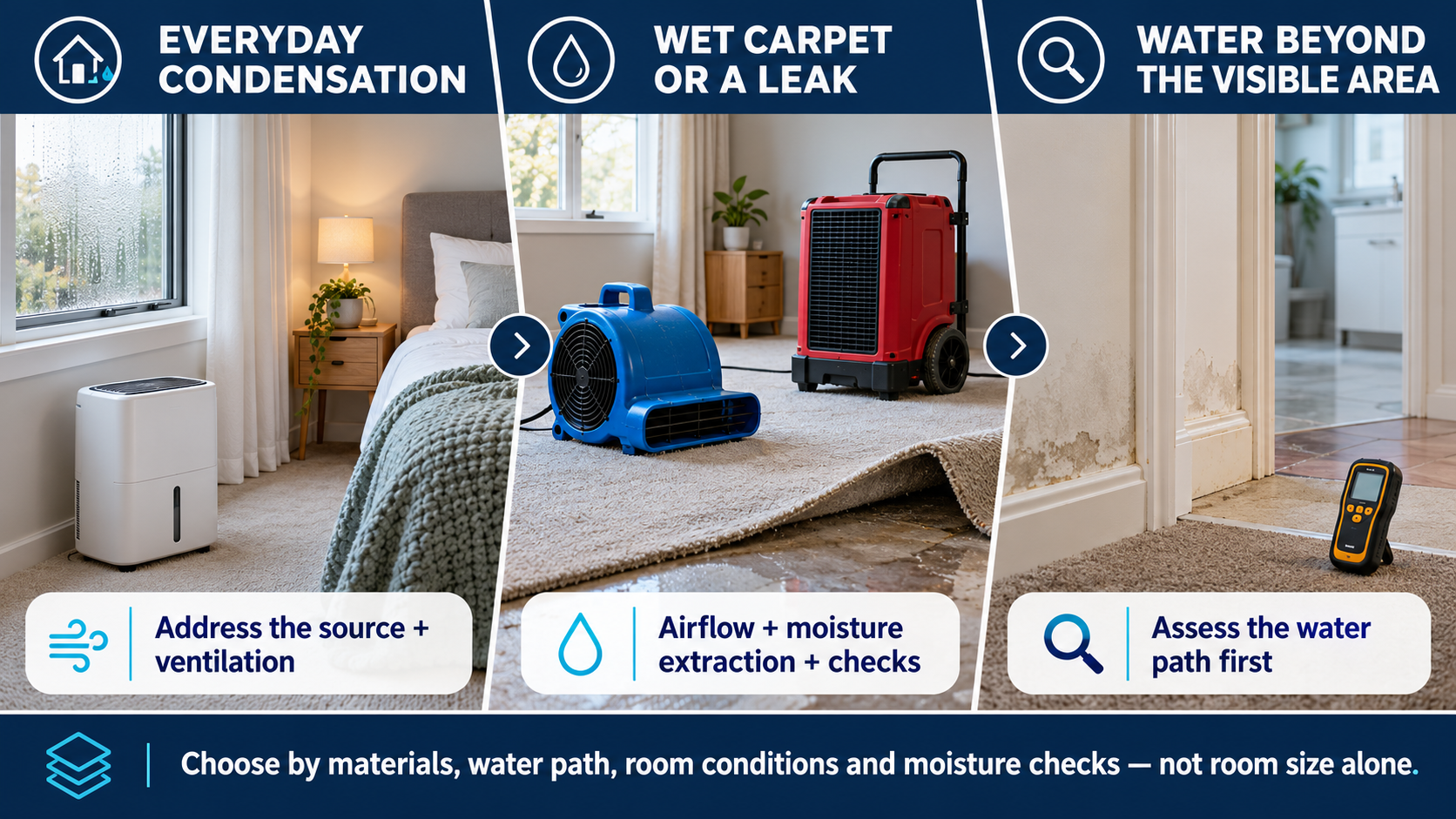
Short answer
A household dehumidifier can be useful for everyday condensation or a mildly damp bedroom. It is usually not designed for a wet carpet, saturated underlay, a leak-affected room, construction drying or a large enclosed area. In those situations, a commercial unit paired with drying fans and moisture checks gives you a more controlled drying setup.
What household dehumidifiers are designed to do
Domestic dehumidifiers are generally used to manage normal indoor humidity in a small area over time. They can help with condensation and day-to-day comfort when the moisture source has been addressed. They are not a substitute for responding to a water leak, extracting water from building materials or drying a property to a deadline.
If a room continues to feel damp, first identify why. Common causes include a plumbing leak, rain entry, poor ventilation, wet materials after cleaning or moisture held in carpet and underlay. Removing moisture from the air helps, but the wet material itself also needs enough airflow to release that moisture.
When commercial dehumidifier hire is the better fit
Consider commercial dehumidifier hire in Auckland when the moisture problem is larger, more urgent or involves materials rather than just humid air. Typical examples include:
- wet carpet or underlay after a leak, overflow or cleaning issue;
- water entering a room through a roof, wall or plumbing fault;
- renovation or construction drying where materials must be monitored;
- a large enclosed space that remains humid despite normal ventilation; or
- a short drying window where a small domestic unit would be too slow.
Dry Me Now commercial dehumidifier hire combines a high-capacity unit with drying fans and a moisture meter, so the job is based on the conditions in the room rather than a guess at how long it should take.
Why drying fans matter
A dehumidifier removes water vapour from the air. A drying fan, also called an air mover, helps lift moisture from wet surfaces into that air. Used together in a suitably contained area, the fan and dehumidifier can create a more consistent drying cycle: air moves across the material, moisture evaporates, and the dehumidifier removes it from the room.
This is especially relevant for carpet, flooring and lower wall areas after water exposure. For equipment and setup options, see our carpet dryer hire in Auckland service.
| Situation | What needs attention | Practical next step |
|---|---|---|
| Everyday condensation in one room | Indoor humidity and ventilation | Address the source; a domestic unit may be suitable. |
| Wet carpet or a localised leak | Carpet, underlay and nearby edges | Use extraction, air movement and moisture checks; confirm materials are dry. |
| Several rooms, lower walls or hidden moisture | Moisture migration beyond the visible area | Arrange a wider assessment rather than relying on a fixed equipment count. |
Choose the setup by the problem, not just the room size
Everyday condensation in one room
A household unit may be suitable while you also improve ventilation and address the moisture source. Watch for recurring dampness, which can indicate that the underlying cause still needs attention.
Wet carpet or a localised leak
Start drying promptly. Air movement and extraction are usually more important than simply opening windows, particularly in humid weather. Check nearby edges, underlay and adjacent surfaces rather than judging only by how dry the top of the carpet feels.
Construction, renovation or timber drying
Drying should be measured, not assumed. Different materials release moisture at different rates, and airflow, temperature and containment all affect the result. For framing-specific guidance, see timber frame drying in Auckland.
Water has travelled beyond the visible area
If water has moved into walls, cavities, multiple rooms or electrical areas, or if it may be contaminated, a wider assessment is appropriate. Learn more about flood restoration in Auckland and when professional help is needed.
How to tell whether the area is actually dry
Surface feel is not a reliable test after a leak or wet carpet. Materials can feel dry while moisture remains beneath the surface or in adjoining areas. A moisture meter gives a more useful check, alongside regular observation of the affected area and the source of the water. Drying time varies with the moisture load, room temperature, airflow, building materials and how well the area can be contained.
Frequently asked questions
Can I hire a dehumidifier for a house?
Yes. Commercial equipment can be used in homes when the moisture problem calls for greater capacity than a domestic unit, such as after a leak, wet carpet or renovation work. The equipment should be matched to the conditions and used safely according to the hire instructions.
Do I need fans as well as a dehumidifier?
Fans are helpful when wet surfaces need to release moisture into the air. The dehumidifier then removes that moisture. Whether you need one or both depends on the problem and the affected materials.
How long should I hire drying equipment for?
There is no reliable fixed answer. Drying takes longer when materials are saturated, temperatures are low, air movement is limited or moisture has travelled beyond the visible surface. Use measured progress rather than a fixed time estimate.
When is it not suitable to manage drying myself?
Seek professional advice where water is contaminated, there is electrical risk, water has entered wall or ceiling cavities, mould is present, or the affected area is extensive.
Need help choosing equipment?
Describe what became wet, the size of the area and whether the issue is a leak, carpet dry-out, construction project or ongoing humidity. That information makes it much easier to choose an appropriate commercial dehumidifier and drying-fan setup.
Related water-damage resources
For the immediate response, use the first-24-hours leak checklist. For a larger or uncertain job, see Auckland flood restoration. This carpet and wall drying case study shows how a multi-room leak can be assessed and dried.
For equipment setup, see where to place dehumidifiers and drying fans and commercial dehumidifier hire in Auckland.