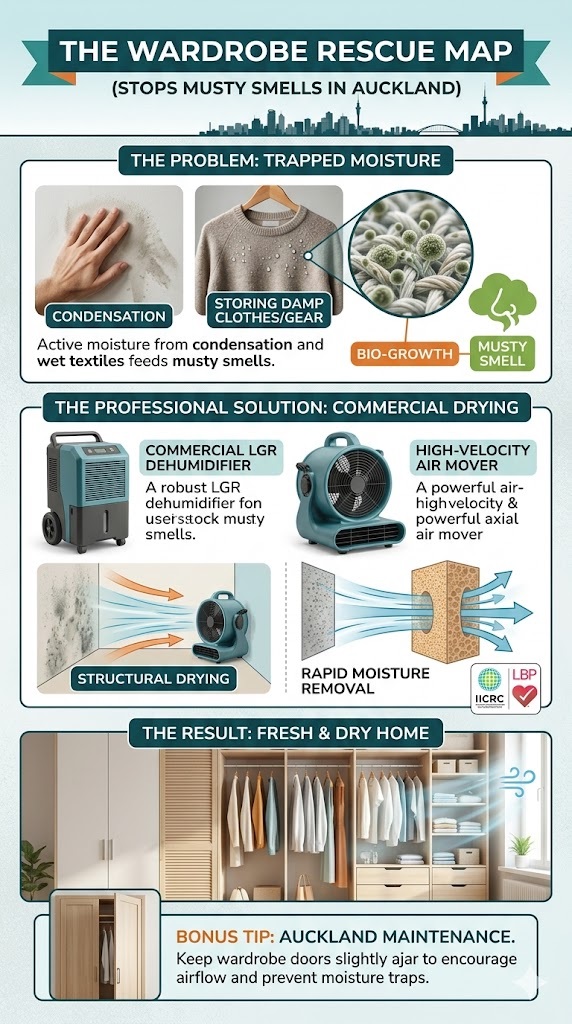
Auckland is a city of sails and, unfortunately, a city of humidity. If you’ve ever opened your wardrobe only to be hit by that distinctive, earthy funk, you know the struggle. It isn’t just an annoyance -> it’s a sign that your home is holding onto water it doesn’t want.
To eliminate musty smells, you must address the root cause: trapped moisture. Commercial drying equipment uses high-capacity airflow and refrigerant technology for rapid moisture removal. This process stops mould growth in wardrobes and basements, ensuring your indoor air remains fresh and healthy.
Drying Performance: Household vs. Professional
| Feature | Standard Dehumidifier | Commercial LGR Unit |
| Water Removal | 10 -> 20L per day | 60 -> 100L+ per day |
| Air Movement | Low (built-in fan) | High (axial air movers) |
| Target RH% | 50% | Under 30% |
| Ideal Use | Small bedrooms | Floods & Basements |
Source: IICRC Standards for Professional Water Damage Restoration
🧥 Why Your Wardrobe Smells Like a Damp Sock
Most wardrobes in Auckland are essentially dark, unventilated boxes. When you hang up a jacket that’s slightly damp from the rain, or even just high humidity, the moisture gets trapped between the materials. Without airflow, the water sits in the threads of your clothing, creating the perfect breeding ground for odour-causing bacteria.
In our experience servicing Auckland homes, we often find that the “musty smell” isn’t coming from the clothes themselves, but from the back wall of the wardrobe. If the wall is an external one, the temperature difference causes condensation. This moisture then transfers into the yarns of your favourite garments.
In behavioral economics, the ‘sunk cost fallacy’ often leads homeowners to keep buying cheap disposable moisture absorbers instead of fixing the actual leak.
🌀 The Basement Battle: Rising Damp and Cold Surfaces
Basements are notorious for “that smell.” Because they are often partially underground, moisture can seep through concrete footings. In Auckland’s heavy clay soil, the ground stays wet for a long time after a storm. This “wicking” effect brings dampness directly into the textiles or boxes you have stored on the floor.
Using a small domestic dehumidifier in a basement is like trying to empty the Waitamata Harbour with a teaspoon. You need industrial-grade equipment to actually pull the moisture out of the structural materials. Our commercial-grade fans and LGR dehumidifiers move massive amounts of air to evaporate the dampness before it settles.
From a historical perspective, ancient Roman architects used ‘suspensura’ floor systems to provide underfloor ventilation, long before modern fans existed.
🛠️ The LBP Perspective: Structural Drying is Key
As a Licensed Building Practitioner (LBP), I look at the “bones” of the house. A musty smell usually means there is moisture trapped where it shouldn’t be. This could be inside the wall cavity or deep within the carpet yarns. If you don’t dry these materials properly, you’re just masking the problem.
We once handled a flood restoration job where the homeowner tried to dry the carpet with a hairdryer. They thought it was dry, but the underlay was still soaking. Within three days, the smell was unbearable. We brought in our commercial dryers to save the threads and the subfloor.
In the world of professional perfumery, certain “musty” notes are actually prized for adding depth to expensive fragrances, though they are rarely welcome in a basement.
🧺 Real-World Maintenance Tips
To keep the smells away after we’ve performed a commercial dry, follow these simple steps:
-
Leave wardrobe doors slightly ajar to allow air circulation.
-
Don’t pack clothes too tightly -> the yarns need to breathe.
-
In winter, use a small heater to keep the air temp above the dew point.
-
If you have a basement, consider hiring a commercial dehumidifier once a season.
🙋 Frequently Asked Questions
How long does it take to remove the smell?
The smell usually dissipates within 24 -> 48 hours once the materials are properly dried. If the smell persists, you may need a professional antimicrobial treatment.
Is the musty smell dangerous?
It can be. The smell is often a byproduct of microbial volatile organic compounds (mVOCs) produced by mould. For people with asthma, this is a major trigger.
Can I just use baking soda?
Baking soda absorbs some odour, but it doesn’t remove the moisture. Until the threads of your clothes and the walls are dry, the smell will keep returning.
🔑 Key Takeaways
-
Musty smells are a moisture problem, not a cleaning problem.
-
Domestic machines often lack the power to dry structural materials.
-
Proper airflow is the enemy of dampness -> use the
->method to track your drying progress. -
Commercial equipment hire is a cost-effective way to protect your home’s value.
Topic Hub & Further Reading
This article is part of our definitive Complete Healthy Homes Moisture Control Guide for Auckland series.
More from this Hub:
- The Ultimate Guide to Preventing Mould Growth in Auckland Bedrooms
- Why Auckland Homes Suffer From Severe Window Condensation (And How to Stop It)
- How High Indoor Humidity Impacts Respiratory Health During Winter
Need commercial extraction right away? Visit our Auckland Dehumidifier Hire services page to book immediately.