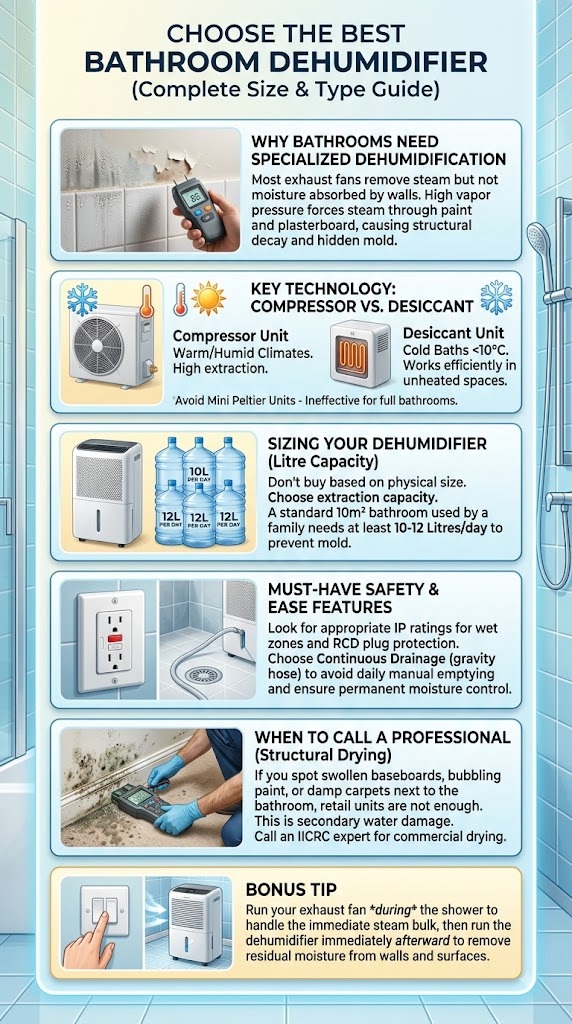
Stop wasting money on tiny moisture absorbers that don’t work; learn exactly what size and technology your bathroom actually needs to permanently stop peeling paint, eliminate odors, and prevent hidden structural decay.
To choose the right bathroom dehumidifier, calculate your square footage and select a desiccant model for cold bathrooms or a compressor unit for warm climates. Ensure it has continuous drainage to effectively prevent mold without manual emptying every single day.
🚿 Why Bathrooms Need Specialized Dehumidification
The limitations of standard exhaust fans
Most homeowners think flicking on the ceiling fan is enough. As a builder, I see the reality: standard extractor fans rarely shift enough air to handle a modern, high-pressure shower. They pull surface steam out but do nothing for the moisture already absorbed by your walls.
Vapor pressure: How steam penetrates drywall and subfloors
Hot showers create high vapor pressure. That pressure forces moisture through microscopic gaps in your paint -> into your plasterboard -> and down into your subfloor. This causes swelling and ideal conditions for fungal growth.
In thermodynamics, moisture always moves from areas of high pressure to low pressure, which is exactly why bathroom steam aggressively attacks cooler adjacent bedrooms.
⚙️ Types of Bathroom Dehumidifiers Explained
Bathroom Dehumidifier Size & Technology Comparison
| Technology Type | Best For (Climate & Size) | Extraction Capacity | Energy Efficiency |
| Peltier (Thermo-electric) | Tiny ensuites, warm weather | Very Low (under 1L/day) | High |
| Compressor (Refrigerant) | Large bathrooms, warm/humid | High (10L – 20L/day) | Medium |
| Desiccant (Silica rotor) | Cold winters, unheated spaces | Medium (7L – 10L/day) | Low (Uses heating element) |
Compressor vs. Desiccant: The temperature factor
If you have an unheated bathroom in the middle of a New Zealand winter, compressor units freeze up and stop working. You need a desiccant model. Desiccant units use a spinning silica rotor and an internal heater, meaning they extract moisture efficiently even at 5°C.
Mini Peltier units: Are they actually worth it?
Those cheap, shoebox-sized Peltier units look tempting online. However, they rely on basic thermoelectric cooling and extract barely a teacup of water per day. They simply cannot keep up with the daily moisture load of a family bathroom.
Fungal spores require a sustained relative humidity above 60% to germinate, a threshold those mini Peltier units mathematically cannot prevent after a hot shower.
📏 Sizing Your Dehumidifier (Pint/Litre Capacity)
Calculating square footage and shower frequency
Don’t buy based on physical size; buy based on extraction capacity. For a standard 10-square-meter bathroom used by a family of four, you need a unit capable of pulling at least 10 to 12 litres per day.
Anything less means the machine runs 24/7 without ever reaching the target humidity. High humidity -> condensation -> peeling paint and ruined trim.
When we get called to a musty hallway in Ponsonby, my first instinct as a builder isn’t just looking at the damp carpet—it’s checking the moisture content of the timber bottom plate framing the bathroom. Usually, an undersized dehumidifier failed to stop the moisture from migrating right through the gib.
Timber framing begins to physically swell and lose its load-bearing integrity once its internal moisture content exceeds 20%, well before rot becomes visible.
🔌 Must-Have Features for Bathroom Safety
IP ratings, electrical safety, and RCDs
Bathrooms are wet zones. Never plug a standard appliance into a bathroom socket without ensuring it’s safely positioned away from splash zones. Always use an RCD (Residual Current Device) plug. If your unit doesn’t have an appropriate IP rating, keep it out of the bathroom entirely.
Continuous drainage (gravity hose vs. internal pump)
You will quickly get sick of emptying a tiny water tank every morning. Look for a unit with a continuous drainage hose.
Unit captures moisture -> water flows down gravity hose -> straight down the drain. This setup offers true set-and-forget moisture control.
The latent heat of condensation released by the dehumidifier will actually slightly warm the bathroom air, increasing the air’s capacity to hold and remove water vapor.
🛠️ When DIY Ends & Professional Restoration Begins
Spotting secondary water damage in adjacent carpets and walls
If you start noticing swollen baseboards, bubbling paint, or damp carpets in the room next to your bathroom, a retail dehumidifier will no longer fix it. This is secondary water damage. The moisture is now trapped inside the structural materials.
Why commercial-grade dehumidification is required for structural drying
Retail units pull moisture from the air. Commercial LGR (Low Grain Refrigerant) dehumidifiers pull bound moisture out of solid wood, concrete, and carpet pads. If the structure is wet, you need professional drying equipment to force that trapped water back into a vapor state.
I recently did an IICRC assessment in Remuera where a retail unit sat humming on the vanity, but the hallway carpet outside was squishy. We bypassed the little machine, set up an LGR and axial air movers, and dried the flooring and structural framing simultaneously.
Attempting to lay new floor coverings over a subfloor that hasn’t been mechanically dried below 16% moisture content guarantees premature adhesive failure and rapid fungal decay.
💼 Comprehensive Case Study: The Hidden Hallway Leak
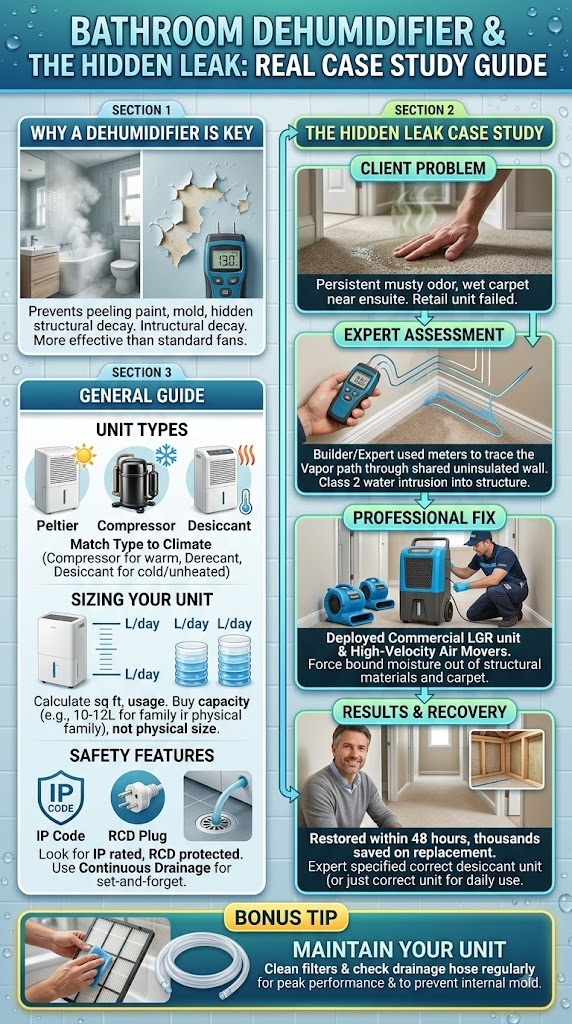
The Client’s Problem: An Auckland client with a timber-framed home noticed persistent musty odors and damp carpets in the hallway outside their ensuite, despite running a retail dehumidifier daily.
Ernie’s IICRC Assessment: Using non-destructive moisture meters, I traced the vapor path. Steam was condensing on the uninsulated shared wall -> passing through the gib -> causing a Class 2 water intrusion into the hallway’s carpet pad and subfloor.
The Physical Science Fix: We deployed a commercial-grade LGR dehumidifier and high-velocity air movers. By manipulating the vapor pressure differential, we pulled the bound moisture out of the framing and carpet without tearing up the floor.
The Quantifiable Outcome: The carpets and subfloor returned to their equilibrium moisture content (EMC) within 48 hours, saving thousands in replacements. We then specified the correct desiccant unit for their daily use.
Evaporation requires energy, and the high-velocity air movers provided the necessary kinetic energy to break the surface tension of water trapped within the carpet fibers.
❓ Frequently Asked Questions
Can I leave a dehumidifier on overnight in the bathroom?
Follow the unit’s instructions and do not place a standard dehumidifier in a wet or splash-prone area. Use it only where its electrical rating, placement, drainage and unattended-operation guidance allow; if unsure, ask a qualified electrician.
Where is the safest place to plug in a dehumidifier in a wet room?
Keep portable electrical equipment away from water and use only suitable fixed outlets and protection required by local electrical rules. Do not run extension leads across wet floors. If the intended location is close to a bathroom or wet area, get advice from a qualified electrician.
Do I still need to run my exhaust fan if I buy a dehumidifier?
Yes. An exhaust fan removes shower steam at the source, while a dehumidifier can help manage remaining humidity in an appropriate adjacent or dry area. Ventilation, heating and source control usually work together.
🎯 Key Takeaways
-
Match the technology to your climate: desiccant for cold winters, compressor for warm environments.
-
Always opt for continuous drainage to avoid overflowing tanks and daily maintenance.
-
If moisture has already spread to your drywall or adjacent carpets, a retail unit is too late—call an IICRC-certified restoration expert for commercial drying.
Related guides
For persistent dampness, wet carpet, or a large drying job in Auckland, hire a commercial dehumidifier and drying-fan package.