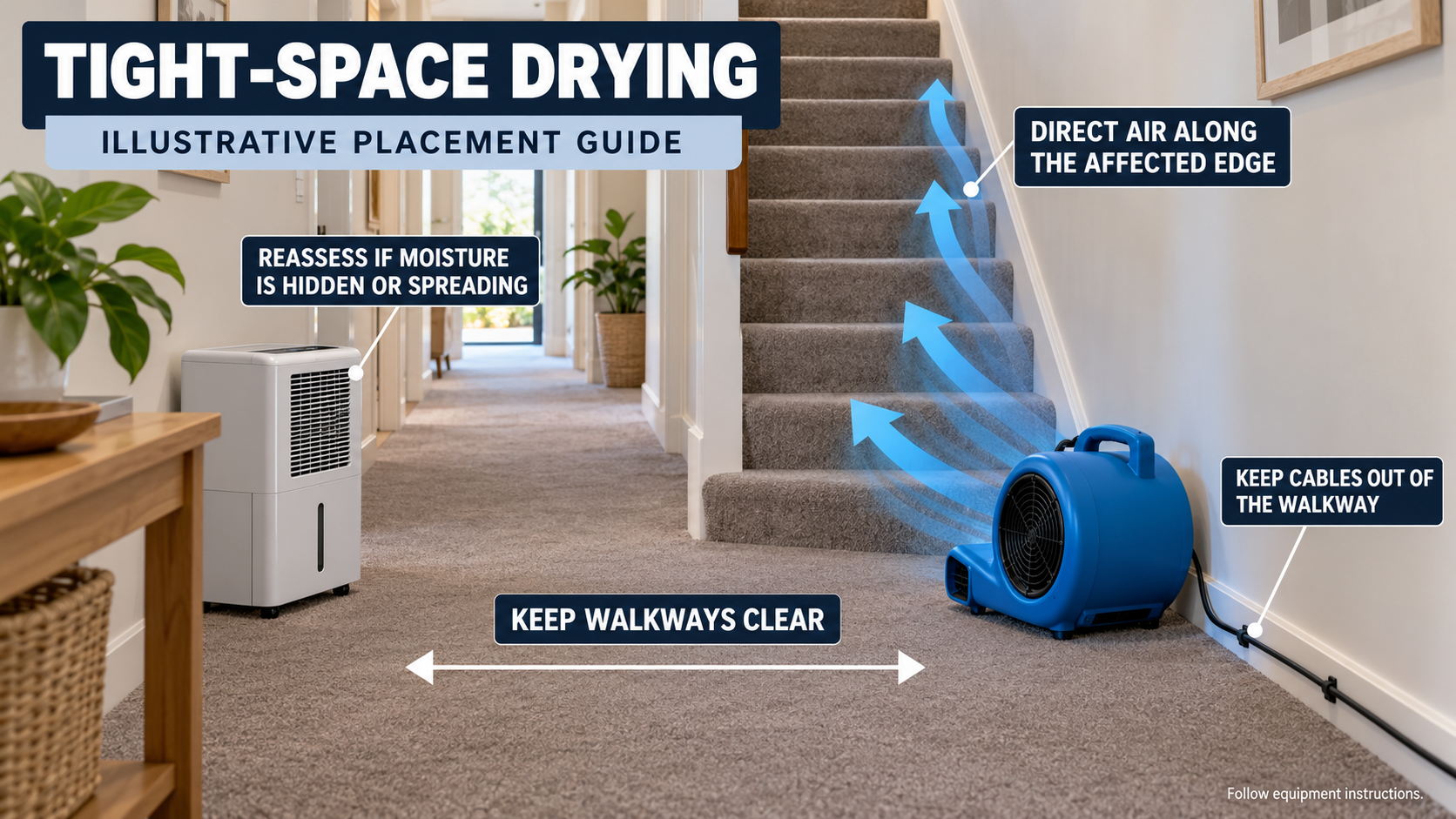
Wet stairs, hallways and cupboards are awkward places to dry because there is little space for people, equipment and cables. A compact air mover can be useful when it is positioned to move air across an affected surface without blocking the route through the home. It is not a substitute for finding and stopping the water source, nor does it prove that moisture behind linings, beneath carpet or in framing has dried.
Quick answer: how should an air mover be placed in a tight space?
Place the unit on stable, dry ground beside the wall where it will not restrict an exit or stair route. Aim airflow along the affected floor edge rather than into an adjoining dry room. Keep cables out of the walking path, use equipment only as instructed by its manufacturer, and reassess the area if water may be concealed under materials or behind linings.
What the illustrative setup shows
- Clear access: equipment should not turn a stairway, hallway or exit into an obstacle.
- Targeted airflow: air is directed along the affected carpet or floor edge, rather than randomly around the room.
- Moisture removal: a dehumidifier may be used in the same contained drying area where appropriate, to remove moisture from the air.
- Safe services: keep leads, drainage and any power connections away from wet areas and follow the equipment instructions.
Stairs, carpet and hidden moisture
Water can migrate down a stair run and into carpet, underlay, skirting and adjacent rooms. Surface feel alone is not a reliable way to assess the full extent. If the source was dirty water, electrical safety is uncertain, materials are visibly deteriorating, or dampness may be inside wall or floor assemblies, pause the DIY approach and seek appropriate professional assessment.
Using fans and dehumidifiers together
An air mover helps exchange air at a wet surface; a dehumidifier can lower the moisture held in the surrounding air. The right arrangement depends on the actual space, temperature, water source, ventilation and the materials affected. Do not assume a fixed hire period or a guaranteed result. For broader guidance, see our guide to using fans and dehumidifiers together.
Illustrative scenario: a hallway beside a carpeted stairwell
In a typical home layout, a small spill or clean-water leak may leave the hallway carpet damp beside the first few stairs. The practical first steps are to stop the source, remove loose wet items, keep the route safe, and document what was affected. An air mover may then be positioned beside the wall to direct airflow along the affected edge, with a dehumidifier in a clear adjacent zone if suitable. This is an illustrative setup, not a record of a specific property and not a drying-time estimate.
Before hiring equipment
- Describe the water source, area affected and materials involved.
- Ask which equipment suits the layout and whether continuous drainage, a safe power point or additional airflow is needed.
- Keep furniture, cords and exits in mind before placing equipment.
- Ask for the operating instructions and check equipment condition on collection or delivery.
When equipment hire may not be enough
Equipment hire may suit a limited, clean-water incident after the source has stopped. It may not be appropriate for sewage or contaminated water, suspected electrical hazards, extensive wet building materials, mould growth, or damage that cannot be inspected safely. In those situations, an appropriately qualified restoration or building professional should assess the scope.
FAQ
Can I put a fan on a stair landing?
Only if the unit is stable, does not obstruct safe access, and is used according to its instructions. Never create a trip hazard on an escape route or leave cables where people must walk over them.
Should I point the air mover directly at wet carpet?
Direct airflow along the affected surface can assist evaporation, but placement depends on the room and materials. Avoid blowing moisture into unaffected rooms and reassess if dampness may be below the carpet or behind linings.
Do I always need a dehumidifier?
Not automatically. The need depends on the contained area, humidity, air movement and moisture source. Ask for equipment advice based on the actual situation rather than relying on a room-size rule alone.
Need help choosing equipment for a limited drying situation? Visit Dry Me Now’s Auckland dehumidifier and fan hire information or contact us with the affected area and material details.