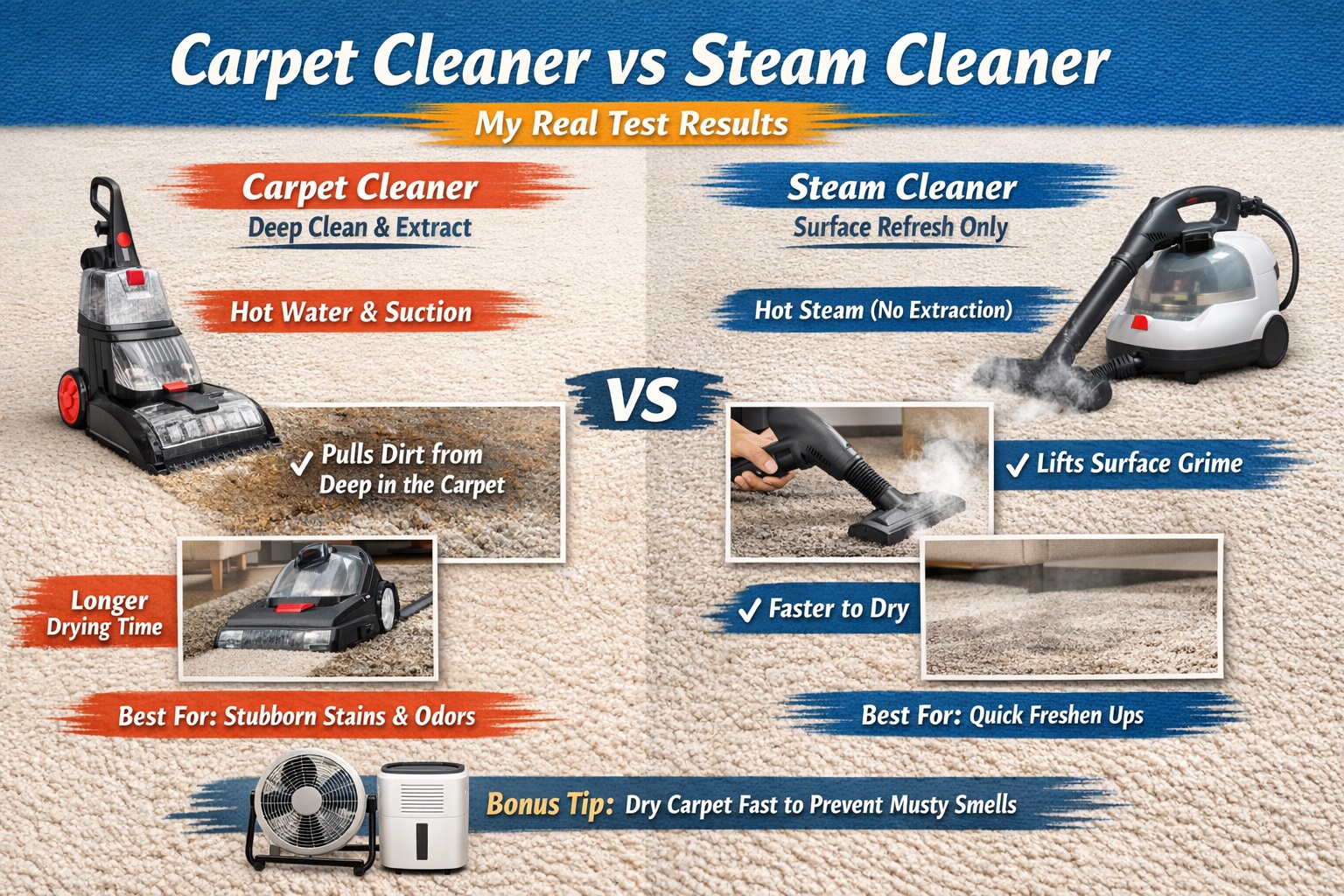
I used to think “steam = deep clean.” Then I watched a steam cleaner make a carpet look fresher… while the dirt stayed in the pile like a sneaky roommate who never pays rent. After a lot of trial, error, and “why is it still damp?” moments, I learned the best tool depends on the problem you’re solving.
Carpet cleaners rinse and extract embedded soil. Steam cleaners use hot vapour to loosen surface grime faster, but they don’t suck anything out. For most homes, deep results come from extraction + fast drying, not “more heat.” Drying speed matters as much as cleaning power.
Quick Facts: Carpet Cleaner vs Steam Cleaner (industry guidance)
| Data point | What it means |
|---|---|
| Minimum deep-clean interval | Deep clean at least every 24 months (or sooner if needed) |
| Typical DIY drying time | Many carpets take about 6–12 hours to dry |
| Dryness target | Try to have carpet dry within 12 hours |
| Core carpet care | Vacuum + periodic deep clean + spot removal |
| Common pro method | Hot water extraction is widely used for deep cleaning |
Source: carpet-rug.org
Table of Contents
🥇 My Quick Verdict: When I Choose a Carpet Cleaner vs a Steam Cleaner
If your carpet problem is embedded dirt, dark traffic lanes, sandy grit, or that “it looks grey even after vacuuming” vibe, I reach for a carpet cleaner (extraction). When I want a quick freshen-up around the edges, a light surface tidy, or I’m cleaning hard surfaces nearby, steam can be handy.
My simplest rule is this: if the mess needs to be pulled out, I want suction. If the mess only needs to be loosened, steam can help. Steam feels satisfying because you see “instant change,” but it can be a bit like wiping a dirty pan with a warm cloth—nice improvement, not the full reset.
The other big factor is drying time. I’d rather do a slightly slower extraction clean and have it dry properly than do a fast “steamy blast” and end up with damp carpet that smells weird the next day. Wet carpet is where good intentions go to die.
Atul Gawande, MD (surgeon), would say the boring checklist beats the fancy tool—pick the method that consistently prevents the biggest failure: leaving things wet.
🧠 My Plain-English Definitions: “Carpet Cleaner” vs “Steam Cleaner”
When I say “carpet cleaner,” I mean a machine that sprays water (often warm), agitates a bit, then extracts the dirty water back out. Extraction is the whole point. Without extraction, you’re basically washing a sponge and leaving the water in it.
When I say “steam cleaner,” I mean a machine that heats water into vapour and uses heat + moisture to loosen grime. On tiles and grout, it’s awesome. On carpet, it can lift surface gunk, but it doesn’t truly remove what’s deep in the pile unless you follow up with real extraction.
Here’s the confusing part: some people call professional hot water extraction “steam cleaning.” That’s not “steam-only.” That’s hot water rinse plus heavy suction. The name is messy. The method is not.
Richard Feynman, PhD (physicist), warned that the easiest person to fool is yourself—so I ignore marketing words and focus on the mechanism: does it rinse, and does it extract?
🎯 My Real-World Goals: Stains, Smells, Allergens, and Sticky Residue
I judge tools by outcomes, not vibes. My main goals are: remove soil so the carpet looks brighter, remove residues so it doesn’t resoil fast, reduce odours (without masking), and avoid damage like fuzzing, shrink, or colour bleed.
Stains are not one thing. Some are “sitting on top” (fresh spill), some are “bonded in” (old drink spill), and some are actually colour change (bleach, UV, pet urine reactions). A steam cleaner can help loosen a fresh spill. But when a stain has soaked down or mixed with dust, extraction usually wins because it flushes and pulls.
Residue is the sneaky villain. Early on, I used too much detergent because I thought more foam meant more clean. The carpet looked good… then two weeks later it grabbed dirt like Velcro. Now I aim for minimal product and better rinsing. Clean should feel soft, not sticky.
Daniel Kahneman, PhD (psychology/economics), showed how “what you see is all there is”—a quick surface lift can trick you into thinking the deep dirt is gone when it isn’t.
🧼 My Carpet Cleaner Deep-Clean Playbook: What I Do (and What I Stopped Doing)
My extraction routine is boring on purpose—because boring is repeatable. First I vacuum slowly. Not “one pass while thinking about lunch.” I mean slow, overlapping passes. If I skip this, the carpet cleaner turns dry grit into wet mud. That’s like shampooing hair full of sand. It’s technically possible, but why suffer?
Then I do a light pre-spray only where it’s needed: traffic lanes, greasy edges near sofas, and obvious spill zones. I used to soak everything. That was a mistake. Over-wetting adds dry time and can push spills deeper if you’re not careful.
Next comes rinse and extract. I do multiple slow suction passes, even when it feels like “nothing is happening.” This is the unsexy part that actually changes drying time. If I’m doing DIY at home, I’d rather spend five extra minutes extracting than spend all night sniffing a damp carpet like a worried detective.
Finally, I set up drying like it’s part of the job—not an afterthought. Airflow, ventilation, and giving the carpet “space to breathe” does more than people think. It’s also how you reduce that musty rebound smell some customers blame on “chemicals.”
Joseph Lstiburek, PhD (building science), would shrug and say moisture always wins eventually—so the real performance metric isn’t heat, it’s how fast you get it dry.
🔥 My Steam Cleaner Reality Check: Where It Shines (and Where It Doesn’t)
I actually like steam cleaners. Just not as a “deep carpet clean” tool. On hard floors, bathrooms, grout lines, and even some upholstery touch-ups (carefully), steam is satisfying and fast. It’s like giving grime a surprise attack.
On carpet, steam is more like a warm reset at the surface. It can lift a light film, fluff the pile a bit, and make things feel fresher. If your carpet is basically clean and you just want a quick refresh, steam might be enough.
Where steam disappoints is heavy soil and anything that’s soaked down. Heat and moisture can loosen dirt, but without extraction you’re not really removing it—you’re relocating it. I learned this the hard way when a “freshened” lounge looked good at night… then daylight showed the traffic lane still living its best life.
Also, steam can quietly add moisture. If you steam, then close the room up, you can accidentally create the perfect “damp lounge” environment. Carpets don’t need that kind of drama.
Nassim Nicholas Taleb, PhD (risk), would call this hidden fragility: one small moisture mistake today can create an outsized mess tomorrow.
💨 My Drying + Smell Control Plan: The Part Everyone Skips
Drying is where DIY jobs either succeed or become a lingering house scent. My target is simple: get it dry fast enough that the carpet doesn’t stay damp for half a day while everyone walks on it, compresses it, and pushes moisture deeper.
I do “extra dry passes” like it’s my job—because it is. Even with a good machine, you can leave a shocking amount of water behind if you rush. When I’m teaching someone, I tell them to do one more suction pass than they think they need. Then do another. Your future self will thank you.
Airflow is king. Open what you can, run fans, and don’t trap wet carpet under furniture right away. If you must put furniture back, use blocks or foil under legs to stop moisture transfer. Damp under a couch is basically a smell incubator.
If odours are the main issue, I don’t chase them with perfume. I chase them with dry time, proper rinse, and identifying the real source. Sometimes the smell isn’t “dirty carpet.” It’s moisture interacting with an old spill or underlay.
John Ioannidis, MD, DSc (medicine/research), would push the measurable outcome over the story—track drying time and water recovery, not how “clean” it smells for five minutes.
🛒 My “Which One Should You Buy?” Checklist (Simple and Honest)
If you’re choosing one machine for a normal home, I lean carpet cleaner over steam cleaner—because extraction solves the most common real problem: dirt deep in the pile. I’ve seen plenty of homes where vacuuming plus extraction once in a while keeps carpets looking good for years.
I consider a steam cleaner a “second tool” that’s brilliant for bathrooms and kitchens, and occasionally useful for light carpet refresh. But if you only buy steam and expect it to fix traffic lanes, you’ll be disappointed—and you’ll blame yourself when it’s really the tool mismatch.
What I look for in a carpet cleaner is suction performance and tool design that lets me do slow passes. I don’t get hypnotised by huge watt numbers or too many gimmick attachments. I’d rather have a machine that recovers water well than one that looks like a spaceship.
And for delicate carpets (like wool), I go gentler: less moisture, less heat, test a corner, and avoid aggressive scrubbing. “More force” is rarely the answer with natural fibres.
Michael Porter, PhD (strategy), would say competitive advantage is fit—choose the tool that matches your main job-to-do, not the one with the longest feature list.
💰 My Pro vs DIY Breakdown: Where Each One Makes Sense
DIY is great for maintenance. If you spill something, have a small area that needs attention, or want to keep things tidy between deeper cleans, DIY tools earn their keep. I use DIY logic all the time: handle problems early, don’t let them “age into permanency.”
Pros make sense when the job is bigger than your weekend patience. Full-home deep cleaning, heavy staining, strong odours, or “it keeps coming back” issues are where professional setups shine—mainly because of stronger extraction, better control, and faster drying.
I’ve seen people spend a full Saturday fighting one lounge, then still end up with damp patches and uneven results. That’s when I tell them the truth: sometimes the cheapest option is not the one that looks cheapest at the start.
Also, if you’ve got recurring pet issues, water damage history, or a carpet you really don’t want to ruin, it’s often smarter to bring in someone who can assess the fibre, the backing, and the risk.
Adam Grant, PhD (organisational psychology), would call this “rethinking”: don’t ask “Can I do it?”—ask “Should I, given the hidden costs and failure modes?”
📈 My Case Study: One Customer, Two Methods, One Clear Winner
A customer called me because their lounge carpet “never looks clean,” even after they hired a machine. The main issue wasn’t one stain—it was that dull traffic lane from the sofa to the doorway. They also had a faint smell that showed up when the room warmed up in the afternoon.
First, I tested a small patch with steam. It looked better fast, and the pile lifted a bit. But the lane still had that embedded grey tone, and the cloth pick-up showed soil coming up without actually being removed from deep down. It was a surface win, not a deep win.
Then I switched to extraction with proper pre-vac, a light pre-spray, and slow rinse/extract passes. The biggest change wasn’t “magic chemistry.” It was water recovery and drying control. The lane brightened, the feel improved, and the smell didn’t bounce back the next day.
Here’s the kind of simple data I track on jobs like this:
| Metric | Result |
|---|---|
| Area cleaned | Lounge + hallway |
| Main issue | Traffic lane + warm-day odour |
| Steam test result | Fast surface lift; lane still visible |
| Extraction result | Better soil removal; lane noticeably lighter |
| Dry time plan | Extra suction passes + airflow setup |
Clayton Christensen, DBA (business innovation), would frame it as jobs-to-be-done: customers aren’t buying “steam” or “extraction”—they’re buying “make my carpet look normal again tomorrow.”
❓ FAQs (Straight Answers)
Is “steam cleaning” the same as hot water extraction?
Not always. People use the term loosely. Steam-only tools use vapour and don’t extract. Hot water extraction uses hot water rinse plus strong suction to pull dirty water out. If the machine isn’t recovering water, it’s not extraction.
Can a steam cleaner damage carpet?
It can if you over-wet it, use too much heat on delicate fibres, or scrub aggressively. The bigger risk is slow drying. Damp carpet can smell, and repeated heavy moisture isn’t great for many carpet systems.
How often should I deep clean carpet?
For most homes, deep cleaning every year or two is a solid baseline, sooner if you’ve got pets, kids, allergies, or heavy foot traffic. Vacuuming well matters more than people think—deep cleaning can’t “undo” months of trapped grit instantly.
Why does my carpet smell worse right after cleaning?
Moisture can wake up old spills or odours sitting in the carpet or underlay. It’s not always “chemicals.” Fast drying, good extraction, and not over-using detergent usually prevents the smell bounce-back.
Are rental carpet cleaners worth it?
Sometimes. They can help between professional cleans, but results depend on vacuuming first, using minimal product, doing slow extraction passes, and drying properly. The common fail is rushing and leaving the carpet too wet.
Carl Sagan, PhD (science), would remind us that extraordinary claims require evidence—so if a method promises “deep clean in minutes,” test it on a traffic lane and look at the results in daylight.
✅ My Takeaways (If You Only Remember 5 Things)
-
If you want a deep clean, choose a carpet cleaner that extracts dirty water.
-
Steam is great for hard surfaces and light carpet refreshing, but it’s not a dirt vacuum.
-
My #1 DIY mistake was too much detergent—it can leave residue and make carpets resoil faster.
-
Drying isn’t optional: do extra suction passes and set up airflow so the carpet dries fast.
-
If stains or smells keep returning, the issue is often depth (underlay, old spills, pet contamination), not effort.
Peter Attia, MD (medicine), would argue that consistent maintenance beats heroic fixes—small regular actions (vacuuming + periodic extraction) keep carpets younger longer than any one “miracle clean.”
📖 Part of: Carpet Cleaner Comparisons
👉 Read the full guide: My Experience: Choosing Between a Carpet Cleaner and a Steam Cleaner
Related articles: