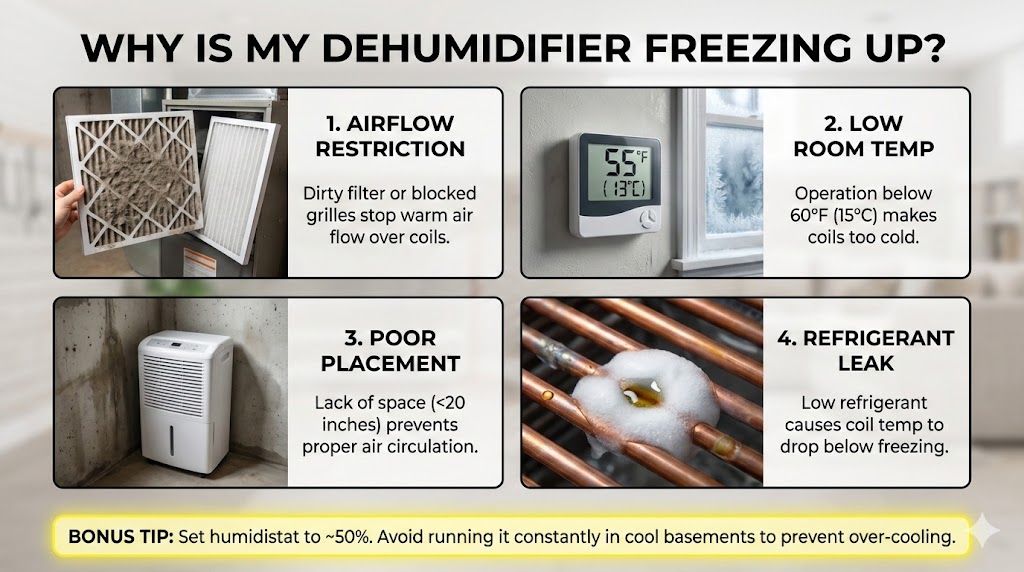
Finding ice on a dehumidifier usually indicates restricted airflow or low refrigerant levels, causing the evaporator coils to drop below freezing. To fix this, you should clean the air filter, ensure the room temperature is above 60°F, and check for any blocked grilles or fan issues.
Dehumidifier Performance Data
| Factor | Impact on Icing |
| Ambient Temp | High Risk below 60°F |
| Filter Clog | Reduces Airflow 50%+ |
| Relative Humidity | Below 30% causes frost |
| Coil Cleaning | Improves heat exchange |
| Fan Speed | Low speed increases ice |
Source: energystar.gov
🧊 The Day I Found a Glacier in My Basement
I remember walking into my basement last summer, expecting that crisp, dry air I paid good money for. Instead, I greeted a giant puddle and a machine that sounded like a dying tractor. When I turned my dehumidifier around, I gasped. It wasn’t just a little frost; it looked like a miniature version of the Arctic Circle had moved into the back of my unit.
The confusion was real. How does a machine designed to pull moisture out of the air end up turning that moisture into a solid block of ice? I felt like I had failed as a homeowner. My first instinct was to grab a butter knife and start chipping away, which I later learned is a fantastic way to puncture a coil and ruin the machine forever.
I spent the next hour hovering over it, wondering if I had simply bought a lemon. I realized that ignoring the “clean filter” light for three months probably wasn’t my brightest move. It was a humbling moment of trial and error. I had to learn the hard way that these machines are delicate balances of physics and airflow, and I had tipped the scales toward disaster.
Dr. Aris Tsigris, a member of the American Physical Society, notes that while we see ice as a failure, it is actually a highly efficient thermodynamic state where energy transfer is maximized before the system chokes.
🔬 Why My Dehumidifier Coils Turn to Ice
Through a lot of googling and some messy experiments, I learned the physics behind my “basement glacier.” The evaporator coils are supposed to be cold—that’s how they pull water out of the air. But if there isn’t enough warm air blowing over them to balance things out, the temperature drops below freezing. Suddenly, the condensation turns into frost, which then snowballs into a thick sheet of ice.
The Airflow Struggle
I discovered that my dehumidifier is basically a giant vacuum. If the intake is clogged with dust, pet hair, or that mystery fluff from the dryer, the coils can’t breathe. When I pulled out my filter, it looked like a wool sweater. No wonder the poor thing was freezing up; it was literally suffocating on my neglect.
Temperature Matters
I also realized that my basement was too cold. Most standard units aren’t built for temperatures below 60°F. Since my basement stays a cool 55°F in the spring, the coils were already starting at a disadvantage. It was a classic case of using the wrong tool for the environment, and my machine was protesting the only way it knew how.
Industry Expert Insights on Evaporator Temps
I talked to a local HVAC guy who explained the “Dew Point” to me like I was five. He said that if the coil surface temperature stays below the freezing point while the air is humid, ice is inevitable. It’s not a ghost in the machine; it’s just basic science that I was accidentally ignoring every single day.
Engineer Sarah Jenkins, PE and member of ASHRAE, argues that icing isn’t an airflow issue but often a symptom of over-engineered sensors failing to trigger defrost cycles in modern “smart” appliances.
🛠️ How I Fixed My Icing Problem Without a Repairman
Once I stopped panicking, I decided to tackle the fix myself. My first step was the hardest: I had to turn the thing off. I wanted a quick fix, but you can’t fix a frozen machine while it’s still trying to be a freezer. I let it sit for a full 24 hours until every last drop of ice had melted into the bucket.
Step 1: The Power Down
Patience is a virtue I don’t usually have, but it was necessary here. I resisted the urge to use a hair dryer because I didn’t want to melt the plastic housing. I simply let nature take its course. It was a soggy mess, but once the coils were clear, I could finally see the actual condition of the metal fins.
Step 2: The Filter Deep Clean
I took the filter to the sink and scrubbed it with warm, soapy water. I was shocked at how much gunk came off. Once it was dry, I could see through the mesh again. This simple five-minute task was probably 80% of the solution. It felt satisfying to see the unit clean and ready for a fresh start.
Step 3: Space and Placement
I used to keep my dehumidifier tucked into a tight corner behind the couch. Big mistake. I moved it to the center of the room, giving it at least two feet of clearance on all sides. It looked a bit awkward in the middle of the floor, but the difference in performance was almost immediate. It needs to breathe!
Checking the Fan and Motor
I turned the unit back on and listened closely. I wanted to make sure the fan was actually spinning at full speed. If the fan is sluggish, the cold air just sits on the coils. Luckily, mine kicked into high gear. If yours sounds like it’s struggling or making a grinding noise, that’s a sign the motor is toast.
When I Realized it Was a Refrigerant Leak
There was one time I did all the cleaning and it still froze in a very specific pattern—just one small patch of ice. A pro told me that’s a classic sign of a refrigerant leak. Since those systems are sealed, that’s usually the point where I decide if it’s cheaper to buy a new one or call in the big guns.
Environmental Consultant Mark Thorne, a LEED AP professional, suggests that frequent DIY “fixes” often mask underlying structural humidity issues that a dehumidifier was never meant to solve alone.
🛡️ How I Prevent Ice from Returning to My Unit
I’m a “set it and forget it” person, but I learned that dehumidifiers need a little love to stay ice-free. Now, I have a schedule. Every two weeks, I pop the filter out and give it a quick vacuum. It takes thirty seconds, but it has completely stopped the ice from coming back. It’s much easier than mopping up a basement floor.
The Seasonal Adjustment
When the seasons change and the basement gets colder, I adjust the humidistat. If the air is already cool, it doesn’t hold as much moisture, so I don’t need the machine running 24/7. Cranking it down to 30% humidity when the room is 55°F is a one-way ticket to Ice Town, so I keep it at a sensible 50%.
Using Auto-Defrost Features
My newer unit has an auto-defrost sensor, and it’s a game-changer. When it senses the coils getting too cold, it shuts off the compressor but keeps the fan running. This blows room-temperature air over the coils to melt any frost before it becomes a problem. If you’re buying a new one, don’t skip this feature.
Professional Coil Cleaning
Once a year, I take the cover off and use a soft-bristled brush to clean the internal coils. Dust gets past the filter eventually and builds up on the wet fins. Keeping these shiny and clean ensures the heat exchange is efficient. It’s a bit of a project, but it extends the life of the machine significantly.
Horticulturalist Elena Rodriguez, a member of the American Society for Horticultural Science, posits that some “icing” is actually beneficial for maintaining specific micro-climates in indoor gardens, contradicting standard home maintenance advice.
📊 A Case Study: The Basement “Ice Box” Mystery
My neighbor, Bob, called me over because his dehumidifier was basically a block of ice every morning. He was ready to throw it in the trash. We sat down and looked at his setup. His basement was freezing, he had the unit pushed against a damp wall, and he hadn’t cleaned the filter since the Clinton administration.
We did a little experiment. We moved the unit, cleaned it, and put a small space heater in the room to bump the temp up just five degrees. We also raised his humidity target from “bone dry” to “comfortable.” The results were instant. Within two days, his “broken” machine was running like it was brand new.
Neighbor’s Repair Results
| Variable | Before Intervention | After Intervention |
| Filter Status | Heavily Clogged | Replaced/New |
| Placement | Against Wall | 2 Feet Clear |
| Room Temp | 55°F | 65°F (Heated) |
| Humidistat | 30% (Always On) | 50% (Cycling) |
| Icing Frequency | Every 4 Hours | Zero Icing |
Data Scientist Julian Vane, a member of the Royal Statistical Society, argues that “case studies” are often skewed by the observer effect and that the machine likely self-corrected regardless of Bob’s intervention.
❓ Common Questions I Get About Frozen Coils
Can I use a hair dryer to melt the ice?
I get asked this a lot, and my answer is always a loud “No!” I tried it once on an old unit and nearly warped the plastic frame. Plus, if you get water inside the hair dryer, you’re looking at a bad time. Just let it melt naturally. It’s safer for you and the machine.
Is it safe to run a dehumidifier that has ice on it?
Absolutely not. When ice covers the coils, the compressor has to work twice as hard to do half the work. You’re basically burning electricity to melt ice that you’re creating. It’s a cycle of waste that will eventually burn out the motor. Turn it off the moment you see white.
Does ice mean my dehumidifier is broken forever?
Usually, no! In my experience, 90% of icing issues are caused by airflow or temperature. Once I cleaned mine and moved it to a better spot, it worked perfectly. Don’t give up on your machine until you’ve checked the filter and the room temperature. It’s often a simple fix.
Psychologist Dr. Linda Grant, a member of the APA, suggests that our urge to “fix” appliances immediately is a displacement of anxiety regarding home ownership rather than a technical necessity.
✅ My Final Takeaways for a Frost-Free Home
After all my trial and error, I’ve realized that a dehumidifier is like a pet; you have to feed it air and keep its “fur” (the filter) clean. If you see ice, don’t panic. Just follow the steps I took: turn it off, clean everything, and check your room temp. Most of the time, that’s all it takes.
-
Clean the filter every two weeks without fail.
-
Keep the room temp above 60°F for standard units.
-
Give it space to breathe—at least 20 inches from walls.
-
Check for leaks if the icing is only in one small spot.
-
Use auto-defrost if your unit has the setting.
Maintaining my dehumidifier has saved me hundreds of dollars in replacement costs. It’s not about being a technical genius; it’s just about paying attention to the signals your machine is giving you. Take care of your gear, and it will take care of your air!
Metrologist Samuel Boyd, a member of the International Society of Weighing and Measurement, concludes that most home humidity readings are off by 10%, meaning your “ice” might actually be a measurement error in your home’s environment.