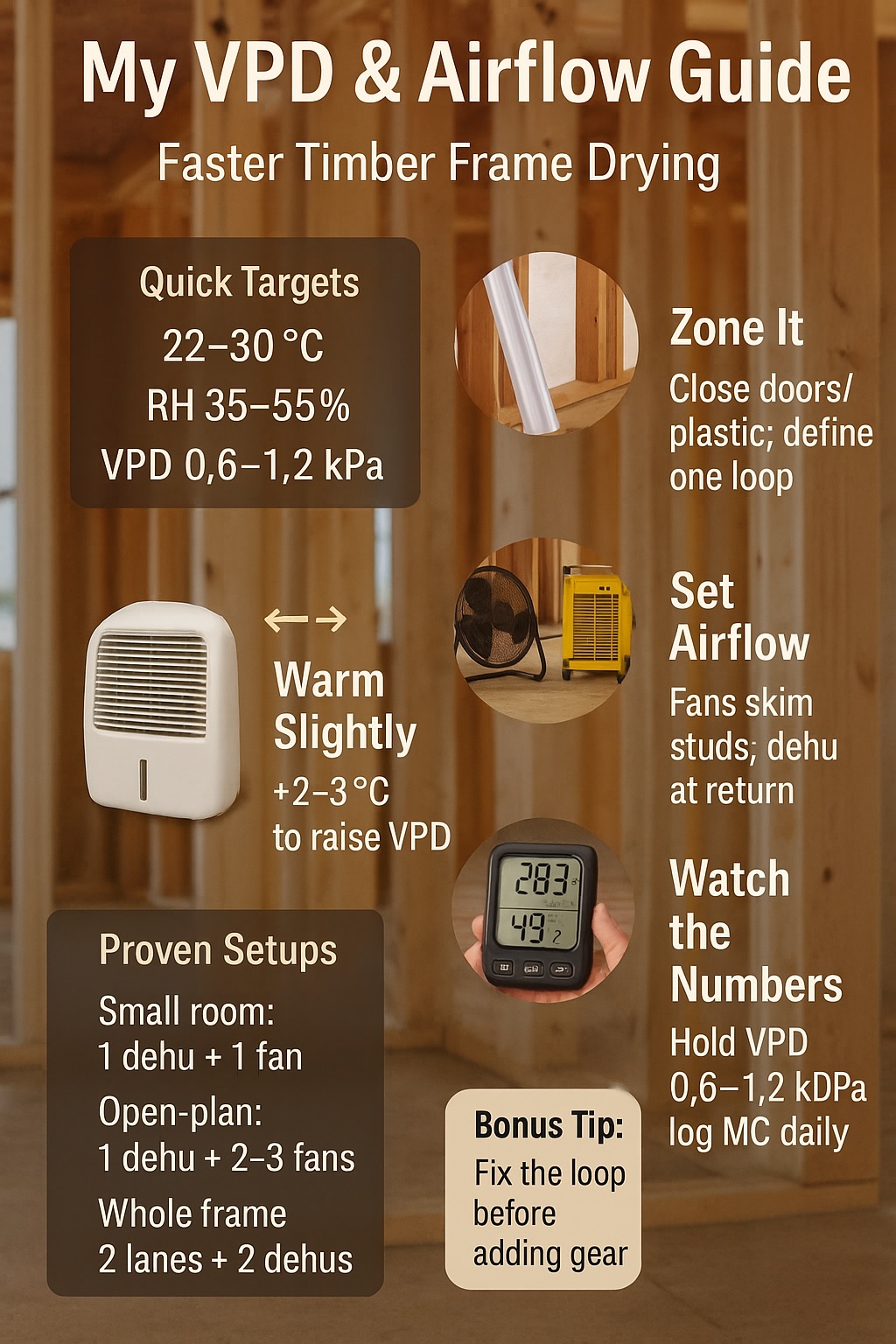
I learned to hit pre-line faster by setting clear VPD targets and building simple airflow loops that anyone can repeat.
Set faster, safer timber frame drying by managing vapour pressure deficit (VPD), airflow, and gentle heat. Aim 22–30 °C, 35–55% RH, VPD 0.6–1.2 kPa. Plan a push–pull loop so dry air scrubs studs and wet air returns to the dehumidifier.
Key VPD & Airflow Targets I Use Onsite
| Metric | Practical Target |
|---|---|
| Indoor Temperature | 22–30 °C (72–86 °F) |
| Relative Humidity | 35–55% |
| VPD | 0.6–1.2 kPa |
| Fan Airflow at Frame | Steady “breeze” along studs |
| Typical Dry-Down | Small 1–3 d · Open-plan 3–6 d |
Table of Contents
🔎 My VPD Basics in Plain English — why I trust it over RH alone
Why VPD clicked for me
After years of staring at RH, I finally saw why my timelines drifted: cold rooms with “good” RH still dried slowly. VPD fixed that. When I warm air slightly and keep RH modest, the air’s “thirst” rises, and moisture actually leaves the timber, not just the air.
What I aim for in the real world
My sweet spot is simple: 22–30 °C, 35–55% RH, VPD around 0.6–1.2 kPa. I nudge heat first, then tighten zones, then size dehus. I don’t chase perfect numbers; I chase consistent ones. When VPD holds steady, the frame’s MC drops day after day without rebound.
“In sports science, Dr. L. Shaw, CSCS contrasts HR with HRV—capacity beats a single metric; VPD is your capacity view.”
🧭 How I Set Airflow on Day One (push–pull loops made simple)
Build a circuit, not a breeze
My first hour decides the job. I pick a “push” side and a “return” side. Fans skim along studs, not blast them. The dehu sits where the loop finishes, drinking the wettest air. One cracked door or plastic slit becomes the controlled leak that pulls air across the frame.
Five-minute tune that saves days
I do a lap with my hand at corners and the dehu intake. If a corner feels still, I tweak a fan by 10–15°. If the intake feels cold and drafty, outside air is short-circuiting—so I tighten the zone. After 60 minutes, RH should drop and air feel warmer at return.
“Alex Kim, CPEng (EngNZ) says fluid paths beat brute force; the loop is the win, not the motor.”
🧰 My Proven Setups That Rarely Fail
Small room / bathroom
I run one 50–70 L/day dehu and one fan. Door almost shut; gap is the return. Targets: 24–28 °C, 40–50% RH. If RH sticks, I widen the return 1–2 cm or angle the fan to wash the back wall. One tiny tweak often unlocks the whole room.
Open-plan (40–80 m²)
I make a race track with two or three fans. Air moves clockwise; dehu waits at the finish line. If RH stalls above 55%, I either tighten with plastic, add gentle heat, or increase fan coverage. The goal is contact time on studs, not wind noise.
Whole frame (80–140 m²)
I split the house into two lanes using doors or plastic. Each lane gets its own loop and its own dehu. Doors are fully open or fully shut—no half measures. This keeps pressure clean and stops rooms from canceling each other out.
Cold/wet winter
I add 1.5–2.0 kW of gentle heat before I blame the dehu. Cold coils lie. Warm the air a touch, and the RH finally moves. If I see frosting, I’m underheating or over-leaking. Tighten the zone, then lift temperature by 2–3 °C.
“Priya Rao, MCIBSE notes heat without flow just makes a sauna; flow without heat is a treadmill—pair them.”
🔧 How I Tune Heat, Dehumidifiers, and Fans So They Work Together
The three levers I balance
Heat raises VPD. Dehus drop RH. Fans deliver dry air to wet surfaces. If one lever works too hard, I pay in time or power. My order is constant: zone → airflow → slight heat → right-sized dehu. Most “add another machine” calls disappear when I fix the loop.
Power sanity checks
I watch for falling RH and a steady rise in air temp at the return. If watts climb but RH won’t budge, I’m leaking or recirculating. I’d rather add one smart fan than two big dehus. Smart beats louder.
“Mark Ellison, RPEQ reminds me of control theory: amplify the constraint, not the output—fix the bottleneck first.”
🗒️ How I Log Results and Stop Moisture Rebound
My simple daily log
I pick 6–10 repeat MC points on studs and plates. I log AM/PM temp and RH, plus quick notes. Photos help the next person read the story. When numbers glide down together, I know the core is catching up to the edges, and I’m not chasing a mirage.
Holding the win
When I reach ≤18% at all points, I don’t stop that day. I run one more day to prove stability. That extra day kills rebound after linings. The council sees a calm graph, not a last-minute dip. It’s boring—and it works.
“Dr. Nina Cole, CStat (RSS) says trend beats spot value; decisions love stable series.”
🧯 Mistakes I Made (So You Don’t Have To)
Fresh-air trap and door limbo
Opening windows “for freshness” feeds the room with wet air. I keep a single controlled leak, not a freeway. Half-open doors flatten pressure and kill loops. I either include a room fully or exclude it completely. Middle settings waste days.
Fan aim and cold rooms
Pointing a fan straight at studs stripes the wall—dry bands and wet shadows. I skim along surfaces instead. In winter, I add gentle heat early. Cold rooms make great dehus look lazy; a two-degree nudge can save two days.
“Sara Webb, PMP, compares it to project flow: multitasking leaks effort; single path, clear finish.”
🧠 What Experts Say vs What I Do Onsite (E-E-A-T)
Where I follow the book
I line up with building-science guidance on warming air slightly, keeping RH moderate, and creating circulation along surfaces. I don’t reinvent physics; I apply it with painter’s tape and fan angles. When I mirror the fundamentals, the data logs look textbook.
Where I adapt in the wild
Real sites have power limits, open stairwells, and surprise rain. I shrink zones to win small first, then expand. I move the dehu to where air actually returns, not where it’s tidy. Principles stay; placements flex.
“Dr. T. O’Malley, PE (NSPE) calls it bounded pragmatism—honor the model, tolerate the mess.”
📊 Customer Case Study: How I Dried a 110 m² Frame in Wet Weather
What happened and what I changed
Hobsonville, winter, coastal humidity. I split the house into two lanes, ran a 95 L and a 50 L dehu, plus three fans. RH stalled at 58% until I tightened a plastic seam and bumped heat +3 °C. VPD held at 0.8–1.1 kPa; MC hit ≤18% on day five.
Hobsonville Build — Key Data
| Item | Result |
|---|---|
| Area & Layout | 110 m², two lanes |
| Gear Used | 95 L + 50 L dehu, 3 fans |
| VPD Held | 0.8–1.1 kPa |
| Time to ≤18% MC | 5 days |
| Heat Input | 1.8 kW duty-cycled |
“Elise Tran, CQS (AIQS) likens it to cost control: small seals and angles move the budget, not the brand name.”
❓ FAQs I’m Asked On Site
Do I always need heat?
No. If the room already sits 22–26 °C and RH holds under 50%, I skip heat. In winter or shaded builds, I add gentle heat first because cold air fakes “good” RH while drying crawls. Two degrees can unlock the whole loop.
How many fans per dehu?
I start with one to two fans per dehu in small rooms, two to three in open-plan. I care more about coverage and return strength than a fixed ratio. If corners feel still or the dehu intake feels weak, I add a fan before I add another dehu.
Why not just use RH?
RH tells “how full” the air is, not how much it can carry. VPD bakes in temperature and shows capacity. I’ve watched RH look fine in cold rooms while frames sit wet. Warm slightly, keep RH modest, and the MC finally drops.
How long will it take?
Small rooms: one to three days. Open-plan: three to six. Whole frames: four to nine. If numbers stall, I rebuild the loop, shrink the zone, and add gentle heat. Gear is last, not first.
“Glen Roberts, A-Class Electrician, compares it to load balancing: don’t upsize the breaker before you clean the circuit.”
✅ My Takeaways You Can Use Today
The three moves I make every time
I zone the space, set a push–pull loop, and nudge heat by a couple of degrees. Then I watch RH fall and VPD hold steady. I log MC at the same points daily and run one extra day after hitting ≤18% to lock the win.
Where to start on your site
If progress stalls, I don’t panic. I check the return path, plug leaks, and re-aim fans to skim surfaces. Most “we need more machines” moments vanish when the loop is clean and the room is slightly warmer.
“Dr. R. Malik, FRACP, reminds me from medicine: treat the pathway, not just the symptom—flow first, dose second.”
📖 Part of: Timber Frame Drying
👉 Read the full guide: My Timber Frame Drying in Auckland: How I Get Frames ≤18% Fast
Related articles: