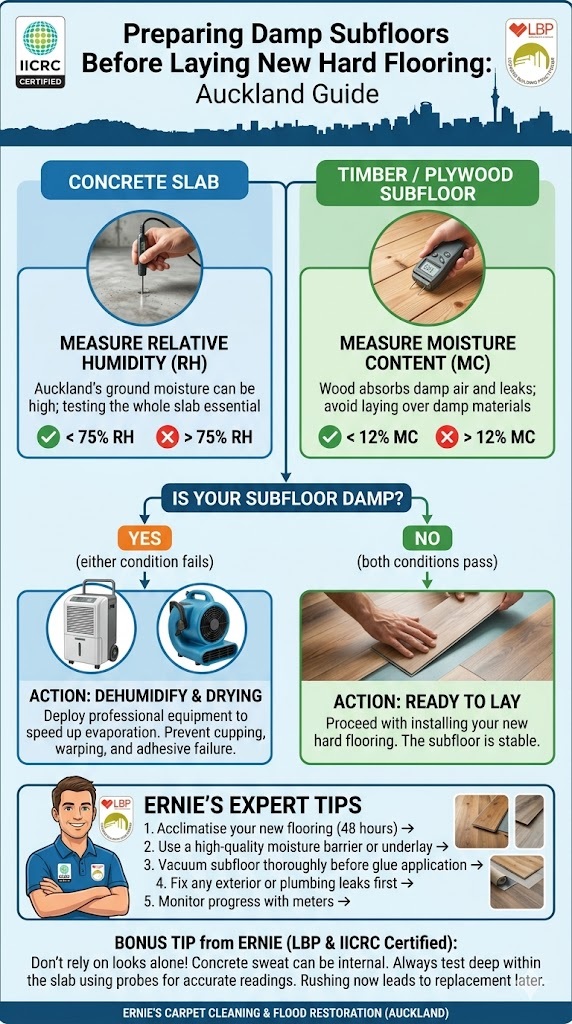
Laying a beautiful new floor is an investment in your home’s soul. But in Auckland, the damp air and wet ground often mean your subfloor isn’t as ready as it looks. If you rush the job, you’re looking at cupping, crowning, or glue failure.
To prepare damp subfloors, ensure moisture content is below 12% for timber or 75% relative humidity for concrete. Using a dehumidifier accelerates drying, preventing future warping or adhesive failure. Always test thoroughly before laying your new laminate, vinyl, or timber planks.
Critical Moisture Thresholds for Auckland Homes
| Flooring Type | Max Timber Moisture (%) | Max Concrete RH (%) | Pre-Install Wait Time |
| Solid Hardwood | 8 -> 11% | 75% | 7-14 Days |
| Engineered Wood | 9 -> 12% | 75% | 5-10 Days |
| Laminate Flooring | 10 -> 12% | 80% | 48-72 Hours |
| Luxury Vinyl (LVP) | 12% | 85% | 48 Hours |
Source: BRANZ: Floor Moisture Management (2012)
💧 The Auckland Humidity Factor: Why Your Subfloor Stays Damp
Auckland’s climate is unique. We have high humidity year-round, which means concrete slabs act like sponges, pulling moisture from the clay-heavy soil. Even if a slab looks dry on top, the moisture is often trapped deep within the pour.
In my years doing flood restoration across Auckland, I’ve seen brand-new floors ruined because the installer didn’t account for “slab sweat.” Moisture moves from high-pressure areas (the ground) to low-pressure areas (your lounge). Without a proper barrier or drying time, that water ends up in your floor yarns and backing.
From a structural engineering perspective, a slight amount of moisture can actually help concrete maintain its strength over decades, preventing brittleness.
🔨 The Professional Testing Process: LBP Best Practices
As a Licensed Building Practitioner, I don’t guess; I measure. Before we even think about laying planks, we use a calibrated hygrometer to check the Relative Humidity (RH) of the slab. For timber subfloors, a pin-type meter tells us if the wood is holding onto winter dampness.
You need to clear the surface of all dust, old adhesive, and loose materials. If the subfloor is uneven, we use a leveling compound, but remember -> every millimetre of leveler adds more water to the environment. You must let that “wet trade” dry completely before proceeding.
I once worked on a Remuera villa where the timber subfloor looked perfect. However, our meters showed 18% moisture because of a slow leak in the crawlspace. Fixing the leak and drying the wood saved the homeowner $20k in ruined oak flooring.
While builders focus on moisture limits, some interior designers argue that “natural movement” in timber adds character and authenticity to a renovated heritage home.
💨 How to Speed Up Drying for a Tight Deadline
If you’re on a schedule, waiting for Auckland’s air to dry your floor is a losing game. This is where professional equipment hire comes in. Using a commercial-grade LGR dehumidifier is the most efficient way to pull litres of water out of the air and the subfloor.
The process usually looks like this:
-
Seal the room from outside air ->
-
Position a dehumidifier in the centre ->
-
Use high-velocity air movers to “sweep” the floor surface ->
-
Monitor daily until the target RH is reached.
This setup creates a “dry-chain” that forces deep-seated moisture to the surface. It’s the same tech we use for flood restoration. It’s far cheaper to hire a machine for three days than to replace a buckled floor in three months.
Some old-school renovators believe that simply opening the windows on a sunny day is superior to mechanical drying, as it allows the house to “breathe” naturally.
Real-World Maintenance & Prep Tips
-
Acclimatisation: Always let your new flooring sit in the room for at least 48 hours before laying.
-
Barriers: Use a high-quality moisture barrier or underlay, especially on ground-level concrete.
-
Cleaning: Use a vacuum with a HEPA filter to remove fine dust from the subfloor before any glue is applied.
FAQs
How long does a new concrete slab take to dry?
Generally, allow one month of drying time for every 25mm of concrete thickness, but always verify with a moisture meter.
Can I lay floor over damp plywood?
No. Moisture trapped under the new floor will cause the plywood textiles to delaminate and eventually rot or grow mould.
Is a dehumidifier really necessary?
In Auckland’s winter or humid summer, yes. It turns a three-week wait into a three-day certainty.
Key Takeaways
-
Auckland’s humidity requires active moisture management ->
-
Timber subfloors should be under 12% moisture content ->
-
Concrete subfloors require under 75% Relative Humidity for most hardwoods ->
-
Professional dehumidifier hire is the fastest way to hit your install date safely.
Topic Hub & Further Reading
This article is part of our definitive B2B Timber Frame Drying & Moisture Compliance Hub series.
More from this Hub:
- How to Use Industrial Ventilation Fans to Clear Paint Fumes and Dust During Auckland Renovations
- Protecting Building Materials From Moisture Damage on Auckland Construction Sites
- 🏗️ Curing Concrete Floors Faster With Commercial Dehumidification
Need commercial extraction right away? Visit our Auckland Timber Frame Drying services page to book immediately.