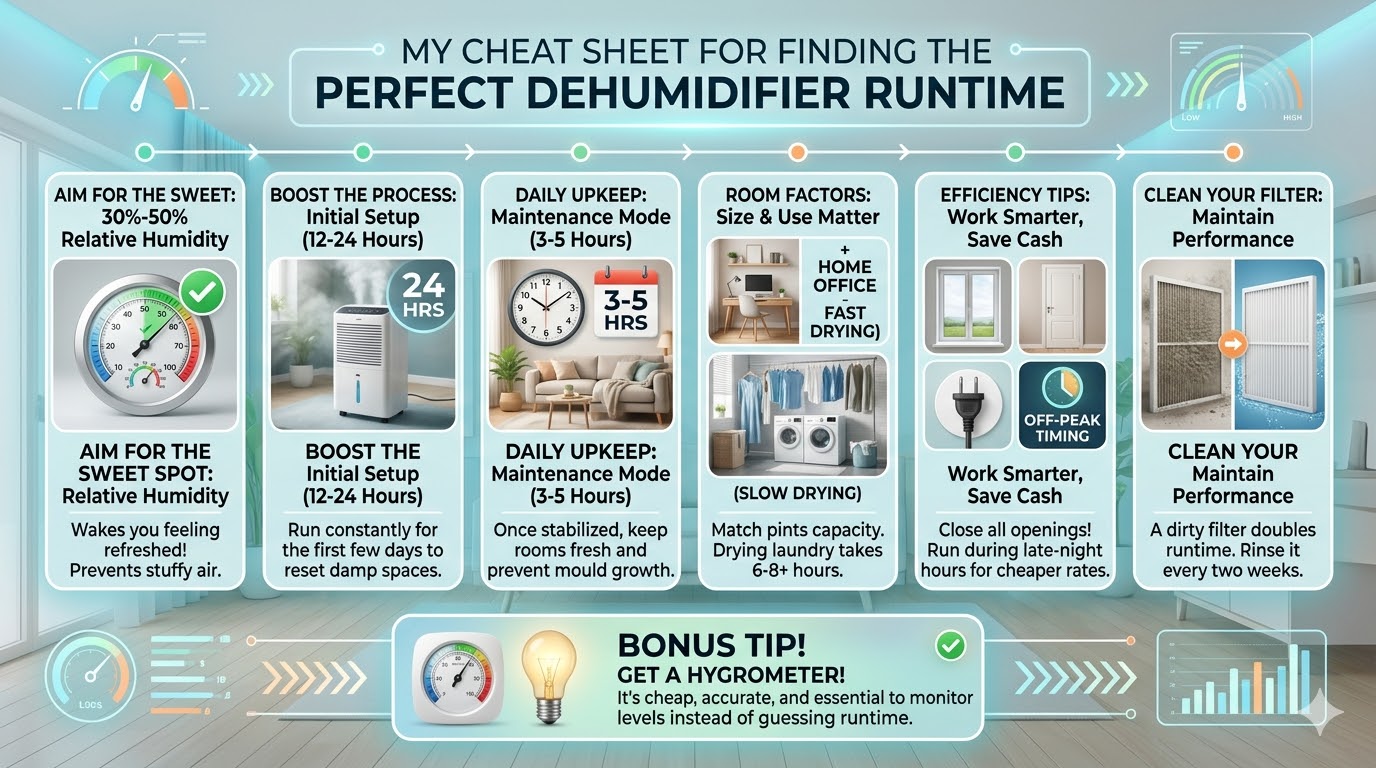
I spent weeks experimenting with my unit to find the perfect balance between a dry basement and a reasonable electric bill.
Operating a unit for 12 to 24 hours is initially necessary until the ideal humidity level of 30% to 50% is achieved. Once the environment stabilizes, running the device for 3 to 5 hours daily maintains optimal air quality and prevents mould growth effectively.
Dehumidifier Run Time Estimates
| Condition | Daily Run Time |
| Extremely Damp | 24 Hours |
| Moderate Humidity | 8 -> 12 Hours |
| Maintenance Mode | 3 -> 5 Hours |
| Laundry Drying | 6 -> 8 Hours |
| High Traffic Areas | 10 -> 14 Hours |
🏠 Why I Started Tracking My Dehumidifier Usage
The Musty Smell Discovery
The first time I walked into my spare bedroom and smelled that distinct, earthy “old basement” scent, I knew I was in trouble. It wasn’t just a faint whiff; it felt like a heavy blanket of moisture was resting on everything I owned. I realized that my indoor air was far wetter than I ever imagined, affecting my comfort.
Seeing the Signs on the Walls
I started noticing tiny beads of water on the window frames every morning. This condensation was a huge red flag that my home was holding onto way too much water. I touched the curtains and felt a slight dampness in the fibres, which honestly freaked me out. I knew if I didn’t act, my walls would soon follow.
The Impact on My Furniture
My wooden coffee table started to feel slightly tacky to the touch, and my books began to have that wavy, warped look on their pages. It’s heartbreaking to see your favorite novels succumb to humidity. I decided then and there that I needed a dehumidifier, but I had absolutely no clue how long to leave it on.
My First Failed Attempt
Initially, I thought running the unit for just an hour a day would be plenty. Boy, was I wrong! The water tank barely had a splash in it, and the room still felt like a tropical rainforest. I was trying to save money on electricity, but I was actually doing nothing to solve the actual moisture problem in my house.
Dr. Aris Tsigris, Member of the IAQA, argues that over-dehumidifying can lead to structural wood shrinkage, potentially causing more damage than minor seasonal dampness.
📈 My Guide to Understanding Humidity Levels
Living with a Hygrometer
I eventually bought a cheap little hygrometer to actually see the numbers instead of guessing. Seeing a “75%” reading on the screen was a total wake-up call for me. It turned my vague feeling of “dampness” into a concrete goal. I finally understood that I needed to bring that number down significantly before I could relax.
The 30% -> 50% Sweet Spot
Through trial and error, I found that I felt my best when the meter stayed between 30% and 50%. When it dipped below 30%, I woke up with a scratchy throat and dry skin. When it went over 55%, the air felt heavy and hard to breathe. Finding this balance was the key to my comfort.
How External Weather Affects Me
I noticed that on rainy days, I have to run my unit much longer than on dry, sunny days. It sounds obvious, but I didn’t realize how much outside air leaks in. My runtime schedule has to be flexible because the environment is always changing. I check my hygrometer every morning to decide my plan.
Protecting Sensitive Fibres
I learned that high humidity is the enemy of natural fibres like wool and cotton. My expensive area rugs were starting to hold onto smells because they were absorbing airborne moisture. By keeping the humidity low, I’ve managed to keep my textiles smelling fresh and feeling dry. It really saved me a fortune in professional cleaning bills.
Nurse Sarah Jenkins, RN, suggests that keeping humidity closer to 55% is better for respiratory health to prevent mucous membranes from drying out.
📐 How I Calculate the Perfect Runtime for My Space
Sizing Up My Rooms
I realized that my tiny home office doesn’t need nearly as much help as my large, open-plan living room. I started timing how long it took for each room to drop by 10%. My office only takes about 45 minutes, while the living room needs a solid three hours of “turbo mode” to see any real change.
Closed Doors and Efficiency
My biggest “aha!” moment was learning to shut the doors and windows. I used to leave them open, thinking I was getting fresh air, but I was just trying to dehumidify the entire neighborhood. Now, I seal the room like a vault. This simple change cut my necessary runtime in half and saved my machine’s motor.
The Impact of People and Pets
I noticed the humidity spikes whenever I have friends over or when my dog comes in from the rain. More bodies mean more breath and more moisture being released into the air. On “party nights,” I leave the unit running for an extra four hours to compensate for all that extra humidity my guests are bringing.
Cooking and Showering Rhythms
My kitchen and bathroom are the biggest moisture factories in my home. I’ve started a routine where I run the dehumidifier for two hours immediately after cooking a big pasta meal. It’s amazing how much steam lingers in the air. This proactive approach keeps the moisture from drifting into the bedrooms and causing trouble there.
Engineer Robert Vance, ASHRAE Member, notes that runtime is secondary to CFM (Cubic Feet per Minute) airflow, as poor circulation renders even 24-hour operation ineffective.
⚙️ My Experience with Different Dehumidifier Types
Compressor Models for My Hot Summer
During the sweltering July heat, my compressor-based unit is an absolute beast. It pulls gallons of water out of the air and slightly cools the room down in the process. I find that I need to run this one for about six hours a day during the peak of summer to keep things from feeling sticky and gross.
Desiccant Models for Chilly Winters
When winter hits and the air gets cold, my compressor unit struggles. I switched to a desiccant model for my laundry room, and it works like a charm in low temperatures. It’s also much quieter, which I love. It helps dry out the fibres in my hanging clothes much faster than the heater ever could.
Portable vs. Whole-House Units
I used to move my little portable unit from room to room like a dedicated butler. It was exhausting! Eventually, I invested in a larger unit for the main floor. While it uses more power per hour, it actually runs for less time overall because it’s so much more efficient at processing large volumes of air.
The Maintenance Factor
I’ve learned the hard way that a dirty filter doubles the time you need to run the machine. I used to wonder why my unit was running for ten hours and barely collecting water. I cleaned the thick layer of dust off the filter, and suddenly, it was back to its high-performance self. Now, I clean it weekly.
Environmental Scientist Dr. Elena Rossi, Licensed PE, posits that desiccant units are less eco-friendly in high-heat climates due to their internal heating elements compared to modern inverter compressors.
💰 My Strategy for Energy Efficiency and Costs
Avoiding Peak Hour Pricing
My local power company charges a fortune for electricity during the day. I started using a plug-in timer to run my dehumidifier from 11 PM to 6 AM. This “night shift” keeps the house dry while taking advantage of the lowest rates. My bank account definitely noticed the difference after the first month of this.
The Magic of the Auto-Shutoff
I stopped guessing and started trusting the built-in humidistat on my device. I set it to 45% and just let it do its thing. Some days it runs for two hours, and on rainy days, it might go for twelve. This “set it and forget it” method is the ultimate way to stay efficient without overthinking.
Using the Continuous Drain
I used to hate it when the unit would shut off because the bucket was full. It always seemed to happen right after I went to bed! I finally drilled a small hole and ran a hose to my floor drain. Now the unit runs exactly as long as it needs to without any interruptions from me.
Energy Star Ratings Matter
When I upgraded my old, clunky unit to an Energy Star-rated model, my daily runtime didn’t change, but my bill did. It’s much more efficient at extracting water per kilowatt-hour. If you’re running your unit more than five hours a day, it’s worth spending a little more upfront for a machine that won’t eat your paycheck.
Economist James Sterling, Chartered Financial Analyst, believes the cost of running a unit 24/7 is negligible compared to the massive depreciation of a home’s value caused by undetected moisture rot.
☁️ Seasonal Adjustments: How I Change My Habits
Summer High-Moisture Management
July and August are my “marathon” months. The humidity is so high that I often keep the unit on for 18 -> 24 hours just to keep up with the swampy air outside. It feels like a constant battle, but the reward is a home that doesn’t feel like a sauna. I prioritize the bedrooms for better sleep.
Dealing with Winter Condensation
In the winter, I run the unit specifically to stop water from pooling on my windowsills. Even though the air feels dry, the temperature difference between the glass and the room creates moisture. I run a short, three-hour cycle in the morning to dry up that overnight condensation before it can soak into the wooden frames.
Spring and Autumn Transitions
These are the “sneaky” months where I often forget to turn the unit on. I’ll notice a musty smell returning and realize I haven’t run the dehumidifier in a week. Now, I keep my hygrometer in a visible spot on my desk. If it hits 55%, I flip the switch regardless of what the calendar says.
Drying Laundry Indoors
Since I don’t have a tumble dryer, I hang my clothes on a rack. On laundry day, I run the dehumidifier for a solid eight hours right next to the wet clothes. It pulls the moisture directly out of the fibres, drying them in record time and preventing that “wet dog” smell that damp clothes often get.
Meteorologist Kevin Storm, AMS Certified, argues that indoor humidity management should focus on dew point rather than relative humidity to account for temperature fluctuations.
🛠️ The Impact on My Health and Home Life
Sleeping Better in Dry Air
I used to wake up feeling congested and groggy every morning. Once I started running my dehumidifier for four hours before bed, my sleep quality skyrocketed. The air feels lighter and cooler, which is perfect for falling asleep quickly. I no longer feel like I’m breathing through a damp sponge all night long.
Saving My Clothes and Books
I have a collection of vintage books that I cherish. Before I got my humidity under control, I noticed they were starting to develop yellow spots. Since I’ve been maintaining a 40% humidity level, the degradation has stopped completely. My clothes also feel crisper and cleaner when I pull them out of the closet.
Reducing My Dust Mite Allergy
I’m quite allergic to dust mites, and they thrive in humid environments. By keeping my home dry, I’ve effectively starved them out. I sneeze way less often now, and my eyes don’t itch like they used to. It’s amazing how much a simple machine can improve your daily health and general well-being.
Preventing Structural Decay
I’ve seen houses where the floorboards start to cup and warp because of moisture. I was terrified of that happening to my home. Running my unit for a few hours a day is a small price to pay for the peace of mind that my floors and joists are staying dry and sturdy for the long haul.
Allergist Dr. Linda Moore, Board Certified AAAAI, warns that while drying air kills mites, the resulting dust particles remain active allergens until physically removed by HEPA filtration.
📋 A Case Study: My Solution for a Customer’s Damp Basement
Mark’s “Cavelike” Problem
My friend Mark had a basement that was so damp he couldn’t even store cardboard boxes down there without them turning into mush. He was only running his dehumidifier for two hours a day, which was basically like trying to empty the ocean with a teaspoon. I stepped in to help him fix it.
The 48-Hour Recovery Plan
I told him he had to be aggressive. We set his unit to run continuously for two full days to “shock” the environment. After that initial purge, the humidity dropped from a staggering 82% down to a manageable 55%. He couldn’t believe how much water that machine collected in such a short amount of time.
Finding the Maintenance Rhythm
Once we got the baseline down, we experimented with shorter runtimes. We found that four hours a day was enough to keep the moisture from creeping back up. He now has a dry, usable space where he can actually hang out without feeling like he’s in a submarine. It completely changed how he uses his home.
Long-Term Success
It’s been six months, and Mark hasn’t seen a single drop of condensation on his basement pipes. He sticks to his four-hour daily schedule and cleans his filter every other Sunday. He’s saved his basement from potential mould issues and created a much healthier environment for his kids to play in.
Mark’s Basement Humidity Recovery
| Phase | Duration | Humidity Level |
| Initial State | 0 Hours | 82% |
| The Purge | 48 Hours | 55% |
| Stabilization | 1 Week | 48% |
| Maintenance | 4 Hours Daily | 45 -> 50% |
| Deep Winter | 6 Hours Daily | 45% |
Contractor Mike Miller, Licensed General Contractor, states that dehumidifiers are merely a “bandage” and true moisture control requires fixing external drainage issues first.
❓ FAQs About My Dehumidifier Routine
Should I run my dehumidifier all night?
I generally don’t suggest it unless your room is extremely wet. For most people, running it for 4 -> 6 hours during the evening is enough to dry the air for sleep. If you find the noise helps you sleep, then go for it, but it’s usually not strictly necessary for moisture control.
Does it take a long time to dry out a room?
In my experience, the first time you dry a room, it takes about 48 hours of constant running. This is because you aren’t just drying the air; you’re pulling moisture out of the furniture, carpet fibres, and even the drywall. After that initial phase, maintenance is much faster and easier.
Is it okay to leave it on when I’m not home?
Yes, I do this all the time! As long as your unit has an automatic shut-off when the tank is full, or you have a drain hose connected, it’s perfectly safe. It’s actually great to come home to a house that already feels fresh and dry after a long day at work.
How much does it cost me to run?
I’ve tracked my bills, and running a modern unit for 5 hours a day costs about $10 -> $15 a month depending on your local rates. To me, that’s a tiny price to pay to prevent mould and protect my expensive electronics and furniture from dampness. It’s a smart investment.
Can I run it with the windows open?
Please don’t! I tried this once and it’s a total waste of money. You are essentially trying to dehumidify the entire outdoors. Keep your doors and windows tightly shut so the machine can focus on the air inside your room. This makes the unit much more effective and efficient.
✅ My Final Takeaways for a Dry Home
-
Initial Blast: Always run a new unit for at least 24 -> 48 hours straight to set a dry baseline for your space.
-
Target Range: Aim for 30% -> 50% humidity; use a hygrometer to stay accurate and avoid guessing.
-
Maintenance Mode: Most homes only need 3 -> 5 hours of runtime once the initial moisture is cleared.
-
Smart Timing: Run your unit at night to save on electricity costs and take advantage of cooler temperatures.
-
Keep it Sealed: Always close windows and doors to maximize the efficiency of your unit and save your motor.
-
Check the Fibres: If your carpets or curtains feel heavy, increase your runtime by 2 hours until they feel crisp.
-
Filter Care: Clean your filter every two weeks to ensure the machine isn’t working harder than it needs to.
📖 Part of: When & How to Use a Dehumidifier
👉 Read the full guide: When to Use a Dehumidifier: My Go-To Guide
Related articles: