Commercial drying equipment with moisture checks—not guesswork.
Dry Me Now helps Auckland homes, trades and property managers dry wet materials with a practical, measurable process. Instead of relying on how a carpet or wall feels, we match commercial equipment to the affected space and use moisture checks to track progress.
1. Tell us what is wet
Start with the source of moisture, the rooms affected, the material involved and how long it has been wet. Photos, room size and access details help us recommend an appropriate setup for a plumbing leak, wet carpet, timber framing, renovation drying or persistent humidity.
2. We size the drying setup
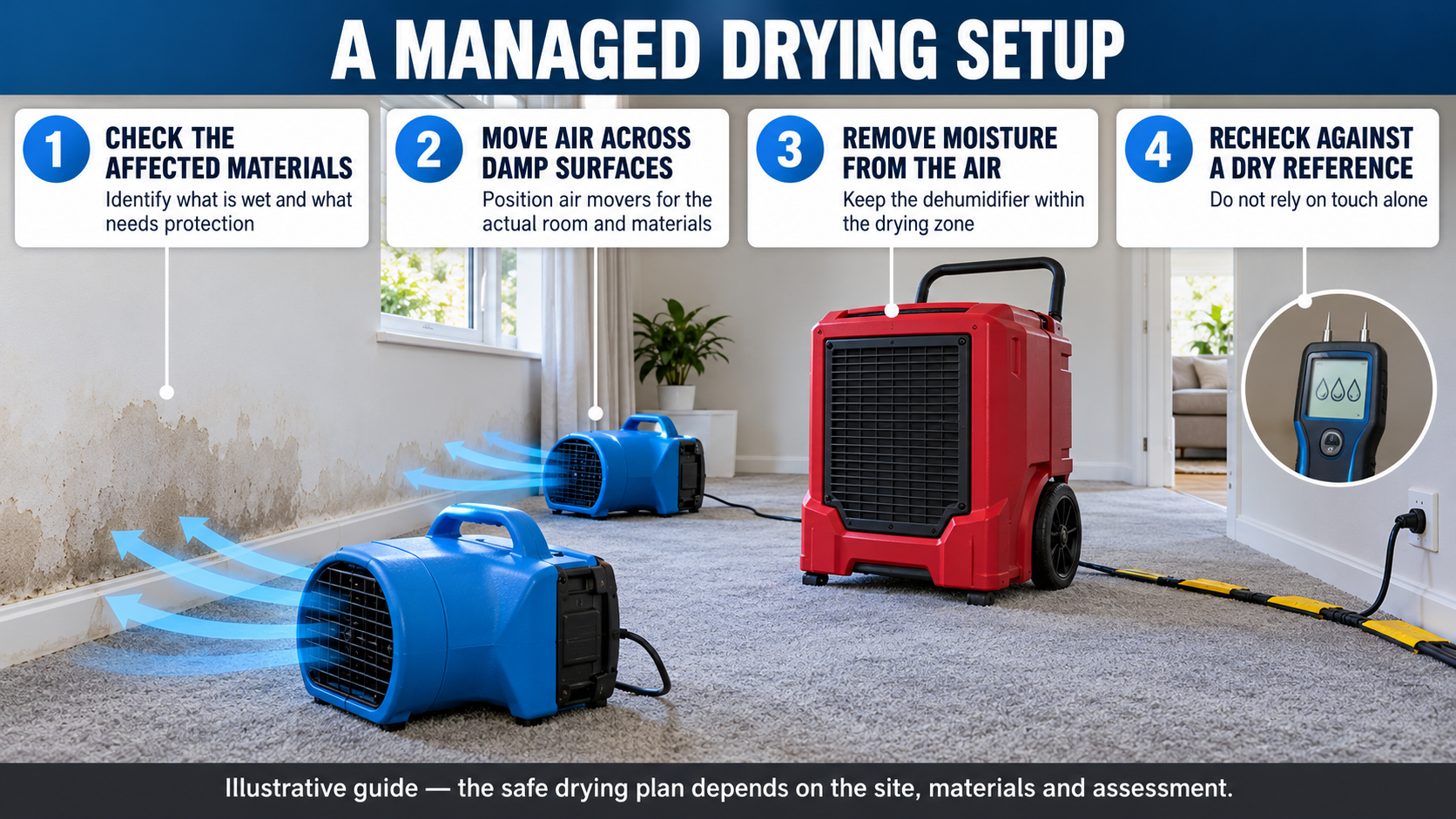
Our standard Auckland hire package centres on a commercial 90L dehumidifier, two drying fans, a moisture meter and an on-site thermal assessment where suitable. Fans promote evaporation; the dehumidifier removes that moisture from the air. For larger, colder or multi-room jobs, the equipment plan can be scaled around the measured conditions.
3. Delivery, placement and safe setup
Dry Me Now delivers and collects equipment across Auckland. We explain where to place the unit and air movers, how to keep the drying zone controlled, and what to avoid around electrical hazards or contaminated water. If the water has travelled into walls, cavities or multiple rooms, a professional flood-restoration assessment may be the safer next step.
4. Check moisture—do not guess
Drying is not finished just because the surface feels dry. Use the supplied moisture meter to compare affected materials with nearby dry areas and check progress over time. This is especially important for carpet and underlay, skirting, wall linings and timber framing.
5. Finish when readings support it
Drying time varies with the moisture load, material, temperature, airflow and how far water has travelled. Equipment should be removed when readings indicate the affected materials have returned to an appropriate dry condition—not solely after a fixed number of days.
What is included in the Dry Me Now setup?
- Commercial 90L dehumidifier: high-capacity moisture removal for contained drying zones.
- Included drying fans: create airflow across carpet, walls, framing and other wet surfaces.
- Moisture meter: supports measured progress checks instead of surface-level judgement.
- Thermal assessment: helps identify likely moisture movement where appropriate.
- Auckland delivery and pick-up: equipment brought to and collected from your site.
Featured commercial drying example: concrete wall preparation before painting
This video records preparation at an Auckland commercial interior with concrete and blockwork walls. The site used five air movers and two commercial dehumidifiers. The clip also shows temporary cable routing, unfinished wall surfaces and a parked vehicle in the workspace.
Air movers support evaporation by moving air across a surface, while dehumidifiers remove moisture from the air. The five-air-mover and two-dehumidifier configuration was selected for this site; equipment quantity and placement depend on the space, temperature, moisture conditions, drainage and power access. Final substrate requirements, including any moisture or preparation criteria, remain the painter’s or coating supplier’s decision.
What this footage shows—and what it does not
- Shows: five air movers, two commercial dehumidifiers, a concrete and blockwork interior, temporary power leads and the wall condition during preparation.
- Does not show: moisture-meter readings, wall moisture content, equipment sizing, drying duration, paint-system requirements or final coating approval.
For suitable projects, see commercial dehumidifier and drying fan hire in Auckland. Equipment selection depends on the site, materials, safe power, drainage and access.
Choose the right Dry Me Now service
For wet carpet and floor coverings, see our carpet dryer and fan hire. For water that has spread beyond a contained area, see flood restoration in Auckland. Builders can also use our timber-frame drying service.
Frequently asked questions
Do I need fans with a dehumidifier?
In most wet-material drying situations, yes. Air movers speed evaporation from the material and the dehumidifier removes that moisture from the air. The exact number of fans depends on the room and moisture load.
How do I know when my carpet or wall is dry?
A moisture meter provides a more useful indication than touch alone. Compare readings with unaffected material and keep checking during the dry-out.
When should I call for flood restoration rather than hire equipment?
Call for professional assessment when water is contaminated, creates an electrical risk, has entered walls or cavities, or affects several rooms. Prompt extraction and moisture mapping can help limit further damage.