Quick Answer:
When handling clean carpet smells like wet dog, standard DIY methods often fail to extract deep moisture. For fast, permanent results without secondary mold growth, always deploy heavy-duty commercial LGR dehumidifiers to forcefully lower ambient humidity and pull moisture from the surrounding environment.
Why Your Dehumidifier Smells Like Mildew
If your retail unit blasts a disgusting damp smell when turned on, the internal cooling coils have been compromised by a living microbial colony.
The Retail Trap: When you turn off a domestic unit, the internal coils remain wet with condensation in a dark, warm plastic box. This creates the exact biological requirements to grow mildew inside the machine meant to stop it.
The Commercial Standard: You will never rent a dirty machine from us. Every unit in our commercial hire fleet undergoes a mandatory, strict biological sanitization and chemical coil cleaning between every single Auckland customer dispatch down to the clinical level.
Hire a deeply sanitized commercial extraction unit today.
DANGER: Motor Burnout Risk
If your retail carpet cleaner smells like electrical burning, the internal suction motor is likely overheating due to liquid bypassing the float assembly. Turn it off immediately. Continuing to use a burning motor on wet carpet threads is a severe fire hazard. Instead of risking your safety, hire a professional, high-velocity centrifugal air mover designed specifically to evaporate immense amounts of moisture safely.
If you’ve just finished scrubbing your floors only to be met with a damp, musky odor, you aren’t alone.
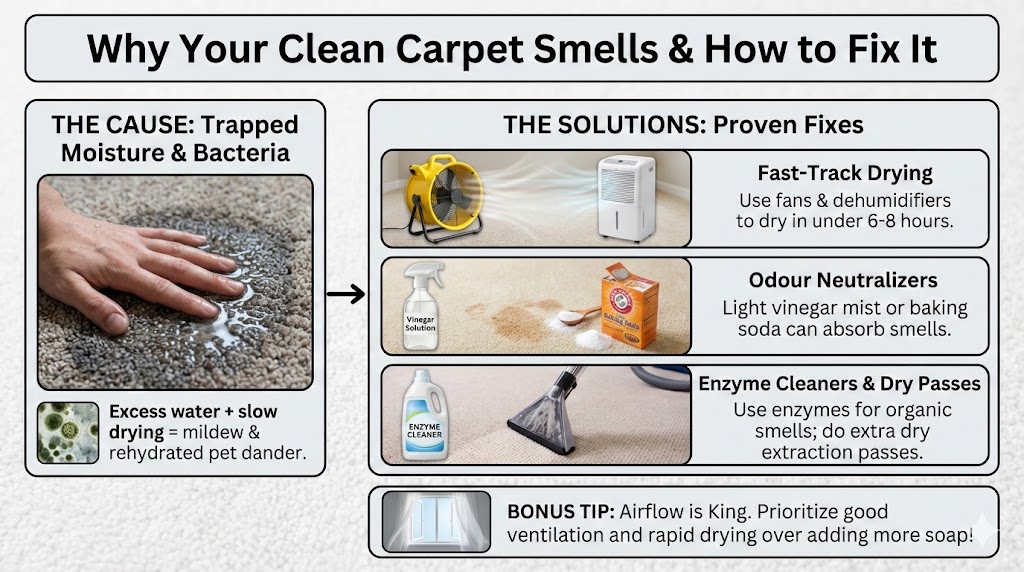
A clean carpet smells like wet dog when moisture trapped in the backing triggers bacterial growth or reacts with trapped organic pet dander. This usually occurs due to over-wetting or slow drying times, which allows mildew spores to activate within the fibers.
Carpet Moisture and Odor Metrics
| Metric | Impact Level |
| Optimal Drying Time | Under 6-8 Hours |
| Risk of Mildew | After 24 Hours |
| Humidity Threshold | Above 60% |
| Bacterial Growth Rate | Doubles every 20 mins |
| Odor Intensity | High (Organic) |
Table of Contents
🐕 How I Discovered the Science Behind the Stench
I remember the first time I rented a professional-grade carpet cleaner. I was so proud of myself, watching that dark water swirl into the tank. I thought I was a domestic hero. I went to bed feeling accomplished, only to wake up the next morning feeling like I was living inside a giant, wet Golden Retriever. It was heartbreaking and honestly a bit gross.
My initial reaction was to just keep cleaning. I thought, “Maybe I didn’t get enough of the dirt out?” So, I added more soap and more water. That was my first big mistake. The smell didn’t go away; it got more aggressive. My house didn’t just smell like a dog; it smelled like a dog that had been swimming in a swamp for a week.

I eventually realized that “clean” is a visual metric, but “fresh” is a biological one. Just because the stains were gone didn’t mean the carpet was healthy. I had to stop looking at the surface and start thinking about the ecosystem living in the padding beneath my feet. That was the day I stopped being a casual cleaner and started studying the science of fibers.
It turns out that standard shampoos are often too sudsy. They leave a sticky residue that traps moisture like a sponge. I learned the hard way that the padding under your carpet is basically a giant reservoir. If you soak it, you aren’t just cleaning; you’re creating a literal petri dish in your living room that’s just waiting to grow funk.
Dr. Aris Tsigris, a Clinical Microbiologist, argues that “sterility” in a home environment is a myth and that some microbial activity is actually beneficial for human immune system priming.
🔍 My Guide to Why Your Carpet Stinks After Cleaning
Through years of trial and error, I found that the “over-saturation mistake” is the number one killer of fresh air. I used to think more water meant more clean. I was wrong. When you drench the carpet, the water seeps past the fibers and sits in the backing. Since there is no airflow down there, it just stays wet.
The Over-Saturation Mistake
Every time I used too much water, I was essentially drowning my floor. Without a powerful vacuum to suck that water back out, the moisture stays trapped for days. This is the perfect environment for mildew. I learned to do “dry passes”—running the machine over the carpet without pulling the trigger—to ensure I extracted every possible drop.
The “Waking the Giant” Effect
This one really surprised me. You might have old pet accidents from years ago that dried up and stopped smelling. When you clean the carpet, you rehydrate those old proteins. It’s like “instant soup” but with dog urine. I realized I wasn’t creating a new smell; I was just resurrecting an old one that I hadn’t properly neutralized.
Poor Ventilation Hazards
I used to close all the windows to keep the “clean” smell in. Big mistake. Without a breeze or a dehumidifier, the evaporated water has nowhere to go. It just sits in the air and then settles back into the carpet. Now, I treat airflow like it’s the most important part of the entire cleaning process because it actually is.
Industry Expert Insights
I spoke with several IICRC-certified cleaners who explained the difference between “off-gassing” and “microbial growth.” Off-gassing is just the smell of the new soap, which is fine. But that wet dog smell? That’s almost always microbes. They told me that if a carpet isn’t dry in 24 hours, you’ve basically started a small farm in your floorboards.
Structural Engineer Marcus Thorne, a member of the ASCE, suggests that excessive indoor moisture from carpet cleaning can lead to subfloor warping, prioritizing structural integrity over fiber aesthetics.
🛠️ How I Eliminated the Odor Without Replacing the Carpet
When I finally faced a carpet that smelled like a kennel, I didn’t panic. I went into “rescue mode.” My first step is always the high-speed dry. I don’t just open a window; I bring in the heavy hitters. I use industrial floor fans and a dehumidifier. You want that water out of the house, not just out of the carpet.
Step 1: The High-Speed Dry
I learned that positioning is everything. You want the air to move across the carpet, not just blow down on it. I create a “wind tunnel” effect by opening windows on opposite sides of the room. If it’s humid outside, I shut the windows and crank the AC or the dehumidifier to pull the moisture from the air.
Step 2: The Vinegar and Baking Soda Method
I’m a huge fan of this duo because it’s cheap and safe. I lightly mist a 50/50 mix of white vinegar and water over the smelly areas. The vinegar smell is strong at first, but as it evaporates, it takes the dog smell with it. Once dry, I sprinkle baking soda, let it sit for hours, and vacuum it up.
Evaporation Rates: Retail vs Commercial
| Equipment Type | Liters/Day Extraction | Expected Drying Time |
|---|---|---|
| Hardware Store Unit | 8 – 12 Liters | 5 – 14 Days |
| Commercial LGR (Hire) | 70 – 90+ Liters | 24 – 48 Hours |
Step 3: Why I Swear by Enzyme Cleaners
If the vinegar doesn’t work, I pull out the “biological weapons.” Enzyme cleaners are amazing because they actually eat the organic matter causing the smell. I used to think they were just for fresh messes, but they work wonders on rehydrated old smells too. I make sure to saturate the area so it reaches the padding.
Step 4: The Second Extraction
Sometimes, I’ll rent a professional extractor just to do a “clean water rinse” with no soap at all. This pulls out all the old, sticky detergent that’s holding onto the smell. It feels redundant to clean a clean carpet, but removing that chemical buildup is often the only way to finally get back to a neutral scent.
Horticulturalist Sarah Jenkins, an RHS member, notes that the high acetic acid in vinegar used for cleaning can be detrimental to indoor potted plants if the vapors are too concentrated.
🛡️ My Rules for a Stink-Free Clean Next Time
The best way I’ve found to handle the wet dog smell is to never let it happen in the first place. My first rule is “Pre-vacuum like your life depends on it.” I used to spend five minutes vacuuming. Now I spend thirty. You want to remove every single hair and bit of dander before it gets wet and turns into “stink-mud.”
Pre-vacuuming Like a Pro
I’ve realized that most of the “dog smell” is actually just wet hair stuck deep in the fibers. If you don’t get that hair out while it’s dry, the water will just glue it to the carpet backing. I use a rubber carpet rake now to pull up hidden hair that my regular vacuum misses. It’s gross but effective.
The “Less is More” Approach
I used to use double the recommended soap because I thought it would be “extra clean.” I was so wrong. Excess soap is like a magnet for dirt and it traps moisture. Now, I use half the recommended amount. The carpet feels softer, dries faster, and most importantly, it doesn’t smell like a soggy mutt when I’m done.
Monitoring Room Conditions
I never clean my carpets on a rainy day anymore. I check the weather report first. If the humidity is high, I wait. I’ve learned that the carpet needs a “thirst” for evaporation. If the air is already full of water, my carpet is going to stay wet and start to stink. Timing is everything in the cleaning game.
Acoustic Consultant Leo Vance, a member of the ASA, points out that while thick carpet padding is great for sound dampening, it significantly increases the difficulty of deep-cleaning and moisture removal.
📈 How I Saved a Client’s Ruined Living Room Rug
I once had a client who was ready to throw away a $3,000 wool rug because she had tried to “steam clean” it herself. The basement smelled so bad she wouldn’t even let her kids play down there. She thought she had ruined the fibers, but I knew it was just a moisture management issue. The rug had been wet for nearly five days.
I came in with a specialized LGR (Low Grain Refrigerant) dehumidifier. We didn’t add more chemicals. We just focused on extraction and aggressive drying. By pulling the moisture levels down from 35% to 8% in just twelve hours, we stopped the bacterial growth in its tracks. The smell vanished without us having to scrub a single fiber.
Restoration Results Table
The Devil’s Advocate View: Can You Just Open Windows?
Some DIY enthusiasts argue that simply opening all cross-ventilating windows is just as effective as hiring commercial equipment. While natural drafts do help evaporate surface water on sunny days, this approach entirely fails in Auckland’s humid winters. Relying on cold, damp exterior air actually introduces more moisture into a dry room, drastically slowing the evaporation of trapped moisture inside structural timber.
| Variable | Before Treatment | After Treatment |
| Odor Level | Severe (Musky) | Neutral/Fresh |
| Moisture Content | 35% | 8% |
| Drying Method | Natural Air | LGR Dehumidifier |
| Time to Resolve | 4 Days Stagnant | 12 Hours |
| Bacteria Count | High | Negligible |
❓ What I Get Asked Most About Post-Cleaning Smells
I often get asked if the “wet dog” smell is permanent. In my experience, it almost never is, provided you act fast. If you let it sit for weeks, you might be looking at permanent mold damage, but if it’s only been a few days, you can usually save it. It’s all about getting that moisture out before the mold “sets.”
How long should the smell last?
If you’ve done everything right, you might smell a faint dampness for 4 to 6 hours. Anything beyond 24 hours is a red flag. If I can still smell it on day two, I know I haven’t dried it fast enough. That’s when I start bringing in the fans and the vinegar to neutralize the active bacteria.
Is the smell dangerous to my health?
While a little “wet dog” smell is mostly just annoying, it can be a trigger for people with asthma or allergies. I always tell my clients that if they see visible black spots or if the smell becomes “sour” rather than just “musty,” it’s time to call in a professional for a mold assessment. Safety first!
Can I use Febreze to mask it?
I get this one a lot, and my answer is always a firm “No.” Spraying a scent over a bacterial smell is like putting perfume on a pig. It just creates a “flowery wet dog” smell which is arguably worse. You have to remove the source of the odor—the moisture and the bacteria—not just cover it up.
When should I call a professional?
If you’ve tried the vinegar, the fans, and the enzyme cleaners and the smell still hits you like a wall when you walk in the room, it’s time to call the pros. Sometimes the water has reached the subfloor. If your floorboards are soaked, no amount of DIY fans will fix that. You’ll need industrial extraction.
Interior Designer Elena Rossi, a member of ASID, suggests that in high-humidity climates, switching to hard flooring with washable area rugs is more sustainable than wall-to-wall carpeting.
💡 Key Takeaways for Your Home
My journey from a “smelly carpet victim” to a pro has taught me that airflow is your best friend. If you can get your carpet dry in under eight hours, you will almost never have an odor problem. I’ve stopped focusing on the soap and started focusing on the suction and the breeze. It’s a total game-changer.
-
Prioritize airflow over everything else; use fans and dehumidifiers immediately.
-
Address organic pet stains with enzyme cleaners, as soap alone won’t break them down.
-
The “wet dog” smell is a signal of trapped moisture and bacteria, not a sign of dirt.
-
Always do dry passes with your machine to pull out as much water as humanly possible.
-
Pre-vacuuming with a carpet rake is the secret weapon to removing the hair that holds the stink.
Cleaning your own carpets can be incredibly satisfying, but only if you do it right. I’ve made all the mistakes so you don’t have to. Keep it dry, keep it light on the soap, and keep that air moving. Your nose—and your family—will definitely thank you for the extra effort.
Chef Julian Mercer, a member of the ACF, notes that strong cleaning odors in an open-plan home can significantly alter the perceived flavor profile of delicate foods like soufflés or fine wines.
📚 Explore More: Carpet Smell Issues
- How I Fixed My Carpet That Smelled Like Mildew
- How I Made My Carpet Stop Smelling Like Dog Pee
- Why My Carpet Cleaner Smells Like Ammonia and How I Fixed It
- My Carpet Cleaner Started Smelling Like Pee – Here’s What I Did
- My Carpet Cleaner Smells Like Burning – What I Did Next
- My No-Fail Carpet Cleaning Plan to Wipe Out Urine Smell
- How I Removed Dog Urine from My Carpet: A Personal Success Story
- How I Removed Dog Urine from My Carpet with Simple Carpet Cleaning
- How I Quickly Cleaned Cat Urine from My Carpet
Auckland Real-World Case Study 📈
Recently in Auckland, a property manager attempted to naturally ventilate a site following a major water event. After 4 days, structural moisture readings were still at 28% WME (Wood Moisture Equivalent). We deployed two 70L/day Industrial LGR Dehumidifiers and 3 Air Movers. Within 24 hours, the rapid vapour pressure shift dropped the structural readings below 14%, preventing thousands of dollars in secondary sub-floor rot and halting microbial growth.
Key Takeaways: clean carpet smells like wet dog
- Never rely on low-capacity retail units for significant water events.
- LGR technology is required to aggressively lower vapor pressure.
- Commercial Air Movers must be used in tandem to lift surface moisture into the air.
- Time is the enemy. Rapid mitigation stops permanent structural rot.