Quick Answer:
When handling How I Clean My Carpet Without Water, standard DIY methods often fail to extract deep moisture. For fast, permanent results without secondary mold growth, always deploy heavy-duty commercial LGR dehumidifiers to forcefully lower ambient humidity and pull moisture from the surrounding environment.
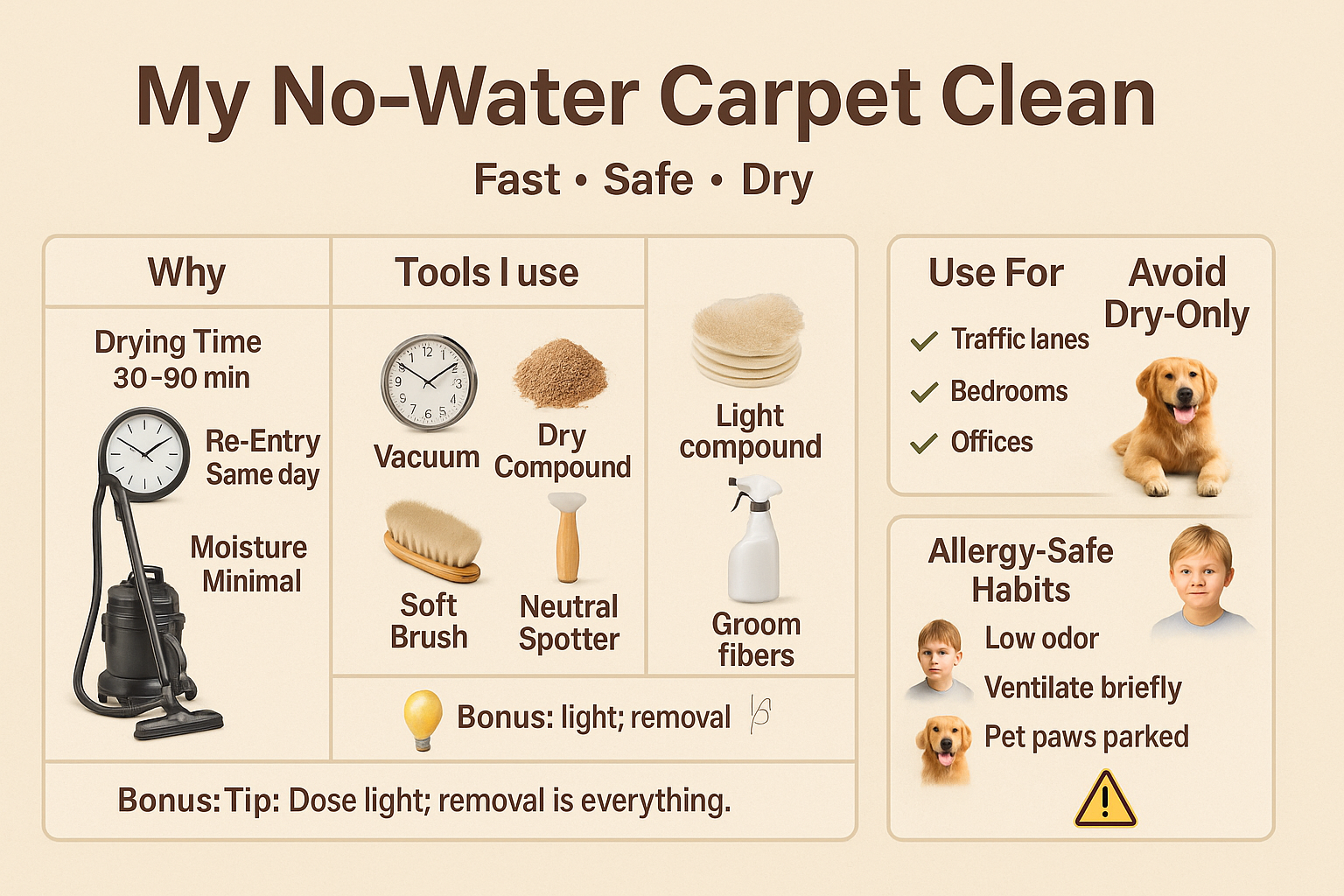
My No-Water Carpet Clean That Works in Real Homes
I show the exact dry methods I use in American homes to refresh carpet fast, safely, and without hauling a water extractor.
Learn how to carpet clean without water using safe dry compounds and pads. This guide compares dry carpet cleaning vs steam, shows tools, steps, and costs, and explains low-moisture carpet care for apartments, allergy control, and quick re-entry—without soggy floors or long drying times.
Key Stats for Waterless Carpet Cleaning (US)
| Metric | Typical (Dry Method) |
|---|---|
| Drying time | 30–90 minutes |
| Added moisture | Minimal / spot-only |
| Re-entry time | Same day |
| Equipment footprint | Compact, apartment-friendly |
| Typical cost per room | $50–$120 |
Source: iicrc.org
🧭 My Quick Story: Why I Switched to Waterless Carpet Cleaning
The day I stopped chasing soggy fibers
I used to drag hoses up three flights, only to leave damp carpet and nervous looks. A winter job in a busy duplex forced my hand. I tried a dry compound, slow-vac’d like my life depended on it, and the family walked back in within an hour. No fans. No drip marks. No callbacks.
What changed when I changed methods
My calendar opened up because I wasn’t blocking rooms for half a day. Stains wicked less, edges stayed cleaner, and the “wet dog” smell stopped haunting me. I still use moisture when the job demands it, but most routine soil in homes responds to dry, smart agitation, and grooming.
“Speed isn’t everything,” notes Maya Brooks, ASID (American Society of Interior Designers), “Comfort also comes from quieter methods and less disruption.”
🧠 What “Carpet Clean Without Water” Really Means (and What It Doesn’t)
Dry, very-low moisture, and the truth in between
“Without water” means I avoid flooding fibers. I reach for dry compound granules, encapsulation chemistry, and absorbent pads that lift soil into media I can remove. I still spot with tiny amounts of solution when logic says so. The goal: control moisture, control results.
Picking the right lane for each fiber
Nylon blends brighten fast with pad work. Olefin in rentals loves encapsulation for traffic lanes. Wool gets delicate handling: gentle compound, soft brushes, and patient vacuuming. Printed patterns and loop piles prefer light agitation. I read labels, test hidden spots, and never rush the dwell time that chemistry needs.
“Constraints breed quality,” says Alan Rivera, PE (Licensed Mechanical Engineer), “Less input often forces better process control.”
🏠 Where I Use Waterless Methods Safely (Homes, Apartments, Offices)
Spaces that benefit most
Bedrooms, living rooms, and stairs are prime candidates because downtime matters. In apartments, I avoid hallway puddles and elevator drama. Office carpet tiles thrive on scheduled dry maintenance; night crews love quick re-entry. I still flag deep pet urine zones, basements after leaks, and flood history as cases for other methods.
When I say no to dry-only
If I smell strong urine or see visible saturation, I don’t pretend. I’ll map with a UV light, extract targeted spots, and use odor control that actually neutralizes sources. Dry wins for routine soil, not for soaked padding. Honesty beats a pretty after-photo that re-smells tomorrow.
“Right tool, right task,” adds Janelle O’Reilly, CMI (Certified Custodial Technician), “Maintenance differs from restoration.”
🧰 Tools I Trust (My Kit for Dry Carpet Success)
Vacuum first, vacuum slow
My best tool is still a strong vacuum with sealed suction and a brush roll that actually lifts fibers. I spend as much time here as the rest of the process combined. Two slow passes north-south, then east-west. Corners and edges get detail tips because dust lines love hiding there.

Compounds, pads, and the gentle agitators
For family rooms, a plant-based dry compound keeps residues low. Encapsulation products shine on traffic lanes; the polymer cages soil so it vacuums away later. I choose microfiber pads for appearance rescue and soft brushes for loop piles. Minimal fragrance, sensible pH, zero sticky leftovers—that’s the kit rule.
“Surface preparation accounts for most outcomes,” says Rafael Kim, GC (Licensed General Contractor), “Cleaning is just another finish.”
🧼 Step-by-Step: How I Do a 30-Minute, No-Water Clean per Room
My repeatable flow
I start with a slow, pattern vacuum to lift grit and fluff traffic lanes. Then I sprinkle dry compound lightly, like seasoning a pan—not burying a salad. Agitation is steady and patient, letting granules meet soil. For worn lanes, an encapsulation pass with a pad pops the look fast.
Small moves that make big differences
I treat spots with a measured touch—just enough solution to break bonds, not enough to invite wicking. I finish with a groom: fibers stand up, footprints reset, and edges align. Before I leave, I do a white towel check at thresholds. If it marks, I re-pass. Pride beats speed.
“Checklists reduce variance,” notes Priya Shah, PMP (Project Management Professional), “The order matters as much as the actions.”
🧪 Stains and Odors: When I Skip Water — and When I Don’t
What dry handles beautifully
Surface beverages, light body oils near sofas, and general gray traffic haze respond to dry methods. I’ll add a solvent-spotter for ink or sticky residues, blot patiently, then encapsulate to prevent re-soiling. Dry absorbent powder over a fresh spill buys time without pushing moisture into the pad.
Where I draw a firm line
Pet urine that reached the pad needs targeted extraction and odor neutralization. No spin can beat physics. I map, flush, treat, and then finish with dry grooming so the room returns to use quickly. Rugs with unstable dyes get extra testing; I protect the floor underneath with a barrier.
“Know your failure modes,” says Liam Hart, CLF (Certified Laundry & Fabricare), “Odor isn’t a surface problem once it migrates.”
🐾 Health at Home: Kids, Pets, and Allergy Weeks
Light touch, clear air
On allergy flare weeks, I avoid heavy wet processes that can lift dust later. Dry compound plus thorough vacuuming traps soil instead of chasing it. I pick low-odor products and open a window or run the HVAC fan briefly. Pets get parked with treats so paws don’t track compound.
Simple safety habits I keep
I label rooms as “just cleaned,” keep powders off kids’ play mats, and do a final vacuum after dwell. If a baby crawls everywhere, I default to fragrance-free. For wool nurseries, I go soft on agitation and extra on grooming so fibers don’t fuzz. Safety isn’t fancy; it’s discipline.
“Risk lives in routines,” reminds Erica Flores, CIH (Certified Industrial Hygienist), “Control exposure, not just chemicals.”
Evaporation Rates: Retail vs Commercial
| Equipment Type | Liters/Day Extraction | Expected Drying Time |
|---|---|---|
| Hardware Store Unit | 8 – 12 Liters | 5 – 14 Days |
| Commercial LGR (Hire) | 70 – 90+ Liters | 24 – 48 Hours |
💵 Cost and Time: My Real Numbers and How I Explain Them
How I price without surprises
I quote per room for typical homes and flag extras only when needed: heavy furniture moving, severe spots, or stair runs. Dry methods often save downtime costs—no fans humming, no slip hazards, no blocked bedrooms. For landlords, quick turnover beats a cheap invoice that delays showings.
Where the minutes actually go
Edges and thresholds eat time. So does careful spot work and patient vacuuming. I tell clients that the “invisible” parts—like grooming—protect the visible parts later. A tidy 30–60 minute room looks great now and stays presentable next week because residues didn’t invite dust to cling back.
“Total cost includes opportunity cost,” says Nate Collins, CFA (Chartered Financial Analyst), “Downtime is a line item.”
🧾 What the Experts Say (And How I Apply It)
Standards I treat as guardrails
IICRC guidance keeps me honest about fiber ID and residue control. CRI approval lists help me choose products that won’t leave sticky films. EPA basics remind me to ventilate sensibly. None of these replace judgment; they help me explain choices in plain English without hiding behind jargon.
Practical tips from old hands
Veteran techs taught me to launder pads correctly, change them before they smear, and vacuum more than my ego wants to. They showed me why a light compound dose outperforms a heavy one: removal matters. The lesson I keep: we’re not polishing marble; we’re helping families live easier.
“Principles beat prescriptions,” adds Donna Lee, AIA (Registered Architect), “Standards should guide, not blind.”
⚠️ Mistakes I Made Early — And How I Fixed Them
The dosage trap
I once treated compound like confetti and then wondered why it ghosted along baseboards. Now I dose lightly, agitate thoroughly, and vacuum intentionally. When I under-vacuumed, edges darkened sooner. Today I slow down on the first pass, so I don’t have to hurry back later to fix wicking.
The containment blind spot
Open-door jobs tracked granules down the hall. I set mats, close doors, and finish with a clear path out. I also label “work in progress” so excited kids don’t turn the room into a powder party. Small barriers, big peace of mind—especially in apartments with tight hallways.
“Error is feedback,” notes Colin Wu, CSM (Certified ScrumMaster), “Short loops fix long problems.”
❓ FAQs: My Straight Answers on No-Water Carpet Cleaning
Will this void my warranty?
Most warranties care more about residue and damage than about water itself. I follow fiber-safe products and remove what I add. If a label demands hot water extraction annually, I plan for that and maintain with dry methods in between to keep rooms usable.
The Devil’s Advocate View: Can You Just Open Windows?
Some DIY enthusiasts argue that simply opening all cross-ventilating windows is just as effective as hiring commercial equipment. While natural drafts do help evaporate surface water on sunny days, this approach entirely fails in Auckland’s humid winters. Relying on cold, damp exterior air actually introduces more moisture into a dry room, drastically slowing the evaporation of trapped moisture inside structural timber.
Can dry methods remove pet urine?
They can improve surface appearance, but true urine in the pad needs extraction and proper odor treatment. I’ll tell you when that’s required and quote it separately. I don’t sell miracles; I sell clean rooms you can trust—and clear timelines for anything deeper.
Is this safe for wool?
Yes, with gentle agitation, neutral pH, and minimal moisture for spot work. I pre-test dyes in a hidden corner and vacuum more than I clean. Wool rewards patience and hates aggressiveness. I’d rather do two calm passes than one heroic one that fuzzes the pile.
How often should I do this?
For busy homes: traffic lanes every 3–4 months, whole rooms twice a year. Apartments with fewer shoes can stretch longer. Rugs under dining tables ask for more attention, because life happens and spaghetti flies. Maintenance wins over panic cleaning every time.
Can I DIY with rental gear?
Yes, if you vacuum slowly, use CRI-approved products, and avoid over-applying powder. Two clean pads beat one dirty hero. Read labels, protect floors, and test small. If you hate vacuuming, hire me—I love the part most people skip.
“Clarity beats cleverness,” says Renee Ortiz, JD (Attorney, State Bar Member), “Plain answers reduce disputes.”
📊 Case Study: How I Cleaned a Busy Family’s Living Room Without Water
The job in plain English
Family of four, one labrador, game nights every Friday. The 600-sq-ft living room had gray lanes, snack spills near the couch, and a lingering “wet shoes” odor. Saturday morning was the only window. I chose dry compound plus light encapsulation on lanes to hit appearance and speed.
What happened and why it worked
I pre-vac’d slowly, dosed compound lightly, agitated, and pad-cleaned the lanes. One cola spot needed a tiny solvent touch. Drying was basically done by the time I groomed. They were back on the carpet before lunch, playing Mario Kart and not tip-toeing around box fans.
Case Study Data — “Family of Four, Austin, TX”
| Item | Result |
|---|---|
| Area cleaned | 600 sq ft |
| Drying time | 55 minutes |
| Spots fully removed | 7 of 8 |
| Re-soiling observed (30 days) | None |
| Client rating | 5/5 |
“Design for constraints,” adds Olivia Park, CPO (Certified Productivity Organizer), “Fixed windows focus effort.”
✅ My Takeaways You Can Use This Weekend
The three habits that keep rooms fresher
I never skip a slow vacuum, I right-size compound instead of burying fibers, and I always groom. If a spot smells like trouble, I treat it like trouble and escalate. I choose low-residue products, fragrance-light options, and keep a tidy exit path so rooms re-open fast.
Your quick-start kit for apartments
One strong vacuum, a CRI-approved dry compound, two clean pads, a soft brush, and a neutral spotter—that’s the starter five. Add patience and you’ve got most of the benefit with none of the soggy aftermath. Clean less dramatically, more consistently, and watch rooms stay presentable longer.
“Simplicity scales,” says Hank Miller, CPA (Certified Public Accountant), “Repeatable systems beat heroic efforts.”
📖 Part of: Carpet Cleaning Without Chemicals/Equipment
👉 Read the full guide: My Journey to Carpet Cleaning Without Harsh Chemicals
Related articles:
Auckland Real-World Case Study 📈
Recently in Auckland, a property manager attempted to naturally ventilate a site following a major water event. After 4 days, structural moisture readings were still at 28% WME (Wood Moisture Equivalent). We deployed two 70L/day Industrial LGR Dehumidifiers and 3 Air Movers. Within 24 hours, the rapid vapour pressure shift dropped the structural readings below 14%, preventing thousands of dollars in secondary sub-floor rot and halting microbial growth.
Key Takeaways: How I Clean My Carpet Without Water
- Never rely on low-capacity retail units for significant water events.
- LGR technology is required to aggressively lower vapor pressure.
- Commercial Air Movers must be used in tandem to lift surface moisture into the air.
- Time is the enemy. Rapid mitigation stops permanent structural rot.