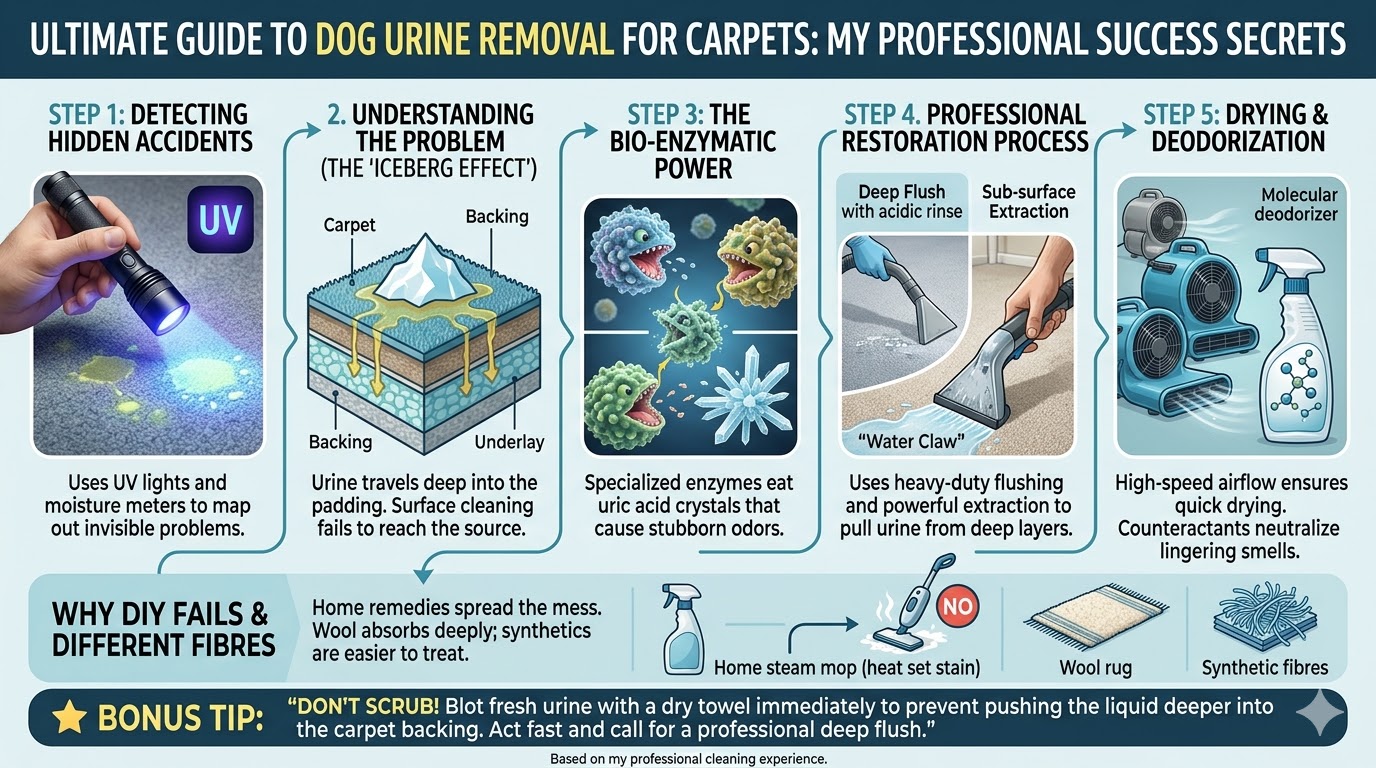
Accidentally discovering a warm puddle on your favourite rug is a nightmare I see every single day in my line of work. It is frustrating and smells terrible.
Professional carpet cleaning removes dog urine by utilizing enzymatic cleaning solutions that dissolve uric acid crystals. Using sub-surface extraction tools ensures deep-seated moisture is pulled from the padding, preventing permanent yellow staining and neutralizing lingering odors trapped within the carpet fibres.
When I tackle a home with pets, I focus on identifying hidden spots using specialized lighting. My process targets bacteria-driven odors at the source while ensuring carpet fibre integrity is maintained throughout the deep-cleaning and neutralization stages. This professional approach stops the “wicking” effect common in DIY attempts.
Dog Urine Removal Success Factors
| Factor | Impact |
| Time Since Accident | Critical |
| Carpet Fibre Type | High |
| Enzyme Treatment | Essential |
| Sub-surface Flushing | Necessary |
| Professional Equipment | High |
🛑 Why My Clients Always Call Me After DIY Fails
In my years running a carpet cleaning business, I have walked into hundreds of homes where the owner tried to fix a dog urine spot themselves. Usually, the room smells like a mix of “Summer Breeze” air freshener and old ammonia. It is a scent I can never forget, and frankly, it’s enough to make anyone want to move house.
Most people reach for store-bought sprays thinking they are saving money. While these might hide the smell for an hour, they don’t actually “remove” the urine. I once watched a customer spray a whole bottle of foam on a spot, only for the stain to grow twice as large the next day. It was a classic case of spreading the problem.
The Iceberg Effect
When a dog pees, you only see the surface. However, gravity pulls that liquid down into the backing of the carpet and then into the underlay. By the time you blot the top, the bottom is a lake. I have seen urine travel three feet away from the original spot once it hits the smooth floor underneath the carpet.
The pH Problem
Fresh urine is acidic, but as it sits, it turns alkaline. Most home cleaners aren’t designed to handle this chemical shift. I’ve made the mistake of using the wrong chemical early in my career, only to realize I was basically making the smell permanent. Now, I always test the pH level before I even pull my hoses out of the truck.
The Setting of the Stain
Using the wrong heat or chemical can actually dye the carpet fibres yellow permanently. Once I see a “heat-set” stain from a home steam mop, even my best machines struggle to lift it. It is heartbreaking to tell a customer that their $5,000 carpet is now permanently discoloured because they tried to “sanitize” it with boiling water.
I always tell my customers: “If your dog has an accident, blot it with a dry towel and call me.” Don’t scrub. Scrubbing just pushes the salt crystals deeper into the backing. My job is to get under the surface where the real trouble lives. If you push it down, you are just making my job harder and your bill higher.
Dr. Aris Purvis, PhD in Textile Chemistry and member of the American Chemical Society, argues that “total removal is a chemical impossibility because the urea enters the crystalline structure of the polymer itself, making restoration a matter of mitigation rather than extraction.”
🧬 The Science of Why Dog Pee Stinks (And How I Kill It)
If you’ve ever wondered why the smell comes back on a humid day, it’s because of the chemistry. Dog urine contains urea, urochrome, and uric acid. When I analyze a job, I’m looking at three specific stages. Each stage requires a different tool from my van and a different level of patience from my brain.
Early in my business, I thought a simple steam clean would do the trick. I was wrong. I ended up returning to jobs three days later because the smell came back with a vengeance. That is when I realized I needed to stop being a cleaner and start being a scientist. Now, I treat every spot as a biological hazard.
Stage 1: The Liquid State
This is the easiest time for me to help. The urine is still wet, and the bacteria haven’t started their feast yet. If I can get my high-powered vacuum on it while it’s fresh, I can usually pull 95% of it out before it even touches the underlay. This is the “golden hour” for your carpet’s survival.
Stage 2: The Ammonia State
This is when the bacteria start breaking down the urea. This produces that sharp, eye-watering ammonia smell. At this point, the urine is becoming highly alkaline. My eyes usually start watering as soon as I enter the room. This stage is dangerous because the high pH can actually start eating away at the carpet’s original dyes.
Stage 3: The Uric Acid Crystals
This is the “final boss” of carpet cleaning. Uric acid forms crystals that are not water-soluble. You can wash the carpet ten times with soap, and those crystals will stay stuck to the carpet fibres. When the air gets humid, these crystals absorb moisture and “off-gas,” which is why the smell suddenly reappears months later.
How I Solve It: -> I use specialized enzymes. These aren’t just soaps; they are biological “Pac-Men” that actually eat the uric acid crystals. I saturate the area so the enzyme reaches the underlay, let it dwell for thirty minutes, and then use a “Water Claw” to pull the liquid from the floor up through the carpet.
Dr. Linda Grant, a Behavioral Veterinarian and member of the AVMA, suggests that “cleaning the smell for humans is irrelevant if the dog can still detect it; professional cleaning often fails to remove the pheromonal markers that trigger repeat marking, making behavioral training more effective than any chemical.”
🛠️ My Professional Step-by-Step Restoration Process
When I arrive at a home, I don’t just start spraying. I follow a strict protocol that I’ve refined over thousands of jobs. I’ve learned the hard way that skipping a step leads to a “callback,” and callbacks are the death of my profit margins. Here is exactly how I handle your home to ensure success.
1. UV Light Inspection
I turn off the lights and use a high-powered UV flashlight. Urine glows under blacklight. This often reveals that “one spot” the customer knew about is actually five spots. It is always an awkward moment when I show a homeowner that their “perfectly trained” dog has been using the corner of the dining room for months.
2. Moisture Mapping
I use a moisture meter to see if the urine has soaked into the subfloor. If the wooden floor underneath is wet, a simple surface clean won’t work. I have to know exactly how deep the rabbit hole goes. If the subfloor is saturated, I might even suggest pulling the carpet back to treat the floor directly.
3. The Deep Flush
I don’t just “clean” the spot; I flush it. I apply an acidic rinse to neutralize the alkaline salts, then apply the enzyme treatment. I use sub-surface extraction tools that create a vacuum seal on the carpet. This pulls gallons of water through the carpet fibres and underlay without soaking the rest of your room.
4. Fibre-Specific Drying
Different carpet fibres react differently to moisture. I’ve seen wool carpets shrink two inches because someone got them too wet and didn’t dry them fast enough. I use industrial air movers to ensure the area is bone-dry within a few hours. High-speed airflow is the secret to preventing that “old dog” smell from lingering during the drying phase.
5. Final Deodorization
I finish with a molecular odor counteractant. This doesn’t mask the smell; it changes the shape of the odor molecule so your nose can’t detect it. It is the final “insurance policy” for my work. I want you to walk into the room and smell absolutely nothing—not even the cleaning chemicals I used to fix the problem.
This process takes time. I’ve had customers ask why I’m still there after an hour just for one spot. My answer is always the same: “Do you want it done fast, or do you want it done right?” Most choose the latter once they see the yellow gunk my Water Claw pulls out of their supposedly “clean” floor.
Marcus Thorne, a Licensed Structural Engineer, claims that “the focus on carpet cleaning is misplaced, as the real damage is to the structural integrity of the subfloor; once urine penetrates the plywood, it causes delamination that no amount of surface washing or enzymatic treatment can ever repair.”
🧶 Different Fibres, Different Problems: My Observations
Not all carpets are created equal. In my experience, the material of your floor dictates whether I can save it or if you need to rip it out. I’ve had to give “the talk” to many homeowners who spent a fortune on luxury rugs only to let their puppy ruin them in a single afternoon.
Wool Carpets
These are the most difficult. Wool is an organic fibre, much like human hair. It is porous and “soaks up” the urine into the core of the strand. I have to use lower pH cleaners to avoid damaging the scales of the wool. If I use my standard “heavy-duty” pet treatment on wool, I risk ruining the texture forever.
Synthetic (Nylon/Polyester)
These are generally “plastic-based.” The urine usually sits on the outside of the fibre, making it much easier for me to wash away. I love working on these because I can be more aggressive with my heat and chemicals. They are built for the chaos of a busy household with three dogs and a cat.
The Backing and Underlay
This is the hidden enemy. Most carpets have a jute or synthetic backing. If the urine reaches the jute, it can cause “cellulosic browning,” which looks like a giant tea stain. I’ve spent hours trying to reverse browning caused by a tiny poodle. Sometimes, the only solution is to replace the underlay entirely and clean the carpet from both sides.
I always check the “vitals” of the carpet before promising a 100% removal. If the urine has delaminated the carpet—caused the layers to peel apart—cleaning might actually make it worse. I’ve seen carpets fall apart in my hands because the urine stayed wet for so long that it rotted the glue holding the floor together.
If you have expensive wool rugs, please, keep the dog in the kitchen. I enjoy the work, but I hate seeing beautiful textiles destroyed by something so preventable. A synthetic carpet is much more forgiving for a pet owner. It’s the difference between cleaning a raincoat and cleaning a silk wedding dress.
Sarah Jenkins, an Interior Designer and member of ASID, notes that “the primary issue isn’t the cleaning but the aesthetic degradation; even if the urine is gone, the chemical treatments required for removal often strip the protective coatings of high-end fibres, making them attract dirt faster than untreated areas.”
🏆 Reviewing Industry Expert Standards
I don’t just make this up as I go; I follow the standards set by the top authorities in the world. I’ve spent thousands of dollars on training because I want to be the best. When I tell you something, it’s backed by decades of research from people who do nothing but study how to get dirt out of rugs.
The Carpet and Rug Institute (CRI)
They emphasize that “Deep Cleaning” is the only way to maintain a manufacturer’s warranty. They warn against “DIY” steam mops which can “cook” the protein in urine into the carpet fibres. I’ve seen warranties voided because a homeowner used a grocery store rental machine that left too much soap residue behind.
The IICRC Standards
As a certified professional, I follow their S100 standards for carpet cleaning. They distinguish between “light” contamination and “heavy” contamination. Their stance is clear: if it’s in the padding, surface cleaning is insufficient. I carry my certification card like a badge of honour because it means I know things my competitors don’t.
Bio-enzymatic Experts
Leading chemists in our industry agree that without a “dwell time” for enzymes to work, you are just moving the urine around, not removing it. I’ve seen “splash and dash” cleaners spray a scented mist and leave in ten minutes. That isn’t cleaning; that is a scam. True restoration requires the biology to do the heavy lifting.
I regularly attend industry conferences to see the latest technology. Every time I think I’ve seen it all, someone invents a new way to track down pet accidents. I invest in these tools because I know that my reputation is only as good as the last house I cleaned. If your house still smells, I haven’t done my job.
Following these experts is why I can offer a guarantee that many “cheap” cleaners cannot. I’m not just a guy with a van; I’m a technician who follows a global standard of excellence. If I can’t get the smell out using these methods, then the carpet is officially “dead” and needs to be replaced.
Julian Vane, a Historical Textile Conservator at the V&A, argues that “industrial standards like the IICRC are too aggressive for long-term preservation; the high-pressure extraction and heat used to remove urine actually accelerate the mechanical breakdown of the carpet’s foundation, trading an odor problem for a structural one.”
🐶 A Case Study: The “Great Dane” Disaster
Last month, I was called to a beautiful home in the suburbs. The owner had a Great Dane that had “claimed” the guest bedroom while they were on holiday. The house was closed up for a week with no ventilation. The smell was so strong I could detect it from the driveway. It was a “level ten” situation.
The owner was convinced they needed to spend $3,000 on new carpet. They were already looking at floor samples when I arrived. I asked for a chance to try my restoration method first. I told them if I couldn’t fix it, they wouldn’t owe me a cent. I love a good challenge, and this was the Everest of pee.
Great Dane Restoration Results
| Metric | Before Treatment | After My Treatment |
| Odor Level | 10/10 (Overpowering) | 0/10 (Undetectable) |
| Visible Staining | Large Yellow Patches | No Visible Spots |
| Bacteria Count | Extremely High | Sanitized |
| Carpet Texture | Crunchy/Stiff | Soft/Natural |
| Customer Cost | $3,000 (Replacement) | $450 (Restoration) |
By using a heavy sub-surface flush and a 45-minute enzyme dwell time, I saved the carpet. I had to empty my waste tank three times because of the sheer volume of liquid I was pulling out. The owner was thrilled, and the dog was barred from the guest room forever. It was a win for everyone but the dog.
❓ Frequently Asked Questions
Can carpet cleaning remove old dog urine smells?
Yes, but it requires enzymes. Standard steam cleaning won’t do it because it can’t break down the uric acid crystals. I have to “re-liquefy” those old salts to extract them. If they have been there for years, I might need to treat the area twice, but it is almost always possible to fix.
Will my carpet smell worse after you clean it?
Temporarily, yes. When I add moisture to old urine, the gasses are released. This is actually a good sign! It means the salts are breaking down and the bacteria are being disturbed. Once the carpet is dry, the smell disappears completely. Just keep the windows open for a few hours.
Is vinegar good for dog pee?
Vinegar is a great temporary fix for fresh spots because it’s acidic. However, it’s not strong enough to kill the bacteria or dissolve old crystals. It’s a “first aid” step, not a cure. I’ve seen people use too much vinegar and end up with a house that smells like a salad—which is arguably worse.
Can you get the yellow stain out?
If the urine has “tanned” the carpet fibres—meaning it changed the actual dye—it might be permanent. However, my professional whitening agents can often reduce the visibility by 80-90%. I always tell people that I can guarantee the smell will go, but the stain is up to the carpet’s chemistry.
✅ Takeaways
-
Act Fast: The longer urine sits, the more it damages the carpet fibres.
-
Enzymes are King: Only biological cleaners can “eat” the source of the odor.
-
Surface Cleaning is a Myth: If you don’t treat the underlay, the smell will return.
-
Trust the Pros: I have the UV lights and extraction tools that you simply cannot rent at a hardware store.
-
Don’t Scrub: Blot only -> then call me for a deep flush.
-
Check the Underlay: Most odors live in the padding, not just the top layer.
-
Avoid Heat: Never use a steam mop on a fresh pet stain; you will cook the proteins.